
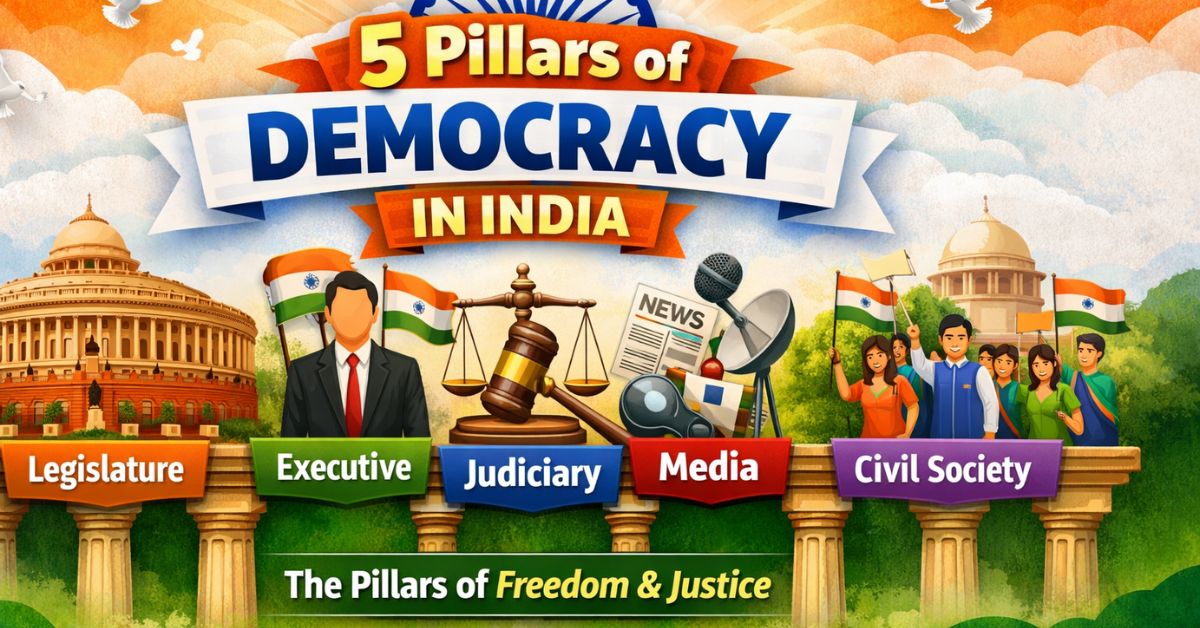
India’s democracy in 2026 is often described as resting on five interlocking pillars—three constitutional institutions plus media and civil society—that together ensure accountability, representation, and civic participation. While some models still use a “four pillars” framework (legislature, executive, judiciary, media), the “five‑pillars” narrative is now widely used in Indian polity discussions, competitive‑exam guides, and even global conferences like the India International Conference on Democracy and Election Management (IICDEM 2026).
This article breaks down the 5 pillars of democracy in India 2026 in an easy‑to‑read, SEO‑friendly format, with 3–4 tables, plain‑language explanations, and practical examples for students, teachers, bloggers, and content creators.
What Are the 5 Pillars of Democracy in India?
In India, the five pillars of democracy are commonly understood as:
- Legislature – Makes laws and represents the people.
- Executive – Implements laws and runs the government.
- Judiciary – Interprets laws and protects rights.
- Media – The fourth pillar; informs and scrutinises.
- Civil society and citizens – The fifth pillar; active participation and checks on power.
These pillars are not isolated; they interact through checks and balances, constitutional values, and public pressure. When one pillar is weakened (for example, if media freedom shrinks or courts face political pressure), the entire system feels the strain.
Pillar 1: Legislature – The Voice of the People
Role of the Legislature in India
The legislature is where laws are debated, passed, and amended. In India this includes:
- Parliament at the Centre: Lok Sabha + Rajya Sabha
- State legislatures: Vidhan Sabha + Vidhan Parishad (in states that have it)
The legislature’s main jobs are:
- Enacting laws and the annual budget.
- Representing citizens’ views through elected MPs and MLAs.
- Overseeing the executive (question hours, motions, committees).
Why it matters in 2026
In 2026, India continues to be the world’s largest democracy, with over 900 million eligible voters. The legislature remains the primary place where:
- Tax policies, welfare schemes, and social‑reform laws are shaped.
- Public grievances are raised through debates and questions.
- Federal tensions (Centre vs States) are negotiated.
If the legislature is dominated by one party, it can pass laws quickly—but also risks weakening debate and scrutiny. That is why strong, active opposition and parliamentary committees are considered parts of a healthy first pillar.
Pillar 2: Executive – The Government That Runs the System
What is the Executive?
The executive is the branch that implements laws and policies. In India it includes:
- Central level: President (formal head), Prime Minister + Council of Ministers (real executive), and the civil‑service bureaucracy.
- State level: Governor, Chief Minister + State Council of Ministers, and state civil services.
The executive’s main tasks are:
- Administering day‑to‑day governance.
- Running ministries, police, defence, and public‑service delivery.
- Executing policies passed by the legislature.
Executive‑power in 2026
In 2026, India’s executive power is concentrated in:
- The Prime Minister and Union Cabinet at the Centre.
- Chief Ministers in each state.
Recent trends show:
- Increased use of central schemes and coordination bodies (e.g., NITI Aayog‑style councils) to align Centre and State actions.
- Growing reliance on digital governance (e‑governance, Aadhaar‑linked services, DBT subsidies) handled by the executive.
A strong executive can deliver fast policy implementation, but if unchecked it can also weaken checks and balances—for example, by pressuring autonomous bodies or delaying information transparency. That is why the second pillar’s health depends on independent institutions (CAG, EC, etc.) and media scrutiny.
Pillar 3: Judiciary – The Guardian of Rights
Role of the Judiciary
The judiciary interprets the Constitution, settles disputes, and protects fundamental rights. In India this includes:
- Supreme Court (apex court).
- High Courts in each state/UT.
- District and lower courts.
The judiciary performs three key roles:
- Adjudication – Resolving disputes between citizens, between citizens and the state, and between states.
- Judicial review – Checking whether laws and executive actions are constitutional.
- Safeguarding civil liberties – Protecting rights like freedom of speech, equality, and life.
Judiciary in 2026
By 2026, Indian courts continue to handle:
- Landmark rights cases (privacy, LGBTQ+ rights, environmental issues).
- Election disputes and electoral‑reform petitions.
- Public‑interest litigation (PIL) filed by citizens and NGOs.
At the same time, the judiciary faces challenges:
- Delays and case backlog (millions of pending cases across levels).
- Debates over judicial appointments and impartiality.
- Balancing national security concerns with fundamental rights.
A strong, independent judiciary is essential to the third pillar; if courts become too slow or politically influenced, the whole democratic system becomes fragile.
Pillar 4: Media – The Fourth Pillar
Why Media Is Called the Fourth Pillar
The media is often called the “fourth pillar” of democracy because it:
- Informs citizens about politics, policies, and social issues.
- Investigates corruption and misuse of power.
- Provides a platform for public debate and dissent.
In India, the media landscape includes:
- Print (newspapers like The Hindu, Indian Express).
- Television news channels.
- Online news portals and apps.
- Social media and citizen‑journalism (YouTube, Twitter/X, WhatsApp, Instagram).
Media in 2026: Opportunities and Risks
By 2026, Indian media is more digital and instant than ever. Advantages include:
- Real‑time coverage of elections, protests, and policy debates.
- Citizen‑led campaigns (Right to Information, anti‑corruption movements).
However, new risks appear:
- Misinformation and fake news spread via social media.
- Polarisation along identity and political lines.
- Commercial pressures and alleged bias in some outlets.
For the fourth pillar to stay strong, media literacy, fact‑checking, and independent‑journalism practices are as important as press freedom and legal safeguards.
Pillar 5: Civil Society and Citizens – The Fifth Pillar
What Is the Fifth Pillar?
The fifth pillar refers to civil society organizations (CSOs) and actively engaged citizens, who:
- Participate in elections and local‑level governance.
- Run NGOs, student unions, labour unions, women’s groups, and environmental‑protection bodies.
- Use mechanisms like Right to Information (RTI), protests, petitions, and social‑media campaigns to demand accountability.
Examples of the fifth pillar in action:
- Anti‑corruption movements (e.g., earlier campaigns against graft).
- Environmental‑protection agitations (protests against large dams, deforestation, pollution).
- Women’s‑rights and LGBTQ+ advocacy groups.
Citizens, Civic Participation, and 2026
In 2026, Indian citizens can participate in democracy through:
- Voting in national, state, and local elections.
- Using RTI to question government agencies.
- Joining local bodies like panchayats and municipal councils.
- Digital‑age tools: online petitions, social‑media activism, e‑governance feedback.
The health of the fifth pillar depends on:
- Civic‑education levels (do people know their rights and duties?).
- Access to technology and information (digital divide matters).
- Legal space for NGOs and protests.
The 5 Pillars of Democracy in India – Quick Overview
How the 5 Pillars Work Together (with Checks and Balances)
No pillar functions in isolation. Their interdependence is what makes Indian democracy resilient yet fragile.
- The legislature can pass laws, but the judiciary can strike them down if unconstitutional.
- The executive runs the government, but the legislature passes motions and the media probes scandals.
- When the executive or judiciary becomes too powerful, the media and civil society raise public pressure.
- Civil society uses RTI and courts to question the executive and legislature’s decisions.
In 2026, examples of this interplay include:
- Media exposés on corruption leading to judicial intervention and parliamentary debates.
- RTI‑based petitions filed by NGOs leading to policy changes implemented by the executive.
Pillar‑by‑Pillar – What Each Body Protects
| Pillar | What it protects or enables | How it is protected by others |
|---|---|---|
| Legislature | People’s representation, lawmaking process, federal balance | Watched by media, judiciary (if laws are unconstitutional), and citizens (via elections and protests) |
| Executive | Government functioning, public‑service delivery, security | Accountable to legislature (questions, no‑confidence motions), media (scrutiny), judiciary (judicial review), and citizens (voting, RTI) |
| Judiciary | Rule of law, fundamental rights, constitutional integrity | Protected by constitutional independence; checked by media and public pressure if perceived as biased or slow |
| Media | Freedom of speech, informed public, transparency | Protected by Constitution (Article 19) and courts; can be misused by commercial or political pressure if not regulated ethically |
| Civil society & citizens | Social justice, rights, local‑level democracy | Protected by laws and courts; can be restricted by laws on protests, NGOs, or digital‑speech rules |
Why “5 Pillars” Not Just “4” in Modern India
Traditionally, many textbooks described only three pillars (legislature, executive, judiciary). The media was later added as the fourth pillar. In 2026, the fifth pillar concept has become popular because:
- People power (protests, social‑media movements, RTI) has visibly changed Indian politics.
- Conferences like IICDEM 2026 frame democracy as relying not just on institutions but on active citizen participation.
Comparing the different models:
“3‑Pillar” vs “4‑Pillar” vs “5‑Pillar” Models
5 Pillars in 2026 – Challenges and Strengths
| Pillar | 2026‑era strengths | 2026‑era challenges |
|---|
You May Also like : Free Mock Test Online, Mock Test Online
