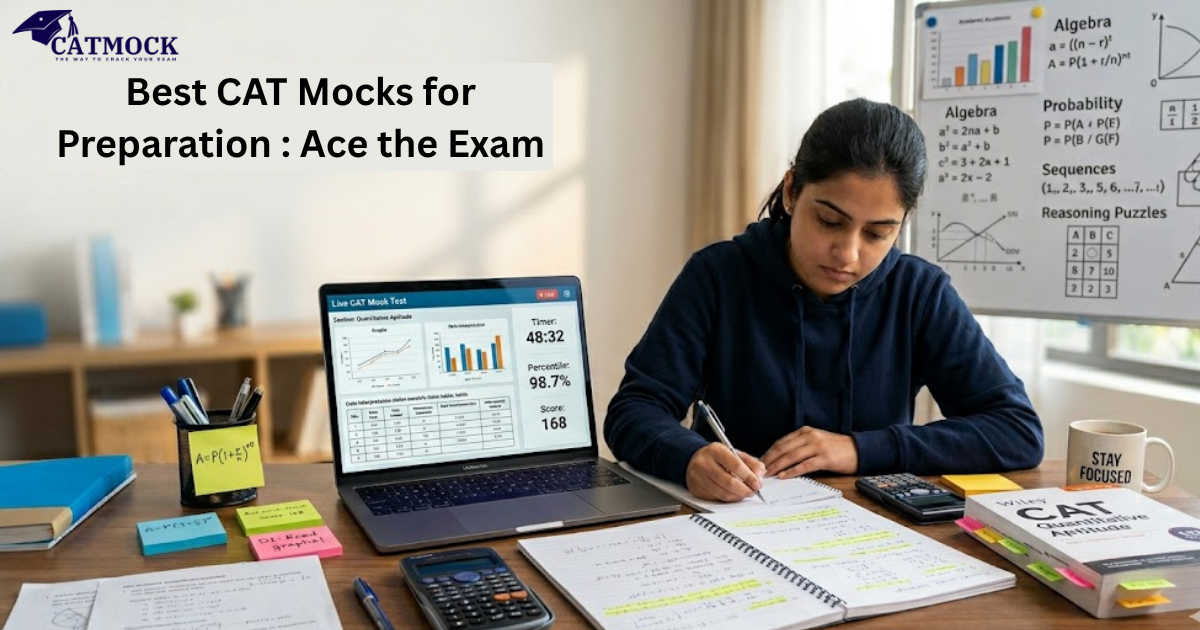
Before choosing or attempting mocks, you must clearly understand what CAT 2026 is testing and how the paper is structured. A well-designed mock will closely mirror the latest pattern, section division, difficulty trend, and marking scheme so that your practice translates into real percentile gains.
CAT Mocks for Preparation 2026 Exam Structure
CAT 2026 continues with a three-section online test format aimed at checking verbal, analytical, and quantitative skills. Each section has a fixed time limit and you cannot switch between sections during the test, which makes time management and mock practice extremely important.
CAT 2026 Section-wise Structure
| Section | Name | Duration | Approx. questions | Skills tested |
| VARC | Verbal Ability & Reading Comprehension | 40 min | 24 | Reading speed, inference, vocabulary, CR |
| DILR | Data Interpretation & Logical Reasoning | 40 min | 22 | Data analysis, puzzles, logical patterns |
| QA | Quantitative Aptitude | 40 min | 22 | Arithmetic, algebra, geometry, numbers |
| Total | Overall CAT 2026 paper | 120 min | 68 | Integrated aptitude & test-taking stamina |
CAT 2026 is expected to have around 68 questions with a total test duration of 120 minutes, split equally across the three sections. This distribution means you get roughly 1.7 minutes per question overall, making accuracy and question selection—as trained through mocks—crucial.
Marking Scheme and its Impact on Mocks
The CAT 2026 marking scheme rewards accuracy and punishes random guessing, especially in MCQs. Non-MCQ or TITA (Type In The Answer) questions carry no negative marking, which influences how you should experiment and strategize in mocks.
Key points of CAT 2026 marking scheme
- +3 marks for every correct answer across sections.
- −1 mark for every wrong answer in MCQs only.
- 0 negative marking for non-MCQ (TITA) questions.
Practicing with mocks that strictly follow this marking scheme trains your instinct for risk vs reward and helps you set clear rules for when to attempt, skip, or mark a question for review. Over time, mock test data shows you whether your strategy is increasing your net score or just inflating attempts with mistakes.
Why CAT Mocks Matter So Much
Mock tests are not just “extra practice papers”; they are simulation tools that recreate exam pressure and reveal your readiness level for CAT 2026. When you use them systematically, they improve everything from accuracy and speed to mental stamina and confidence.
Core Benefits of CAT Mock
Well-designed mocks aligned with the 2026 pattern help you become comfortable with the interface, timer, and sectional locks. They also build the 120-minute concentration span that many aspirants underestimate until it is too late.
How Mocks Boost CAT Readiness
| Benefit area | How mocks help in 2026 context |
| Time management | Train you to allocate 40 minutes per section optimally . |
| Accuracy | Show patterns in careless errors and negative marks . |
| Question selection | Help you identify low-hanging fruits vs time-trap sets . |
| Stamina & focus | Build comfort with 120 minutes of sustained effort . |
| Strategy refinement | Provide data to tweak attempts, order, and pacing . |
Regular mocks also reduce exam-day surprises because you repeatedly experience similar difficulty levels, question mixes, and pressure situations in a low-stakes environment. Over time, this repetition turns anxiety into familiarity, which is a major competitive edge on the actual day.
Role of Mock Analysis
Taking mocks without analysis is like giving repeated exams without learning from mistakes. Detailed analysis is where percentile jumps actually come from, because you systematically fix gaps in concepts, strategy, and temperament.
Key outcomes from good mock analysis include:
- Identification of weak topics in VARC, DILR, and QA that consistently pull down your score.
- Understanding whether you are losing marks to accuracy, speed, or poor selection of sets/questions.
- Insights on ideal attempt range per section for your current accuracy level.
Mock providers that offer section-wise reports, accuracy breakdowns, and detailed solutions maximize this learning loop and should be prioritized when selecting the “best” mocks for CAT 2026.
Types of CAT Mocks You Should Use
To prepare intelligently, you need to use more than one type of mock across your CAT 2026 journey. Each type serves a specific purpose at a different stage of your preparation.
Full-length, Sectional, and Topic-Wise Mocks
Full-length mocks simulate the exact exam experience and should form the core of your strategy in the final months before CAT. Sectional and topic-wise tests act as focused drills that you can use to build specific skills during the earlier and mid stages of prep.
Types of CAT 2026 Mock Tests
| Mock type | Duration | When to use (prep stage) | Purpose |
| Full-length CAT | 120 minutes | Mid to advanced stage (4–5 months to exam) | Build stamina, strategy, real-exam simulation . |
| Sectional | 40 minutes | Throughout prep, more frequently early on | Improve one section at a time (VARC/DILR/QA) . |
| Topic-wise | 20–30 minutes | Concept-building phase and revision phase | Sharpen specific topics like geometry or RC . |
A smart mix ensures that you are not only “surviving” full-length mocks but also actively repairing micro-weaknesses uncovered by those tests. This layered approach also keeps your study plan flexible; when a topic is consistently weak in mocks, you can immediately switch to topic-wise drills and then re-test it with sectionals.
Free vs paid Mock Test Series
The CAT prep ecosystem in 2026 offers both free and paid mock tests from major coaching platforms and dedicated test providers. Free mocks are excellent to get your baseline and test different interfaces, while paid series usually provide better analysis, variation in difficulty, and closer pattern alignment.
Key differences often include:
- Depth of analytics dashboards and performance reports.
- Number of mocks and frequency of new tests updated as per latest CAT trends.
- Quality of explanations and video solutions, especially from 99+ percentile scorers.
Using a combination of one strong paid test series and a few free mocks from other platforms can expose you to multiple question styles and keep your preparation more robust and flexible.
What Makes a Best Cat Mocks for Preparation in 2026
Not all mocks are equal, and choosing the right ones can make a big difference to your Best Cat mocks for preparation 2026 score. Good mocks are defined by how closely they simulate the real exam and how useful their analysis is for improving your performance.
Features to look for in Top Mocks
The Best Cat mocks for preparation replicate the latest official pattern in terms of question count, marking scheme, sectional timing, and difficulty level. They also reflect recent trends like moderate RC passages with tricky inference questions, data-heavy DILR sets, and QA dominated by arithmetic and algebra.
Essential features of high-quality mocks include:
- Updated to CAT 2026 pattern: 3 sections, 120 minutes, around 68 questions, latest marking scheme.
- Balanced difficulty: some tests tougher, some easier, but average closely aligned to recent CAT papers.
- Detailed solutions and explanations for every question, preferably with logical shortcuts.
- Section-wise and topic-wise analytics, including accuracy, speed, and strong vs weak areas.
Without these features, mocks can mislead you—either by giving unrealistic scores or by failing to highlight where your real issues lie. Good mocks, on the other hand, act like a mirror for your preparation, offering clear, data-backed feedback on how to improve.
Interface, AI Insights, and User Experience
Mock platforms increasingly offer adaptive or AI-enhanced features that can improve how you interpret results and set your next targets. These can include automated identification of your slowest question types, recommended question order, and even personalized next steps after each test.
User experience factors that matter:
- Clean, clutter-free interface similar to the official CAT platform.
- Easy navigation for question review, bookmarking, and answer changes within the section time.
- Mobile-friendly dashboards for viewing analysis and revision on the go.
While flashy features should not replace content quality, a smooth interface and helpful analytics make it easier to take mocks regularly and stick to your plan.
How Many CAT Mocks to Take and When
The number of mocks you need depends on your starting level, but broad benchmarks for CAT 2026 can guide your planning. The goal is not just quantity but consistent practice followed by thoughtful analysis.
Recommended mock count for CAT 2026
Experts and mock strategy guides suggest that a serious aspirant should aim for several dozen full-length mocks by the time Best Cat mocks for preparation 2026 arrives, spaced intelligently through the year. This is usually supported by many sectional and topic-wise tests in the earlier phases.
Suggested Mock Volume by Stage (CAT 2026)
| Prep stage (time left) | Full-length mocks (approx.) | Sectional tests (approx.) | Focus |
| 9–6 months before CAT | 5–10 | 30–40 | Concept building, early strategy experiments . |
| 6–3 months before CAT | 15–20 | 25–30 | Refining strategy, building stamina . |
| Last 3 months to CAT 2026 | 15–25 | 15–20 | High-intensity mocks, exam-like simulation . |
Many aspirants who target 99+ percentiles often land in the 35–50 full-length mock range, provided they also put equal effort into post-test analysis. However, quality and consistency are more important than hitting an arbitrary number without proper review.
Weekly Mock Plan as Exam Nears
As CAT 2026 approaches, the frequency of mocks should gradually increase, while routine chapter learning shifts into revision and error-correction mode. In the last 8–10 weeks, many serious aspirants move to 2–4 full-length mocks per week, paired with focused analysis days.
A strong weekly structure might look like:
- 2–3 mocks per week: taken on fixed days to simulate exam day discipline.
- Next-day analysis: 3–4 hours per mock to review every mistake, doubtful question, and guess.
- Topic revision slots: based on errors logged from the last mock’s analysis.
This rhythm ensures that each mock meaningfully changes your preparation instead of becoming just another test in a long list. Tracking scores, percentiles, accuracy, and attempts week by week also shows whether your strategy tweaks are working.
How to Analyse CAT Mocks for Maximum Improvement
Mock analysis is where the real learning happens, so you need a simple but disciplined method for reviewing each test. The goal is to convert every wrong, right, and unattempted question into a clear lesson.
Stepwise Approach to Mock Analysis
A structured analysis routine helps you move beyond just checking answers and scores. Instead, you examine “why” a question went right or wrong and what system-level change you must make to improve.
Basic steps include:
- Re-take the paper mentally without time pressure to see which questions you could have solved with more patience or a better approach.
- Categorize each question into: knew but made a mistake, could have solved with more time, had no idea, or guessed.
- Note down topic-wise error trends (e.g., algebra inequalities, DI graphs, para jumbles) that repeat across mocks.
- Adjust your next week’s practice to hit these recurring weak spots with topic-wise tests and revision.
Platforms that provide question-level analysis and filters by topic, difficulty, and time spent make this process much faster and more objective.
Using Data From Analytics Dashboards
Advanced mock platforms often give graphs and reports that show your progress over multiple tests. Using this data well can turn your prep into a measurable project, instead of a vague, stressful effort.
Useful metrics to track:
- Section-wise scores and accuracy trends across recent mocks.
- Average time spent per question and per successful question vs per wrong question.
- Relative performance vs other test-takers, where available, to estimate likely percentile ranges.
Tracking these numbers gives you a reality check and helps you set practical score and attempt targets for the next few mocks. Over time, increasing stability—rather than occasional spikes—is a strong indicator that you are truly ready for CAT 2026.
Practical Mock Strategy for VARC, DILR, and QA
Different sections of CAT 2026 demand different tactics, and your mocks are the best place to test and refine these approaches. Rather than applying a one-size-fits-all strategy, use section-specific plans and adjust them based on mock data.
VARC strategy through mocks
VARC in CAT Mocks 2026 is expected to focus heavily on reading comprehension (RC) with additional questions on para jumbles, para summary, and odd sentence out. Mocks can help you fine-tune reading speed, choice of passages, and answer selection in inference-based questions.
Using mocks for VARC:
- Experiment with different passage orders: easiest-looking first vs in order of appearance.
- Track accuracy in fact-based vs inference-based vs tone/attitude questions and adjust approach.
- For non-RC, log question types where you repeatedly lose marks and practice them separately via sectional tests.
The objective is to use mocks to find a stable VARC routine that balances attempts with strong accuracy over 40 minutes.
DILR strategy through mocks
DILR often becomes the make-or-break section because of its unpredictable sets and the time required to crack the logic. Mocks allow you to repeatedly practice the skill of quickly scanning all sets and picking the right ones for your level.
Using mocks for DILR:
- Train yourself to spend the first 3–5 minutes scanning all sets and marking 2–3 “must do” sets.
- Use analysis to identify set formats where you are strong (e.g., tables, Venn diagrams, puzzles) vs weak and adjust practice.
- Track how often you get stuck in a set and over-invest time; set rules to move on after a fixed threshold.
DILR success in CAT 2026 will come from smart selection plus steady practice of diverse set types across mocks and sectionals.
QA Strategy Through Mocks
Quantitative Aptitude for CAT 2026 is expected to be dominated by arithmetic and algebra, with geometry and number systems appearing in smaller proportions. Mocks help you learn which question categories you should attack first and which you should avoid or attempt later.
Using mocks for QA:
- Identify 2–3 “comfort topics” where you can quickly pick up marks and prioritize those questions in mocks.
- Monitor your accuracy in medium vs tough questions; over-ambition in difficult questions often kills QA scores.
- Use topic-wise drills between mocks to shore up basics in repeatedly weak topics like geometry or inequalities.
Over several mocks, your QA approach should evolve into a clear plan: a first round of easy-medium questions, followed by selective attempts on slightly tougher ones, all within 40 minutes.
Putting It All Together: A Sample 8-Week Mock Plan
As CAT 2026 approaches, combining everything—mock selection, frequency, analysis, and section strategies—into a concrete plan can make your preparation more predictable and less stressful. An 8-week blueprint helps turn intent into consistent action.
Example 8-week plan before CAT 2026
A realistic plan for the final 8 weeks might balance full-length mocks, sectionals, and revision time. Adapt the volume slightly up or down depending on your bandwidth and starting level, but keep the structure intact.
High-level weekly pattern:
- 2–3 full-length mocks on fixed days.
- 2–3 days mainly for mock analysis, topic revision, and light sectional tests.
- 1 lighter day per week to avoid burnout but still revise formulas and test-log notes.
By following such a plan and refining it with your own mock performance data, you turn CAT 2026 preparation into a structured, feedback-driven process rather than a random grind. Over these weeks, the Best Cat Mocks for Preparation you choose become more than just tests; they become the central tool that guides, measures, and sharpens your entire journey to acing the exam.
You May Also like : Free Mock Test Online, Mock Test Online