
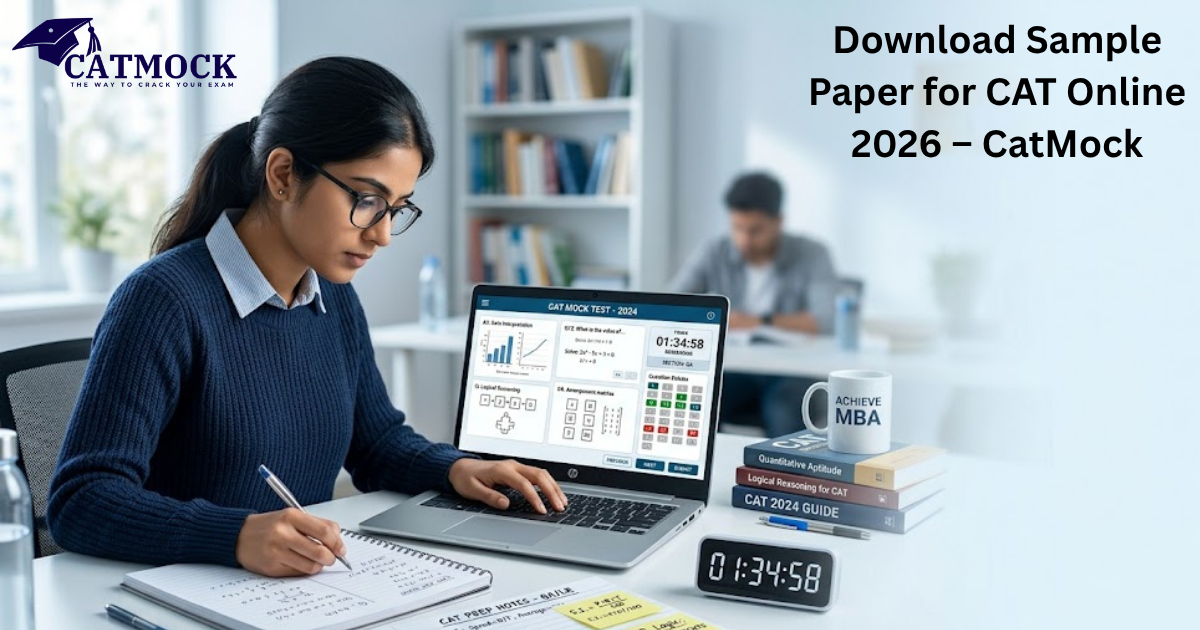
A sample paper for CAT is not just a random practice set—it is a simulated CAT exam built on the latest exam pattern, syllabus trends, and difficulty level. For 2026 aspirants, downloading a CAT 2026 sample paper online from a platform like CatMock gives you:
- Familiarity with the CAT 2026 pattern (sections, time limits, question types).
- A realistic feel of the online interface, including navigation, time‑display, and section siloing.
- A benchmark to track your accuracy, speed, and percentile early in your prep cycle.
Unlike generic PDFs that may be years old, online CAT 2026 sample papers are updated to reflect:
- The 68‑question, 3‑section pattern used in CAT 2024 and 2025.
- The increased weightage of DILR and QA, plus the continued emphasis on VARC comprehension and inference‑based questions.
Downloading a sample paper for CAT online also helps you:
- Detect weak areas (e.g., geometry, para‑jumbles, set‑based DILR).
- Train your time‑management muscle (e.g., 40 minutes per section, rapid question selection).
Below is a quick snapshot of how CAT 2026 expectations map onto sample‑paper practice.
CAT 2023–2025 Pattern vs. CAT 2026 Sample‑Paper Expectations
| Element | CAT 2023–2025 Pattern | CAT 2026 Sample Paper / CatMock Expectation |
| Total questions | 66 (2023), 68 (2024–2025) | 66–68 questions, aligned with 2024–2025 structure. |
| Sections | VARC, DILR, QA | Same 3 sections, 40 minutes each. |
| Question types | MCQs + TITA in all sections, with negative marking on MCQs. | Mix of MCQs and TITA, mimicking actual CAT style. |
| Time per section | 40 minutes per section; 120 minutes total. | Sample paper timer set to 40 minutes per section. |
| Difficulty level | Gradually rising, with more application‑heavy and puzzle‑based questions. | Sample papers calibrated to match 2024–2025 difficulty. |
Using CatMock or similar platforms to download a CAT 2026 sample paper online means you’re not just “practising questions”—you’re practising the exam itself.
What a Sample Paper for CAT Online 2026 – CatMock Actually Offers
The phrase Download Sample Paper for CAT Online 2026 – CatMock suggests a specific use case: getting a CAT‑style sample paper, in digital format, from the CatMock platform, for the 2026 exam cycle.
Here’s what such a workflow typically looks like (and how CatMock fits into it):
What You Get When You Download a CAT 2026 Sample Paper Online
On a platform like CatMock, a CAT 2026 sample paper usually includes:
- Full‑length format: 3 sections (VARC, DILR, QA) with around 22–24 questions per section, total ~66–68 questions.
- CAT‑style interface: Online test window that mimics the IIM CAT exam interface (timer, section navigation, question panel).
- Immediate submission + answer key: After completing the paper, you get:
- Correct answers.
- Basic score breakdown (correct, incorrect, unattempted).
- Light analytics: Some platforms provide:
- Sectional score vs. total score.
- Percentile estimate based on your performance.
CatMock’s USP is to keep the process simple, fast, and exam‑focused, avoiding the clutter of heavy coaching portals while still offering a genuine CAT‑like experience.
How CatMock Stands Up vs. Other Sample‑Paper Platforms
Several sites now offer CAT 2026 sample papers as PDFs or online tests, including:
- HitBullsEye, TopRankers, MBAUniverse, SelfStudys, and Oswaal.
Compared to these, a platform like CatMock can be attractive if:
- You want a minimal, exam‑only interface (no heavy dashboards or ads).
- You prefer quick access to sample papers without long sign‑up funnels.
- You are past the “concept‑learning” phase and now need pure CAT‑style practice.
Even if CatMock explicitly follows its own branding, the core value remains the same: a CAT 2026 sample paper online that mirrors the official exam pattern and difficulty.
Step‑by‑Step: How to Use CatMock Sample Papers Effectively

Solving a CAT sample paper once and moving on is not enough. For CAT 2026, you need a structured, repeatable workflow around each CatMock sample paper you download.
Below is a four‑phase method, tuned for aspirants who want to maximize learning from minimal mocks.
First Attempt – Simulate Real CAT
Goal: Get a baseline score and feel the exam pressure.
Steps:
- Set the environment:
- Use a quiet place, laptop, and stable internet.
- Turn off notifications and keep a watch (CAT‑style exam rules).
- Start the CatMock paper:
- Follow the 40‑minute per section rule strictly.
- Do not skip sections or pause sections.
- Strategy while attempting:
- VARC: Spend 6–8 minutes per RC passage and be quick with VA.
- DILR: First 5–7 minutes to scan all sets, then pick 2–3 strong sets and leave the rest.
- QA: Start with comfort‑zone topics (e.g., arithmetic, algebra basics) and avoid getting stuck on 1–2 hard questions.
- Mark “doubt” questions:
- Use the platform’s “mark for review” or equivalent feature wherever possible.
Key metrics to note:
- Sectional raw score (VARC, DILR, QA).
- Total correct vs. incorrect vs. unattempted.
- Time used vs. time left in each section.
Post‑Test Analysis – The “Real” Learning
Goal: Turn your mistakes into a roadmap for improvement.
After submitting the paper, CatMock or similar platforms usually show:
- Correct answers.
- Sectional score.
- Possibly a percentile estimate.
What you should do manually:
- Create an error log (spreadsheet or notebook):
| Section | Question No. | Topic (e.g., Geometry, Para‑jumbles) | Mistake Type (Concept / Silly / Time) | Key Takeaway |
| VARC | 3 | RC – Inference | Misread the passage slightly | Re‑read final lines carefully. |
| DILR | 8 | Table‑based ranking | Misassigned a variable | Re‑draw the table step‑by‑step. |
| QA | 12 | Number System – Remainders | Forgetting a small property | Revise remainder theorems. |
- Categorize errors:
- Concept gap: You didn’t know the underlying concept.
- Silly mistake: Calculation or misreading the question.
- Time pressure: You knew the concept but ran out of time.
Each CatMock sample paper should shrink your concept‑gap list and your silly‑mistake list over time.
Re‑Attempt Selected Questions – Deep Drilling
Goal: Ensure you don’t repeat the same error in the next paper.
Method:
- Pick 10–15 high‑lever‑value questions from your error log (e.g., 5 VARC inference RCs, 5 DILR sets, 5 QA application questions).
- Re‑solve them without options first, then compare with the provided solution.
- Write short notes (1–2 lines) for each question:
- What trap you missed.
- What shortcut or strategy you can use next time.
This builds a personal “CAT‑style question bank” that you can revise just before the exam.
Plan a Series of CatMock Papers (Monthly / Weekly)
To get reliable insights, don’t treat CatMock sample papers as one‑off events. Think in cycles.
A basic 3‑month plan (for someone starting mid‑2026) could look like:
Sample Paper Practice Plan Using CatMock (CAT 2026 Aspirant)
| Month | Target Sample Papers | Focus | Notes |
| 1 | 2–3 full papers | Pattern familiarity, stamina, spotting weak areas. | Prioritise CAT 2023–2024 style difficulty. |
| 2 | 3–4 full papers | Sectional improvement, speed, and accuracy. | Introduce 2–3 sectional papers (VARC / DILR / QA). |
| 3 | 4–5 full papers | Exam‑simulation, percentile benchmarking. | Vary difficulty (include 1–2 harder papers). |
Over 3 months, you’d be solving 10–12 full CAT 2026 sample papers online, with CatMock as one of your core test‑engines.
Section‑Wise Strategy Using CatMock Sample Papers
Each CAT 2026 sample paper from CatMock or similar platforms is divided into VARC, DILR, and QA. How you approach each section in these papers can make or break your final percentile.
Below is a section‑wise battle plan for using CatMock sample papers.
VARC: Build Speed, Accuracy, and Inference Sense
VARC in CAT 2023–2025 has been dominated by Reading Comprehension (RC) and Verbal Ability (VA).
Typical distribution in a CAT 2026 sample paper:
- RC: 16–20 questions (4–5 passages).
- VA: 4–6 questions (para‑jumbles, OOT, summary, sentence placement).
How to use CatMock VARC papers:
- First 10–15 days:
- Attempt VARC‑only sample sets to build reading stamina.
- Target 6–8 minutes per RC passage and 2–3 minutes per VA question.
- Next 15–30 days:
- Mix VARC with other sections in full papers but keep an eye on:
- % of RC questions attempted correctly.
- % of VA questions attempted correctly.
- Mix VARC with other sections in full papers but keep an eye on:
Common VARC traps exposed in sample papers:
- Option that is partially true but not the best.
- “Which is NOT true?” or “Cannot be inferred?” questions.
Practising VARC in CatMock sample papers helps you:
- Stay under sectional time while maintaining accuracy.
- Reduce the number of “almost‑right” options you pick.
DILR: Turn Puzzles into Patterns
Data Interpretation & Logical Reasoning has become more puzzle‑heavy and logic‑based in recent years.
Typical DILR in a CAT 2026 sample paper:
- 3–4 sets (table‑based, games, rankings, etc.), 4–5 questions each.
- Increasing use of hybrid sets (data + logic).
How to use CatMock DILR papers:
- First pass (in the paper):
- Spend 5–7 minutes skimming all sets and marking:
- Easy set (comfortable in variables and constraints).
- Medium set (doable with focus).
- Hard set (likely to skip).
- Spend 5–7 minutes skimming all sets and marking:
- Second pass (post‑analysis):
- Re‑solve skipped sets offline with a calm mindset.
- Note:
- How many variables were involved.
- Which constraint was the key.
Sample DILR set types you’ll see in CAT 2026‑style papers:
DILR Set Types in CAT 2026 Sample Papers
| Set Type | Description | Typical Questions per Set | What to Learn from CatMock Papers |
| Table‑based logic | Rankings, time‑tables, preferences, scores. | 4–5 questions | Variable mapping, constraint sequencing. |
| Arrangement puzzles | Linear/circular, seating, relations. | 4–5 questions | Drawing clear diagrams, using placeholders. |
| Games & tournaments | Leagues, rankings, wins‑losses. | 4–5 questions | Conditional logic, tracking scores. |
| Data + logic hybrids | Graphs/tables combined with logical rules. | 4–5 questions | Linking data interpretation with reasoning. |
You May Also like : Free Mock Test Online, Mock Test Online