

Everything an MBA aspirant needs to know about the GMAT — structure, scoring, strategy, and career impact.
- What is the GMAT?
- Why GMAT Matters for MBA Aspirants
- The GMAT Focus Edition (2024)
- The Three Sections of GMAT Focus Edition Explained
- How GMAT Scoring Works
- Eligibility & Exam Details
- Career Impact of a Strong GMAT Score
- Top Business Schools Accepting GMAT
- How to Prepare for GMAT
- 15 Frequently Asked Questions (FAQs)
What is the GMAT?
The World’s Leading Management Exam
The Graduate Management Admission Test — known worldwide as GMAT — leads all assessments for graduate management education. It measures critical thinking, analytical reasoning, and data literacy. Moreover, more than 7,000 programmes at over 2,400 institutions globally accept GMAT scores.
GMAC — the Graduate Management Admission Council — owns and runs this exam. This non-profit organisation launched the test in 1953. Since then, it has evolved to match the skills modern businesses demand from managers.
The GMAT Focus Edition
In 2023, GMAC launched the GMAT Focus Edition — a shorter, sharper, and more strategic update. It places greater emphasis on higher-order reasoning over rote problem-solving. Furthermore, it aligns more closely with what leading business schools seek in candidates.
Today, the GMAT Focus Edition stands as the only version for new test-takers. Consequently, all aspirants must prepare for this updated format. Therefore, understanding its structure forms the essential first step for every MBA hopeful.

Why GMAT Matters for MBA Aspirants
The Premier Business School Credential
Among all management entrance tests, GMAT holds unrivalled prestige and global reach. Admissions committees at Harvard, Wharton, INSEAD, and London Business School all rely on it. Furthermore, a strong GMAT score signals academic readiness like no other single metric can.
Beyond admission, a high score unlocks merit scholarships worth tens of thousands of dollars. Additionally, it proves to admissions panels that a candidate carries real analytical rigour. Thus, it functions both as a qualifier and as a major financial lever for ambitious students.
A Globally Accepted Standard
Unlike regional management exams, GMAT scores travel across every continent. North America, Europe, Asia-Pacific, and the Middle East all recognise them equally. Consequently, GMAT opens far more doors than any country-specific test.
Whether the goal is Harvard’s MBA, Oxford’s Saïd MBA, or ISB Hyderabad’s PGP, one GMAT score covers all applications. Additionally, a growing number of master’s programmes in finance and analytics also accept it. Therefore, GMAT preparation yields returns across a remarkably wide range of academic options.
A Differentiator in Competitive Pools
Applications to top MBA programmes are fiercely competitive. Elite schools often admit fewer than 12% of applicants each year. In such a landscape, a GMAT score above 720 tips the scales significantly in a candidate’s favour.
Moreover, a strong score can compensate for a lower GPA or a less traditional work background. Most top schools apply a holistic review process. Therefore, GMAT becomes the most controllable variable every aspirant can improve through focused effort.
The GMAT Focus Edition (2024)
The Biggest Redesign in 70 Years
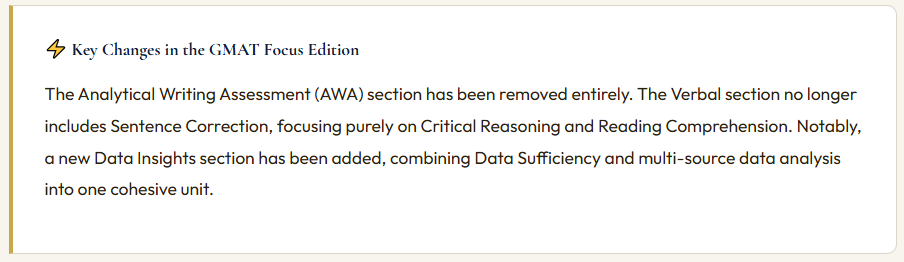
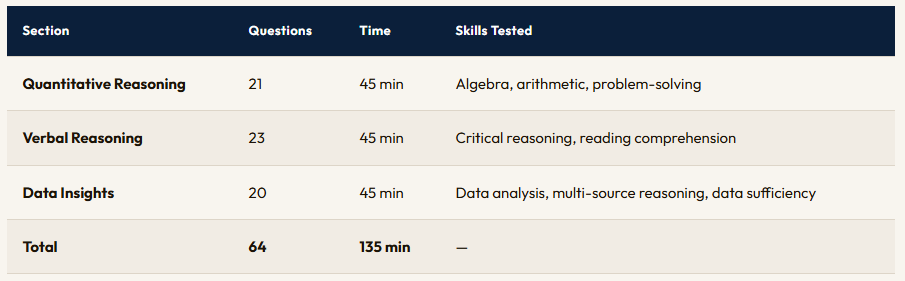
The GMAT Focus Edition represents the most significant exam redesign in its history. It cuts total testing time from 3.5 hours to just 2 hours and 15 minutes. Furthermore, it retains the same predictive power for business school success as the older version.
It also removes Sentence Correction questions from the Verbal section entirely. Additionally, a brand-new Data Insights section now replaces several older question types. Consequently, the test feels sharper, fresher, and more aligned with modern business decision-making.
Greater Control for Test-Takers
Candidates now enjoy far more control over their test experience. They can review and change up to three answers per section before time expires. Additionally, they can choose the order of sections based on personal strengths.
This flexibility rewards strategic thinking at every stage of the test. Furthermore, it reduces the anxiety that often comes with a rigid, fixed format. Therefore, the GMAT Focus Edition consistently favours well-prepared and confident candidates.
The Three Sections of GMAT Focus Edition Explained
Quantitative Reasoning
The Quantitative Reasoning section tests mathematical problem-solving and numerical interpretation. Topics include arithmetic, algebra, geometry, and word problems. All of this sits at the secondary school mathematics level broadly.
However, the real challenge lies in speed and precision under timed conditions. Problem-solving questions reward efficient approaches over brute-force calculation. Furthermore, schools with finance-heavy MBA tracks value strong performance here above all else.
Dedicated timed drills prove most effective for improving this section quickly. Candidates benefit from recognising patterns fast across common question types. Additionally, building mental shortcuts saves crucial seconds during the actual exam.
Verbal Reasoning
The Verbal Reasoning section focuses on two question types: Critical Reasoning and Reading Comprehension. Critical Reasoning tests the ability to evaluate arguments and identify assumptions. Additionally, it asks candidates to strengthen or weaken conclusions using logical analysis.
Reading Comprehension passages span business, science, and social policy topics. These passages demand both speed and analytical depth from every candidate. Moreover, a daily habit of reading long-form non-fiction builds sustainable verbal improvement.
Practising argument mapping and logic-chain analysis sharpens critical reasoning skills effectively. Consequently, verbal preparation often needs a longer lead time than quantitative prep. Most candidates benefit from starting verbal practice at least four months before exam day.
Data Insights
The Data Insights section is the newest and most modern part of the GMAT Focus Edition. It challenges candidates to interpret complex datasets from multiple sources. These sources include tables, graphs, two-part analyses, and multi-source reasoning scenarios.
Furthermore, Data Sufficiency questions test whether a problem is solvable with given data — not the actual answer. This design mirrors the data-driven decisions managers make in real organisations every day. Additionally, it rewards structured thinking and the ability to synthesise diverse information quickly.
Therefore, many GMAT experts consider this the most business-relevant section of the entire exam. Practising with real multi-source datasets builds the right mental habits. Consequently, candidates who practise this section daily tend to see the sharpest overall score gains.
How GMAT Scoring Works
Understanding the Score Scale
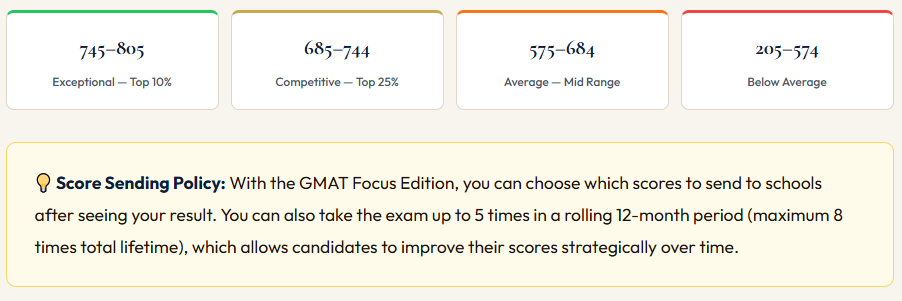
The GMAT Focus Edition uses a total score range of 205 to 805, in 10-point increments. Each section scores individually on a scale of 60 to 90. Additionally, the total score combines all three section scores with equal weight.
How Computer-Adaptive Testing Works
The exam runs on a Computer-Adaptive Testing (CAT) algorithm. This algorithm adjusts each question’s difficulty based on the previous response. Consequently, getting early questions right leads to harder ones — which raises the score ceiling.
Therefore, the first few questions in each section carry extra weight in shaping the score trajectory. Candidates should approach those early questions with full focus and no rushing. Moreover, thoughtful guessing on tough questions always beats skipping or abandoning them.
Eligibility & Exam Details
Who Can Register?
No official educational qualification exists as a hard prerequisite for GMAT registration. However, in practice, all test-takers hold or pursue an undergraduate degree. GMAT scores apply to graduate-level admissions, so this expectation makes clear practical sense.
Candidates must be at least 18 years old to register independently. Those aged 13 to 17 may register only with parental consent. Furthermore, no upper age limit exists, making the exam equally open to students and working professionals.
Exam Logistics at a Glance

Career Impact of a Strong GMAT Score
Access to Elite Organisations
A high GMAT score triggers a career transformation that professionals consistently call life-changing. Graduates of top GMAT-driven programmes land roles at McKinsey, Goldman Sachs, and Google regularly. Moreover, median base salaries at top-10 global MBA programmes frequently exceed USD $150,000 per year.
Beyond compensation, a top MBA opens access to an unmatched global alumni network. This network spans governments, corporations, and venture-backed startups worldwide. Additionally, exposure to global case studies and industry mentors accelerates growth beyond what traditional career paths can offer.
Long-Term Professional Transformation
Entrepreneurs, consultants, and investment bankers all trace major turning points to their MBA experience. Furthermore, the analytical discipline built during GMAT preparation proves invaluable in virtually every professional domain. Consequently, many aspirants view GMAT as the first strategic investment in a lifelong career.
The ability to think clearly under pressure — honed through GMAT prep — shapes how top professionals handle complex decisions. Therefore, the impact of a strong score extends far beyond the admissions stage itself. It reshapes the very way a business leader thinks and acts throughout their career.
Scholarships and Financial Returns
Scores above 720 regularly unlock merit scholarships worth USD $30,000 to $80,000 at elite schools. This significantly reduces the financial burden every MBA candidate faces. Additionally, recruiters at top consulting and finance firms often use GMAT scores as a proxy for analytical ability.
Thus, a strong score keeps generating returns long after the admissions stage ends. Furthermore, the ROI on a top MBA — in salary growth, career acceleration, and network value — consistently outpaces preparation costs. Therefore, candidates who invest seriously in GMAT tend to reap disproportionate long-term rewards.
Top Business Schools Accepting GMAT
A Truly Global Currency
Virtually every top-ranked MBA programme in the world accepts the GMAT. Whether an aspirant targets Ivy League schools, elite European institutions, or leading Asian schools, one score covers all applications. Furthermore, several top Indian institutions also accept GMAT for executive MBA programmes.
ISB Hyderabad, IIM Ahmedabad (PGPX), IIM Bangalore (EPGP), and SP Jain all welcome GMAT scores. Consequently, Indian candidates gain access to both domestic and international elite programmes. Therefore, one focused investment in GMAT preparation unlocks an extraordinary breadth of opportunity.
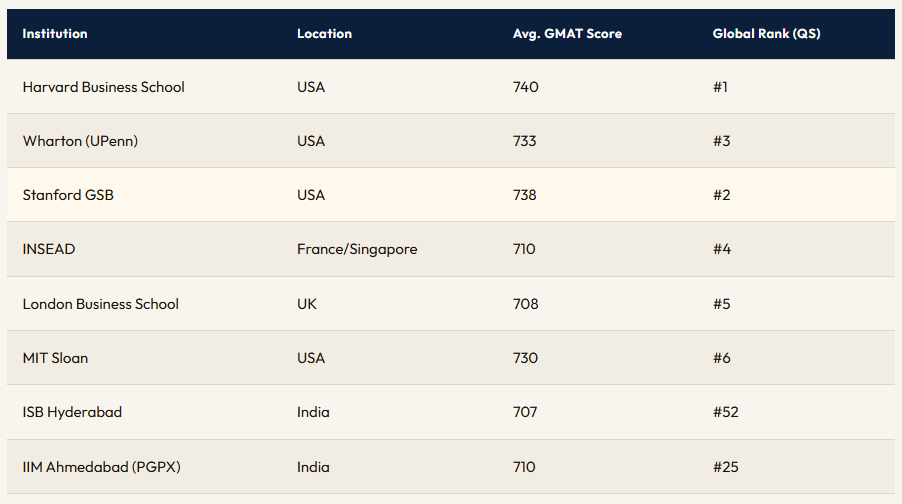
Average GMAT Scores at Leading Schools
How to Prepare for GMAT
Building a Structured Study Plan
Effective GMAT preparation typically demands between 100 and 200 hours of focused study. The exact number depends on the target score and the candidate’s starting point. Most successful test-takers begin with a full-length diagnostic test to map strengths and weaknesses clearly.
Subsequently, they build a structured plan that gives proportional time to each section. A timeline of three to six months suits most candidates targeting scores above 700. Furthermore, regular week-by-week milestones help maintain momentum and allow early course corrections.
Official and Third-Party Resources
GMAC’s official prep materials — including the GMAT Official Guide and the mba.com question bank — form essential starting points. Additionally, third-party platforms with adaptive mock tests and video explanations add significant depth. Consequently, most high scorers combine official and supplementary resources throughout their preparation journey.
Moreover, online forums and study communities help candidates learn from shared experiences. Peer discussion often clarifies concepts that books alone cannot convey. Therefore, joining an online study group boosts both motivation and conceptual clarity at the same time.
The Role of Mock Tests
Full-length, timed mock tests rank as the single most powerful tool in any GMAT preparation strategy. They build the mental stamina needed to perform well across 2+ hours of intensive problem-solving. Moreover, detailed score reports after each mock reveal exactly which topics still need the most work.
Section-Wise Preparation Tips
For Quantitative Reasoning, start by mastering core algebraic and arithmetic concepts first. Then layer in problem-solving strategies and timed drills. This sequence consistently delivers the fastest score improvement for most candidates.
For Verbal Reasoning, build a daily habit of reading dense analytical content — editorials, journals, and long-form essays. This depth of reading builds the comprehension speed the section demands. Furthermore, practising argument mapping sharpens critical reasoning skills rapidly and reliably.
For Data Insights, practise multi-source datasets and Data Sufficiency questions every day. Focus on logical structure rather than raw calculation speed here. Additionally, reviewing every wrong answer carefully prevents repeating the same errors under real exam pressure.
15 Frequently Asked Questions (FAQs)
Q1. What does GMAT stand for, and who runs it?
GMAT stands for Graduate Management Admission Test. GMAC — the Graduate Management Admission Council — owns and administers it. This non-profit organisation founded the test in 1953 and also conducts global research on management education.
Q2. What is the GMAT Focus Edition, and how does it differ from the old GMAT?
The GMAT Focus Edition launched in 2023 as the current version of the exam. It runs for 2 hours 15 minutes instead of 3.5 hours. It covers three sections, drops the Analytical Writing Assessment and Sentence Correction, and adds the new Data Insights section. Furthermore, candidates can review and change up to three answers per section.
Q3. What is the score range for the GMAT Focus Edition?
The total score range runs from 205 to 805, in 10-point increments. Each section — Quantitative Reasoning, Verbal Reasoning, and Data Insights — scores on a scale of 60 to 90. Additionally, all three section scores contribute equally to the final total.
Q4. How many times can I take the GMAT?
Candidates can take the GMAT up to 5 times in any rolling 12-month period. The lifetime maximum stands at 8 total attempts. A mandatory minimum gap of 16 calendar days must separate each consecutive attempt.
Q5. For how long does a GMAT score stay valid?
A GMAT score stays valid for 5 years from the test date. Business schools do not accept scores older than 5 years. However, all attempts within that window appear on the score report unless the test-taker selects specific scores to send.
Q6. What GMAT score does a candidate need for top business schools?
A score of 700 or above is generally competitive for most top-50 global MBA programmes. For elite schools like Harvard, Wharton, and Stanford, average GMAT scores range between 730 and 740. Furthermore, scores above 745 place a candidate in the top 10% of all test-takers worldwide.
Q7. Can I take the GMAT online from home?
Yes, the GMAT Focus Edition runs both online and at test centres globally. The online version uses AI-powered proctoring software to monitor the session. Both formats produce scores that all business schools worldwide accept equally.
Q8. Do Indian business schools accept the GMAT?
Yes, several top Indian institutions accept GMAT scores — including ISB Hyderabad, IIM Ahmedabad (PGPX), IIM Bangalore (EPGP), and SP Jain School of Global Management. Additionally, GMAT serves as the primary score for executive MBA programmes targeting experienced professionals across India.
Q9. How much does it cost to take the GMAT?
The registration fee for the GMAT Focus Edition runs approximately USD $275 per attempt in most regions. Rescheduling and cancellation fees apply based on how close the change falls to the exam date. Furthermore, sending score reports beyond the first five free sends may trigger additional fees.
Q10. What is the difference between GMAT and GRE for MBA admissions?
Both GMAT and GRE suit most major MBA programmes. However, GMAT is specifically built for management education, and many admissions committees prefer it. GRE tests a broader skill set including vocabulary, while GMAT’s Data Insights section more directly mirrors business school expectations.
Q11. How long should I prepare for the GMAT?
Most candidates targeting 700+ invest between 100 and 200 hours of study over 3 to 6 months. Those aiming above 740 often prepare for 6 months or longer. Additionally, starting with a diagnostic mock test helps build a personalised plan rather than a generic one.
Q12. Does the GMAT apply negative marking?
No, the GMAT Focus Edition applies no negative marking for incorrect answers. However, since the exam is computer-adaptive, rushing lowers the difficulty of subsequent questions. Therefore, thoughtful guessing on difficult questions always beats leaving them unanswered.
Q13. Can I cancel my GMAT score after seeing it?
Yes, after the exam, candidates view a preview of their unofficial score and choose to accept or cancel before it goes on record. Furthermore, a cancelled score can return within 4 years and 11 months by paying a reinstatement fee through the official GMAC portal.
Q14. Does the GMAT require prior work experience?
Work experience is not a requirement for GMAT registration. However, most MBA programmes using GMAT scores also require 2 to 5 years of professional experience for admission. Therefore, most candidates take the GMAT during college or early in their professional career.
Q15. What is the best way to prepare for the Data Insights section?
Build familiarity with multiple data formats — tables, graphs, scatter plots, and multi-source passages. Practise the logic of Data Sufficiency without performing full calculations each time. Additionally, work through official GMAT practice questions for this section regularly, as the style is highly unique to this exam. Consistent daily practice over 8 to 12 weeks delivers the strongest results.