


What is the XAT?
The Exam at a Glance
The Xavier Aptitude Test, widely known as XAT, ranks among the most prestigious MBA entrance exams in India. XLRI Jamshedpur — one of the country’s oldest and finest business schools — conducts this exam every year. Furthermore, XAT scores give aspirants access to over 160 top management institutions across the country.
XAT tests a broader set of skills than most other management entrance exams. It uniquely includes a Decision Making section, which no other major MBA exam covers. Consequently, it challenges candidates to think like managers, not just test-takers.
A Brief History
XLRI introduced XAT in 1955, making it one of the oldest management entrance tests in India. Over the decades, it evolved from a paper-based test to a fully computer-based format. Additionally, its reputation has grown steadily, drawing over 2.5 lakh registrations every year today.
The exam runs every January, typically in the first week. Moreover, it lasts for three hours and fifteen minutes in total. Therefore, candidates must build strong endurance alongside subject knowledge to perform well.

Why XAT Matters for MBA Aspirants
The Gateway to XLRI and Top B-Schools
XAT serves as the primary entry point to XLRI Jamshedpur, one of India’s most respected business schools. XLRI’s flagship BM and HRM programmes rank consistently among the best in the country. Furthermore, both programmes command average placement packages above ₹30 lakhs per annum.
Beyond XLRI, over 160 management institutes across India accept XAT scores for their MBA programmes. Additionally, prestigious schools like SPJIMR Mumbai, IMT Ghaziabad, and XIMB Bhubaneswar rely heavily on XAT. Therefore, a single strong XAT score can open many elite doors at once.
What Makes XAT Unique
XAT stands apart from all other MBA entrance exams because of its Decision Making section. This section tests real-world judgment, ethical reasoning, and business scenario analysis. Consequently, it identifies candidates who can truly handle complex managerial situations.
Additionally, XAT includes an Essay Writing component, which CAT and other exams do not. This essay tests a candidate’s ability to think and communicate clearly on business or social topics. Therefore, XAT demands a much more well-rounded level of preparation from every aspirant.
The Competitive Edge XAT Provides
A strong XAT score signals to admissions committees that a candidate has both analytical depth and managerial intuition. Moreover, the rigour of XAT preparation builds skills that carry directly into an MBA curriculum. Thus, the investment in preparing for XAT pays dividends far beyond just the exam itself.
Aspirants who score above the 95th percentile in XAT often receive calls from multiple top-tier institutions simultaneously. Additionally, a high XAT score can compensate for a less impressive academic background during the selection process. Consequently, XAT gives every motivated candidate a genuine chance to compete at the highest level.
XAT Exam Pattern and Structure
Overall Format Overview
The XAT exam runs for a total of 3 hours and 15 minutes in a computer-based format. It divides into two distinct parts that test different types of skills. Furthermore, the first part focuses on aptitude and reasoning, while the second includes the essay component.
Part 1 carries 75 questions covering Verbal, Decision Making, and Quantitative sections. Part 2 carries 26 General Knowledge questions and one Essay prompt. Additionally, Part 1 questions count toward the percentile score, while the essay is evaluated separately for XLRI admissions.
Exam Pattern at a Glance
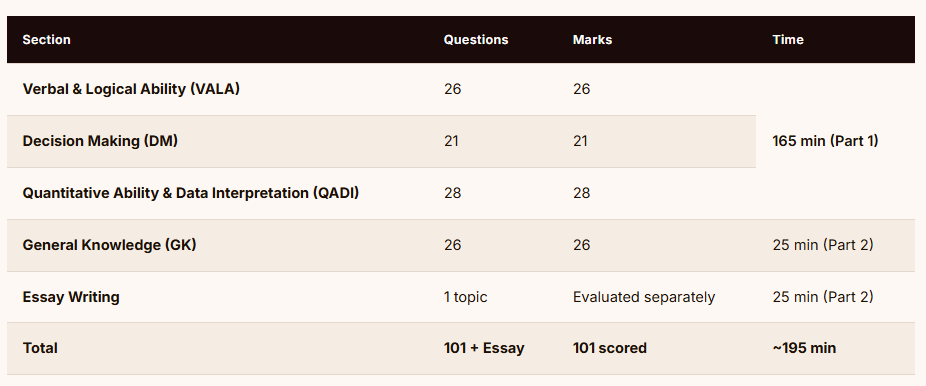
Marking Scheme
Each correct answer in Part 1 earns one mark. However, each wrong answer attracts a negative marking of 0.25 marks. Furthermore, leaving more than eight questions unattempted in Part 1 also triggers an additional penalty of 0.10 marks per skipped question.
This unique unattempted-question penalty makes XAT distinctly challenging to navigate. Consequently, wild guessing and excessive skipping both hurt a candidate’s score. Therefore, smart question selection and confident answering form the core of any winning XAT strategy.
The Four Sections of XAT Explained
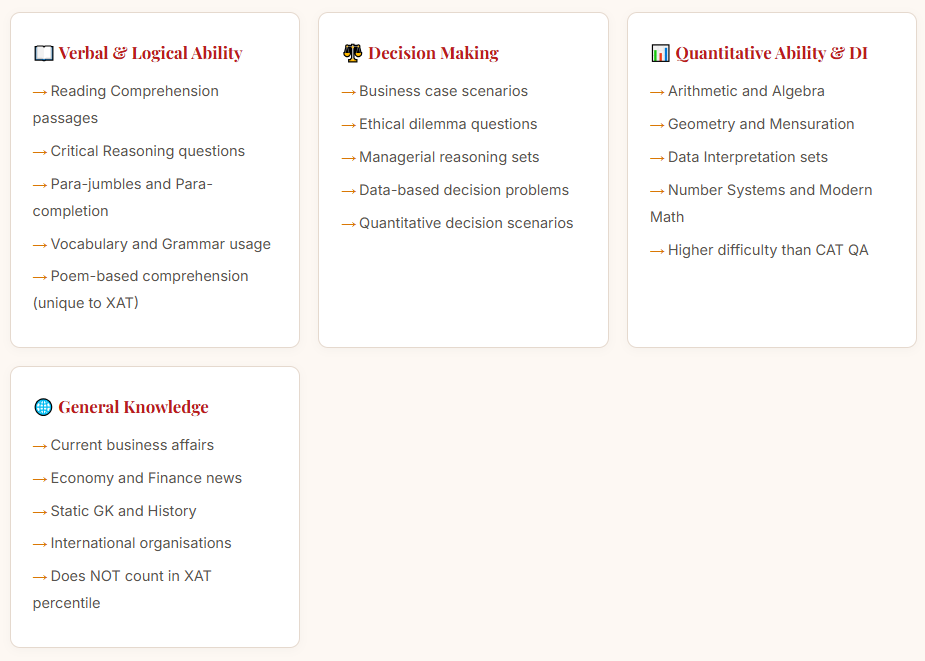
Verbal and Logical Ability (VALA)
The VALA section tests reading comprehension, logical reasoning, and language skills. XAT uniquely includes poetry-based reading passages, which appear in no other MBA exam. Moreover, the passages tend to be more abstract and philosophical than those in CAT or IIFT.
Critical reasoning questions here demand deep analysis of argument structure and inference. Additionally, para-jumbles in XAT are typically longer and more complex than in other exams. Therefore, candidates must invest significant time in building both comprehension depth and logical precision.
Decision Making — XAT’s Defining Section
Decision Making is the section that truly sets XAT apart from every other MBA entrance exam. It presents business scenarios, ethical dilemmas, and complex case-based problems to candidates. Furthermore, each question tests a candidate’s ability to weigh trade-offs and pick the most rational course of action.
This section does not follow standard formulas or shortcuts. Consequently, rote preparation alone cannot crack it — genuine managerial thinking is required. Therefore, aspirants must develop real decision-making frameworks and practise extensively with past XAT papers.
Quantitative Ability and Data Interpretation (QADI)
The QADI section in XAT is widely considered harder than the equivalent section in CAT. It covers arithmetic, algebra, geometry, number systems, and data interpretation sets. Additionally, the questions often combine multiple concepts, demanding both speed and conceptual clarity simultaneously.
Data Interpretation sets in this section frequently involve complex graphs and multi-step calculations. Moreover, accuracy matters enormously here given the 0.25 negative marking for each wrong answer. Consequently, a careful, selective approach to questions proves far more effective than attempting everything blindly.
General Knowledge and Essay Writing
The GK section in XAT covers business news, economic affairs, static general knowledge, and current events. However, GK scores do not factor into the XAT percentile calculation that institutions use for shortlisting. Instead, XLRI considers GK performance separately during its own personal interview stage.
The Essay Writing section asks candidates to write on a given topic in 25 minutes. Furthermore, XLRI evaluates the essay during GD-PI rounds to assess communication and analytical thinking. Therefore, practising concise, well-structured writing well before exam day gives candidates a meaningful edge.
How XAT Scoring Works
Raw Score and Percentile
XAT awards one mark for each correct answer and deducts 0.25 for each wrong answer. Leaving more than eight questions unattempted adds a further penalty of 0.10 per unattempted question. Furthermore, the raw score feeds into a normalisation process that produces the final XAT percentile.
Each section also receives an individual percentile alongside the overall XAT percentile. Consequently, candidates must perform consistently across all three Part 1 sections. Therefore, ignoring any one section completely can derail an otherwise strong overall performance.
What Score Do You Need?

Score Validity and Reporting
Score Validity: XAT scores remain valid for one year from the date of the result. Candidates must apply to institutions directly using their XAT ID during the same admission cycle. Furthermore, XLRI uses a separate application process where candidates must apply and pay an application fee in addition to their XAT registration.
Eligibility and Exam Details
Who Can Appear for XAT?
Any candidate holding a bachelor’s degree of at least three years from a recognised university can apply for XAT. Final-year graduation students may also register, subject to fulfilling the degree requirement before admission. Furthermore, no minimum aggregate percentage is prescribed for XAT registration itself.
There is no age limit for appearing in XAT, making it accessible to both fresh graduates and working professionals. Additionally, candidates can attempt XAT as many times as they wish across different years. Consequently, aspirants who do not achieve their target score in one attempt can plan and retake the exam the following year.
Registration and Key Logistics

Career Impact of a Strong XAT Score
Placement Outcomes at XLRI
XLRI Jamshedpur consistently delivers some of the best placement outcomes among Indian business schools. The average CTC for the BM batch at XLRI regularly crosses ₹30 LPA, and top offers often reach ₹70+ LPA. Moreover, leading recruiters at XLRI include McKinsey, BCG, Goldman Sachs, Amazon, and Hindustan Unilever.
XLRI’s HRM programme also ranks as the best HR programme in India by a significant margin. Consequently, a strong XAT score leading to XLRI admission effectively fast-tracks a candidate’s professional trajectory. Therefore, the effort invested in XAT preparation directly translates into career-defining opportunities.
Opportunities Beyond XLRI
Over 160 institutions accept XAT scores, covering sectors from finance and consulting to entrepreneurship and social impact. Schools like SPJIMR, IMT Ghaziabad, and TAPMI also deliver strong placements to their XAT-admitted batches. Additionally, candidates who perform well in XAT often apply to multiple institutions simultaneously, maximising their admission chances.
Furthermore, the skills built during XAT preparation — decision-making, quantitative reasoning, and verbal clarity — are themselves highly valued by employers. Consequently, even the process of preparing for XAT sharpens the cognitive edge that top companies actively seek. Therefore, every serious aspirant should view XAT preparation as a career investment, not merely an exam exercise.
Long-Term Professional Transformation
An MBA earned through a strong XAT score and admission to a top institution reshapes a professional’s career permanently. Alumni of XLRI and other top XAT-accepting schools consistently lead major organisations across India and globally. Moreover, the alumni networks at these institutions remain powerful resources throughout an entire career.
The analytical discipline and ethical reasoning sharpened during XAT preparation also prove invaluable in leadership roles. Additionally, Decision Making skills practised for XAT translate directly into the kind of managerial judgement that organisations value most. Thus, the long-term ROI of a strong XAT score extends across decades of professional life.
Top Colleges Accepting XAT Scores
Tier 1 Institutions Using XAT
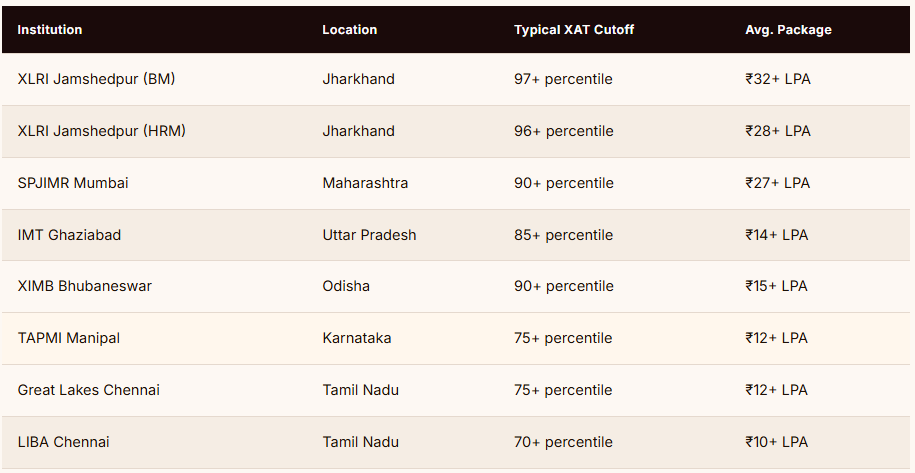
The most sought-after destination for XAT toppers is, without doubt, XLRI Jamshedpur. Beyond XLRI, several other highly reputed schools also place great weight on XAT scores. Furthermore, these institutions attract outstanding recruiters and deliver among the best placement packages in India.
XLRI’s Separate Application Process
Unlike most other institutions, XLRI requires candidates to register separately on its own website in addition to their XAT registration. This separate application carries an additional fee of approximately ₹200 per programme. Therefore, aspirants targeting XLRI must complete both registrations well before their respective deadlines.
XLRI also considers academic performance, work experience, essay quality, and GK scores during its final selection process. Moreover, the Personal Interview and Group Discussion at XLRI carry significant weight alongside the XAT score. Consequently, preparing holistically — not just for the written exam — is essential for XLRI admission.
How to Prepare for XAT
Building Your Study Plan
Most successful XAT candidates invest four to six months of structured preparation. The first step is always a diagnostic mock test to identify strengths and weaknesses across all sections. Subsequently, a weekly plan should allocate dedicated time to each section based on that diagnostic output.
Decision Making and Verbal Ability typically demand more lead time than Quantitative Ability. Furthermore, GK requires ongoing daily attention rather than last-minute cramming. Therefore, beginning preparation early and maintaining consistency across all five components gives candidates the best chance of success.
Section-Wise Preparation Tips
For Verbal Ability, reading diverse and challenging content daily — fiction, philosophy, editorials, and business articles — builds both comprehension speed and vocabulary. For Decision Making, solving past XAT papers extensively and studying business ethics frameworks delivers the most improvement. Additionally, for Quantitative Ability, mastering core concepts first and then tackling hard XAT-level problems helps build the required depth.
For General Knowledge, reading a quality business newspaper daily and reviewing static GK topics each week works best. Moreover, for Essay Writing, practising timed 250-word essays on current affairs and social topics sharpens both speed and clarity. Consequently, a multi-track daily routine that touches all five components is the hallmark of every top XAT scorer.
The Critical Role of Mock Tests
XAT mock tests are the single most important preparation tool available to every aspirant. They simulate the real exam’s unique format, including the unattempted-question penalty that catches many candidates off-guard. Furthermore, regularly analysing mock test performance reveals exactly which topics and question types need the most attention.
Time Management Strategies
Managing time across XAT’s three sections in 165 minutes is a skill that demands specific practice. Spending more than two minutes on any single question early in the exam often destroys the overall time budget. Additionally, keeping a clear mental target for the number of attempts per section before the exam begins gives candidates a decisive edge.
Moreover, the unattempted-question penalty means candidates must avoid over-skipping throughout Part 1. Therefore, practising with full-length timed mocks at least once every week in the final two months builds the pacing instincts that separate high scorers from the rest.
15 Frequently Asked Questions (FAQs)
Q1. What does XAT stand for, and who conducts it?
XAT stands for Xavier Aptitude Test. XLRI Jamshedpur — Xavier School of Management — conducts this exam every year on behalf of the Xavier Association of Management Institutes (XAMI). Furthermore, XLRI has organised this exam since 1955, making it one of the oldest MBA entrance tests in India.
Q2. When does XAT take place each year?
XAT takes place on the first Sunday of January every year. Registration usually opens in July or August on the official website at xatonline.in. Additionally, results come out within two to three weeks after the exam date.
Q3. How many sections does XAT have?
XAT has four main components: Verbal and Logical Ability, Decision Making, Quantitative Ability and Data Interpretation, and General Knowledge. It also includes an Essay Writing section in Part 2. Moreover, only the first three sections — which form Part 1 — contribute to the XAT percentile score.
Q4. What is the unique feature of XAT that other MBA exams do not have?
The Decision Making (DM) section is XAT’s most distinctive feature. No other major MBA entrance exam in India includes a dedicated Decision Making section. Furthermore, this section tests real-world managerial judgment and ethical reasoning — skills that top business schools like XLRI specifically value in candidates.
Q5. Does XAT have negative marking?
Yes, XAT applies a negative marking of 0.25 marks for each wrong answer in Part 1. Additionally, leaving more than eight questions unattempted attracts a further penalty of 0.10 marks per unattempted question. Therefore, candidates must balance speed with accuracy and avoid excessive skipping throughout the exam.
Q6. What percentile do I need to get into XLRI Jamshedpur?
Candidates typically need above 97 percentile overall for the XLRI BM programme and above 96 percentile for the HRM programme. However, section-wise cutoffs also apply — performing poorly in any single section can lead to rejection even with a high overall score. Furthermore, XLRI uses XAT scores alongside work experience, GK performance, and interview scores for final selection.
Q7. Do I need to register separately for XLRI after taking XAT?
Yes, XLRI requires a separate application on its own website in addition to XAT registration. This separate registration costs approximately ₹200 per programme and must be completed before XLRI’s own deadline. Therefore, aspirants targeting XLRI should complete both registrations well in advance to avoid missing either deadline.
Q8. How many colleges accept XAT scores?
Over 160 management institutions across India accept XAT scores. These range from XLRI at the top to numerous other reputed schools like SPJIMR Mumbai, IMT Ghaziabad, XIMB Bhubaneswar, TAPMI, and Great Lakes. Consequently, a single strong XAT attempt gives aspirants access to a wide range of admission opportunities simultaneously.
Q9. For how long does an XAT score remain valid?
An XAT score remains valid for one year from the date of declaration of results. Candidates must apply to institutions using their XAT ID within that same admission cycle. Additionally, candidates who wish to improve their score must retake XAT in the following year’s exam.
Q10. What is the eligibility criterion for XAT?
Any candidate holding a bachelor’s degree of minimum three years from a recognised university can register for XAT. Final-year graduation students may also apply provisionally. Furthermore, no minimum percentage requirement exists for XAT registration, and there is no age limit for appearing in the exam.
Q11. How is XAT different from CAT?
XAT includes a unique Decision Making section and an Essay Writing component that CAT does not have. Additionally, XAT’s Verbal section tends to be more abstract and includes poetry-based passages, which CAT avoids entirely. Moreover, XAT’s quantitative questions are generally considered harder and more conceptually demanding than those in CAT.
Q12. How long should I prepare for XAT?
Most candidates targeting scores above the 95th percentile prepare for four to six months. Those aiming specifically for XLRI often dedicate six months or more, with special focus on Decision Making and Essay Writing. Furthermore, starting early and maintaining consistency across all sections is far more effective than intensive last-minute preparation.
Q13. Does the GK section score count in the XAT percentile?
No, the General Knowledge section does not factor into the XAT percentile score that institutions use for shortlisting. However, XLRI considers GK performance separately during its own selection process, specifically at the GD-PI stage. Therefore, candidates targeting XLRI must still prepare thoroughly for GK, even though it does not affect the overall percentile.
Q14. How should I prepare for XAT’s Decision Making section?
The most effective approach to Decision Making is practising extensively with past XAT papers, which go back many years and cover a wide variety of scenario types. Additionally, studying business ethics principles and developing structured decision frameworks helps candidates approach new scenarios with clarity. Consequently, candidates who treat Decision Making as a reasoning skill rather than a knowledge-based section tend to score much higher in it.
Q15. Can I take both XAT and CAT in the same year?
Yes, candidates can absolutely appear in both XAT and CAT in the same year, and most serious MBA aspirants do exactly this. CAT takes place in November while XAT happens in January, so the exams do not overlap. Furthermore, preparing for both exams simultaneously is practical because they share overlapping syllabi in Verbal, Quantitative, and Logical Reasoning sections.