

- What is Quants in CAT?
- QA Structure and Exam Format
- Complete QA Syllabus Breakdown
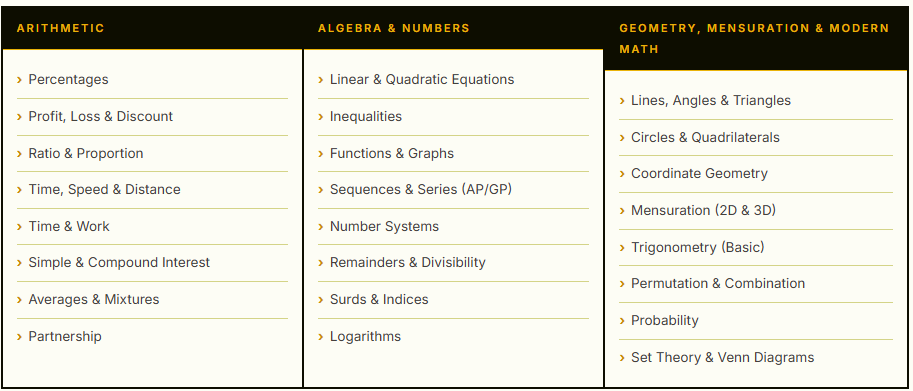
- Arithmetic — The Foundation of QA
- Algebra and Number Systems
- Geometry and Mensuration
- Modern Math and Data
- Scoring, Marks, and Strategy
- Topic Priority Framework
- QA Cutoffs and IIM Requirements
- Mistakes That Kill QA Scores
- The QA Preparation System
- 15 Frequently Asked Questions
What is Quants in CAT?
The Section Most Engineers Get Wrong
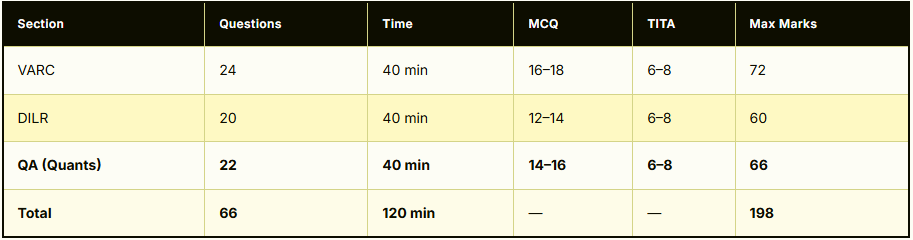
QA stands for Quantitative Ability. It runs as the third and final section in the CAT exam, covering 22 questions in 40 minutes. Furthermore, it tests mathematical reasoning at roughly the Class 10 to 12 level — yet the difficulty of application makes it far harder than school maths.
Many engineering students walk into QA believing it will be their strongest section. However, the timed format and tricky application-based questions consistently humble even the most mathematically confident candidates. Consequently, QA requires as much strategic preparation as VARC or DILR — perhaps more, given the danger of overconfidence.
Why QA Matters Beyond the Score
QA carries the highest number of questions in CAT — 22 — compared to VARC’s 24 and DILR’s 20. Additionally, QA improvements tend to show faster than VARC improvements, making it the highest-ROI section for most candidates. Therefore, a focused six-month QA effort frequently produces the largest single-section score jump across the entire CAT exam.
Furthermore, every IIM sets a QA sectional cutoff that candidates must clear regardless of overall performance. Missing the QA cutoff leads to automatic rejection — even with a 99th percentile overall score. Consequently, every aspirant must treat QA as a non-negotiable priority, not a fallback section.

QA Structure and Exam Format
Format, Questions, and Time
CAT QA runs for exactly 40 minutes and presents 22 questions from five broad topic areas. The section uses both MCQ and TITA formats, with roughly 14 to 16 MCQ questions and 6 to 8 TITA questions. Furthermore, TITA questions carry no negative marking, making every TITA attempt a risk-free opportunity.
The 40-minute window gives an average of just under 2 minutes per question. Additionally, candidates cannot revisit other sections after the QA timer starts. Therefore, time management within QA must rely entirely on a pre-built question-selection strategy, not improvisation.
QA Inside the Full CAT Structure
MCQ vs TITA — The Strategic Difference
MCQ questions carry +3 for a correct answer and −1 for a wrong one. TITA questions reward correct answers with +3 and carry zero penalty for wrong or blank responses. Furthermore, the no-penalty nature of TITA means candidates should attempt every single TITA question — guessing on TITA always beats skipping it.
Additionally, TITA questions in QA often involve exact numerical answers — no answer options exist as hints. Consequently, solving TITA questions demands greater certainty in methodology than MCQ questions, where partial elimination still helps. Therefore, practising TITA-format questions explicitly — not just standard MCQs — forms a critical part of complete QA preparation.
Complete QA Syllabus Breakdown
The Five Core Topic Areas
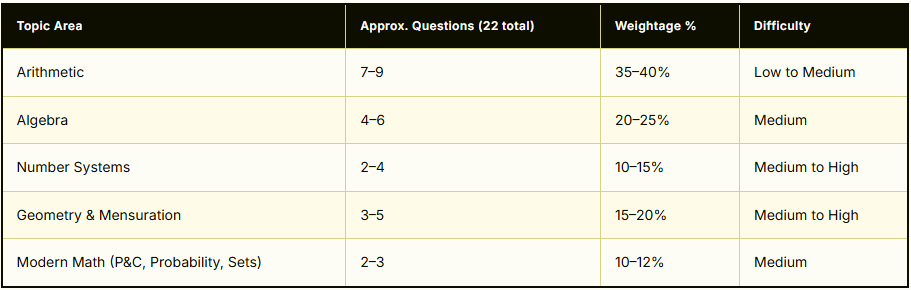
CAT QA covers five broad areas: Arithmetic, Algebra, Number Systems, Geometry and Mensuration, and Modern Mathematics. These five areas divide further into more than 25 specific sub-topics, each appearing at varying frequencies across different CAT papers. Furthermore, understanding this frequency distribution is the single most important factor in building an efficient QA study plan.
Topic Weightage Across Recent CAT Papers
Arithmetic — The Foundation of QA
Why Arithmetic Dominates the QA Section
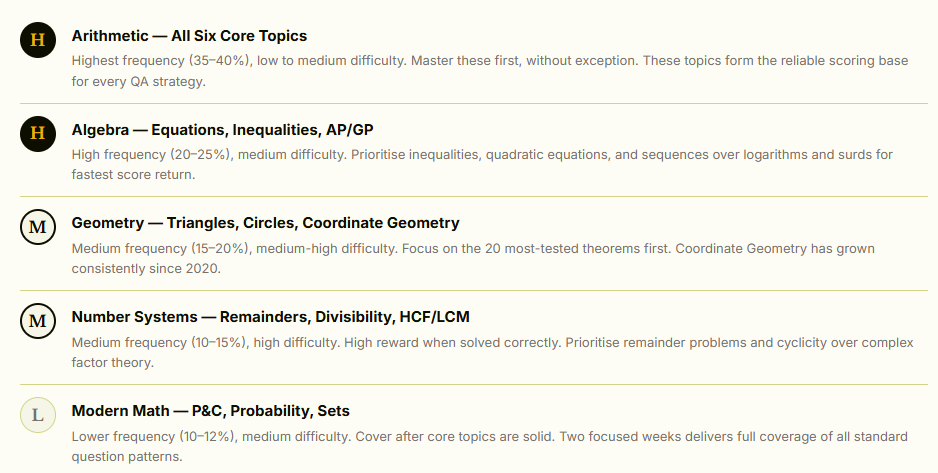
Arithmetic consistently accounts for 35 to 40% of all QA questions in every CAT paper. No other single topic area comes close to this share. Furthermore, Arithmetic questions tend to be more straightforward than Geometry or Number System questions — making them the best source of easy, reliable marks.
Additionally, Arithmetic sub-topics connect to each other in ways that reward holistic preparation. Mastering percentages makes Profit and Loss trivial. Furthermore, strong Ratio and Proportion skills directly speed up Time and Work solutions. Therefore, building Arithmetic as a unified system — rather than isolated topics — compounds preparation efficiency significantly.
The Six Arithmetic Topics Every Candidate Must Master
Percentages and Profit-Loss together account for roughly 15% of all QA questions across recent CAT papers. Time, Speed, and Distance — including trains, boats, and circular motion — contributes another 10 to 12% on average. Furthermore, Time and Work problems, including pipe-and-cistern variants, appear in almost every CAT paper without exception.
Additionally, Ratio-Proportion and Mixtures-Alligation questions test concept application rather than formula recall. Simple and Compound Interest problems appear less frequently but reward fast formula application. Consequently, mastering the core six Arithmetic topics gives every QA aspirant a stable floor of 8 to 10 reliable marks in the section.

Algebra and Number Systems
Algebra — The Second Pillar of QA
Algebra covers linear equations, quadratic equations, inequalities, functions, logarithms, sequences, and series. It accounts for roughly 20 to 25% of QA questions and rewards candidates who can manipulate expressions quickly. Furthermore, algebraic skills underpin many geometry and number system problems — making Algebra investment doubly valuable.
Inequalities and functions appear increasingly frequently in recent CAT papers, particularly in TITA format. Additionally, AP-GP series questions consistently appear in every paper and follow predictable solution patterns. Consequently, Algebra preparation that prioritises inequalities and sequences ahead of logarithms delivers the best marks-per-hour return.
Number Systems — High Difficulty, High Reward
Number Systems covers divisibility rules, remainders, factors, prime numbers, HCF, LCM, and unit digit problems. These questions typically rank as some of the hardest in QA — yet they carry the same 3-mark reward as easier Arithmetic questions. Furthermore, Number System questions in CAT often reward elegant conceptual shortcuts over brute-force calculation.
Additionally, Remainder Theorem-based questions appear frequently and reward candidates who build a genuine number intuition rather than formula-memorising. Cyclicity and unit digit problems test pattern recognition, not complex arithmetic. Therefore, Number Systems preparation should focus on building intuition through extensive practice — not memorising a long list of rules and shortcuts.

Geometry and Mensuration
The Most Feared Topic Area in QA
Geometry and Mensuration together contribute 15 to 20% of QA questions and consistently carry the highest average difficulty rating among all QA topics. However, the same Geometry theorems appear repeatedly across CAT papers — making it a highly learnable topic despite its intimidating reputation. Furthermore, a candidate who thoroughly masters 20 core theorems can confidently tackle the majority of CAT Geometry questions.
Additionally, Coordinate Geometry has grown in frequency since CAT 2020, replacing some traditional Euclidean Geometry questions. Basic Trigonometry — specifically height and distance problems — appears occasionally and rewards straightforward formula application. Consequently, the ideal Geometry preparation strategy prioritises Triangles, Circles, and Coordinate Geometry above all other sub-topics.
Mensuration — 2D and 3D Figures
Mensuration questions ask candidates to compute areas, perimeters, surface areas, and volumes of standard 2D and 3D figures. CAT’s Mensuration questions frequently embed a Geometry reasoning step inside an apparent calculation problem. Furthermore, questions involving combinations of 2D shapes or inscribed figures appear regularly and test spatial visualisation above arithmetic skill.
Additionally, 3D Mensuration — cubes, cylinders, cones, and spheres — appears in at least one CAT QA question per year. Mastering the standard formulas for all 3D shapes takes under two hours and consistently delivers one to two guaranteed marks. Therefore, skipping 3D Mensuration is one of the most wasteful preparation decisions any QA aspirant makes.
Modern Math and Data
Permutation, Combination, and Probability
Permutation and Combination (P&C) and Probability together contribute roughly 10 to 12% of QA questions. These topics intimidate many candidates but follow a small set of recurring problem patterns. Furthermore, arrangement, selection, and distribution problems in CAT rarely go beyond applications of standard formulas applied with clear logical thinking.
Additionally, Probability questions in recent CAT papers are mostly of low to medium difficulty and connect directly to P&C concepts. Set Theory and Venn Diagram problems appear occasionally and test logical data reading rather than formula recall. Consequently, investing two focused weeks on P&C and Probability typically yields a full 2 to 3 marks improvement for most candidates.
Set Theory and Miscellaneous Topics
Set Theory in CAT QA covers Venn Diagrams with two or three sets and maximum-minimum set problems. These questions appear one to two times per paper and reward quick logical deduction. Moreover, questions on Clocks, Calendars, and Coding-Decoding have largely disappeared from CAT QA since the 2017 format revision.
Additionally, Surds and Indices appear occasionally as one-liner TITA questions that test formula fluency. Basic Trigonometry — limited to sin, cos, tan, and height-distance problems — appears roughly once per paper. Therefore, dedicating one focused week to the entire Modern Math section delivers solid coverage without disproportionate time investment.
Scoring, Marks, and Strategy
The Exact Marking Scheme

What a Target QA Score Looks Like
A raw score of 42 to 51 (14–17 questions correct, 0–1 wrong) typically places a candidate in the 90th to 95th percentile range. Scoring above 54 pushes a candidate into the 97th percentile bracket. Furthermore, these targets assume a mix of MCQ accuracy and complete TITA attempts, not just brute-force question attempts.
Additionally, attempting 18 to 20 questions with 70% accuracy often scores lower than attempting 15 questions with 90% accuracy — due to the −1 MCQ penalty drag. Therefore, a selective, high-accuracy approach always outperforms a high-volume, low-accuracy strategy in QA. Moreover, tracking your accuracy rate per topic type in every mock session reveals the exact topics worth attempting on exam day.

The Two-Minute Rule for QA

Topic Priority Framework
How to Prioritise QA Topics for Maximum Marks
Not all QA topics deserve equal preparation time. The expert approach ranks topics by three factors: frequency in CAT papers, average difficulty level, and preparation-time required to reach competence. Furthermore, prioritising high-frequency, low-difficulty topics first builds the fastest scoring foundation for every QA aspirant.

Timed, topic-wise practice — combined with rigorous error analysis — is the preparation habit that separates 80th from 99th percentile QA scorers.
QA Cutoffs and IIM Requirements
IIM-Wise QA Sectional Cutoffs
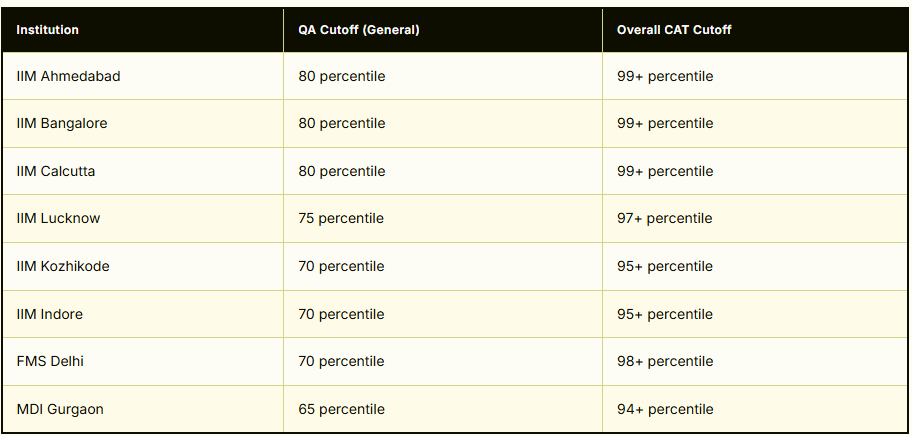
Every IIM sets its own QA sectional cutoff, and falling below it results in automatic rejection regardless of the overall percentile. The older IIMs — Ahmedabad, Bangalore, and Calcutta — typically require a QA percentile of 80 or above for general category candidates. Furthermore, this cutoff creates a hard floor that every IIM aspirant must clear, making QA preparation non-negotiable.
The Arts and Commerce Student Advantage
Arts and commerce students often fear QA, yet their structured preparation approach frequently outperforms engineers who rely on assumed familiarity. The reason is simple: arts students start from scratch and build every concept deliberately. Furthermore, they avoid the overconfidence trap that leads engineers to skip foundational Arithmetic practice in favour of advanced topics.
Additionally, CAT QA does not reward advanced engineering mathematics in any meaningful way. All tested topics sit within the Class 10 to 12 curriculum. Therefore, any motivated non-engineering student who builds QA fundamentals systematically over five to six months can comfortably clear the 70th percentile cutoff and beyond.
Mistakes That Kill QA Scores
Starting with Geometry Before Arithmetic
The most damaging QA preparation mistake is skipping Arithmetic to study Geometry and Number Systems first. Geometry questions are harder, more time-consuming, and worth the same 3 marks as simpler Arithmetic questions. Furthermore, weak Arithmetic foundations create a ceiling on overall QA performance — one that no amount of Geometry practice can raise.
Additionally, many candidates try to compensate for weak Arithmetic by mastering shortcuts and tricks. However, shortcuts without conceptual grounding fail unpredictably on novel question variants. Consequently, building genuine conceptual understanding of every core Arithmetic topic consistently outperforms trick-memorisation every single time.
Ignoring TITA Questions in Practice
Many candidates exclusively practise MCQ-format questions from coaching material and past papers. This habit leaves them unprepared for the 6 to 8 TITA questions that appear in every CAT QA section. Furthermore, TITA questions demand full working-out without the crutch of answer options — a meaningfully different skill that requires specific practice to develop.
Additionally, every skipped TITA question on exam day represents a guaranteed missed 3-mark opportunity. Consequently, including at least 3 to 4 TITA-format practice questions in every daily QA session builds the right muscle memory well before the actual exam. Therefore, always practise TITA questions without looking at answer options until the solution is complete.
Over-Relying on Formulas Without Understanding

The QA Preparation System
The Four-Phase Preparation Roadmap
The Non-Negotiable Daily Practice Habit
Every top QA scorer shares one habit: they solve at least 10 QA questions under timed conditions every single day — even on light preparation days. This daily repetition builds the calculation instincts and formula recall speed that no weekly cramming session can replicate. Furthermore, daily practice spreads the learning load evenly across months and prevents the panic-driven over-preparation that typically characterises the final week before CAT.
Additionally, tracking weekly accuracy by topic — in a simple table or spreadsheet — turns preparation data into preparation direction. Watching accuracy rise from 60% to 85% on Arithmetic percentage problems provides concrete evidence of real improvement. Consequently, data-driven daily practice consistently produces better QA outcomes than gut-feeling-driven study choices.
Resources That Actually Work for CAT QA
Official CAT papers from 2017 to 2024 remain the best QA practice resource available anywhere. Additionally, CATMock uploads fresh daily QA practice sets — covering all five topic areas at calibrated CAT difficulty — to give aspirants consistent exposure throughout their preparation cycle. Furthermore, after solving any practice question, always check whether a faster method exists — this habit builds the speed instincts that separate the 80th percentile from the 95th percentile QA scorer.
15 Frequently Asked Questions
QA stands for Quantitative Ability. CAT includes 22 QA questions running for exactly 40 minutes. Furthermore, QA appears as the third and final section of the exam — after VARC and DILR — making it the section candidates tackle when mental fatigue is at its highest, which is why exam-day stamina training is critical.
Every correct MCQ answer earns +3 marks, and every wrong MCQ answer deducts −1 mark. TITA questions award +3 for a correct answer and carry zero penalty for a wrong or blank response. Therefore, candidates should attempt every single TITA question — guessing on TITA always outperforms skipping it in terms of expected score value.
CAT QA covers five broad areas: Arithmetic, Algebra, Number Systems, Geometry and Mensuration, and Modern Mathematics (Permutation, Combination, Probability, and Sets). Arithmetic carries the highest weightage at 35 to 40% of questions. Furthermore, all tested topics sit within the Class 10 to 12 mathematics curriculum — CAT tests depth of application, not breadth of advanced knowledge.
Arithmetic consistently carries the most questions — typically 7 to 9 out of 22 — making it the most important QA topic area by far. Furthermore, Arithmetic questions tend to fall in the low to medium difficulty range, making them the most reliable source of marks for every QA candidate. Therefore, mastering all core Arithmetic sub-topics should always form the first phase of any QA preparation plan.
CAT QA typically includes 6 to 8 TITA questions per paper. These questions require candidates to type the exact numerical answer without any multiple-choice options. Furthermore, since TITA carries no negative marking, candidates should attempt every single TITA question on the exam — leaving even one unattempted represents a guaranteed missed opportunity.
A raw score of 42 to 50 marks typically corresponds to the 90th percentile range in QA. This translates to roughly 14 to 16 questions answered correctly with minimal wrong attempts. Furthermore, reaching this target requires a high accuracy rate on attempted questions rather than maximising the total number of attempts at the cost of accuracy.
IIM Ahmedabad, Bangalore, and Calcutta typically require a QA percentile of 80 or above for general category candidates. Newer IIMs generally accept QA percentiles between 65 and 75. Furthermore, failing the QA sectional cutoff at any IIM results in automatic rejection — regardless of how strong the overall CAT score is.
Most candidates targeting the 90th percentile or above should aim to attempt 16 to 18 questions with an accuracy rate above 80%. Attempting fewer than 14 questions — even with perfect accuracy — risks falling below IIM sectional cutoffs in certain paper difficulty scenarios. Therefore, a balanced approach of high accuracy on attempted questions plus all TITA attempts delivers the most consistent QA results.
CAT imposes no per-question time limit — only the 40-minute section timer. However, the expert two-minute rule recommends abandoning any question that does not yield a solution within two minutes. Furthermore, sticking to this discipline during practice builds the natural pacing instinct that prevents time collapse on exam day.
Absolutely — CAT QA tests Class 10 to 12 mathematics, not engineering-level concepts. Many top QA scorers come from arts and commerce backgrounds. Furthermore, non-engineering students who build QA concepts systematically from scratch often outperform engineers who skip foundational practice due to assumed familiarity with the material.
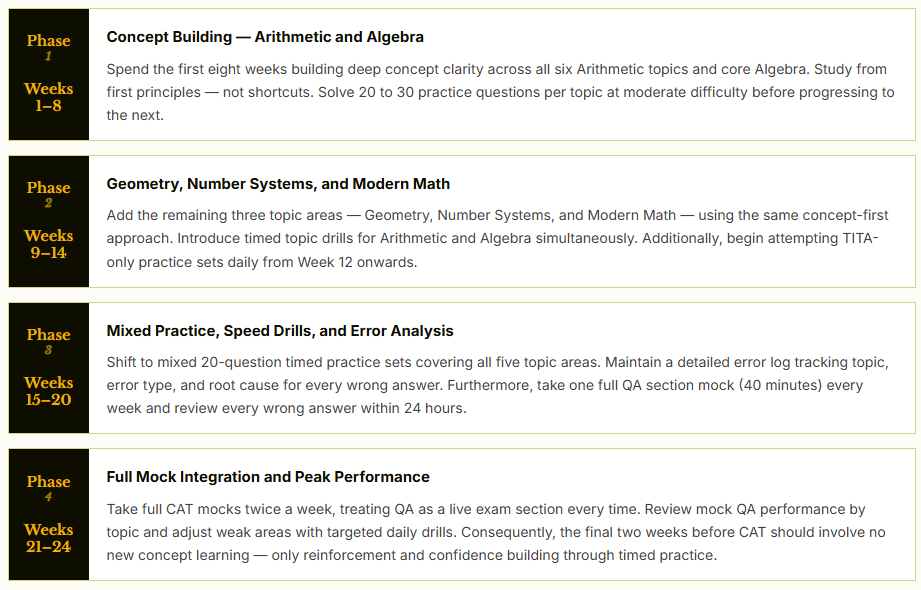
Most candidates targeting the 85th percentile or above should invest five to six months of consistent preparation. The four-phase system — Arithmetic and Algebra first, then Geometry and Number Systems, then mixed timed practice, then mock integration — delivers the most structured improvement over this timeline. Furthermore, candidates who start QA preparation in the final two months almost always plateau before reaching their target percentile.
Shortcuts are valuable only after building a solid conceptual foundation first. Applying a shortcut without understanding its basis leads to errors on novel question variants that look familiar but require one extra reasoning step. Furthermore, the most effective QA preparation approach builds conceptual clarity first and then learns shortcuts as speed tools — never as replacements for understanding.
Official CAT papers from 2017 to 2024 provide the most authentic QA practice available anywhere. CATMock publishes daily QA practice sets — covering all five topic areas at calibrated difficulty — for consistent daily preparation. Furthermore, solving every question from the official past papers at least twice, with full working shown, delivers deeper skill building than any third-party material alone.
Number Systems and Geometry consistently rank as the two hardest QA topic areas across student feedback and difficulty analysis. Number System questions often require creative application of divisibility concepts, and Geometry questions demand multi-step spatial reasoning. However, both areas follow predictable patterns that extensive practice with past CAT papers can systematically decode over two to three months.
CAT QA is generally considered harder than NMAT’s Quantitative Skills and comparable to XAT’s QADI section. NMAT focuses more on calculation-speed with moderate difficulty, whereas CAT QA demands conceptual depth and creative problem-solving. Furthermore, CAT’s TITA format — requiring typed exact answers — adds a layer of difficulty absent from NMAT and SNAP, making CAT-specific practice the most rigorous and comprehensive preparation for any management entrance quantitative section.