
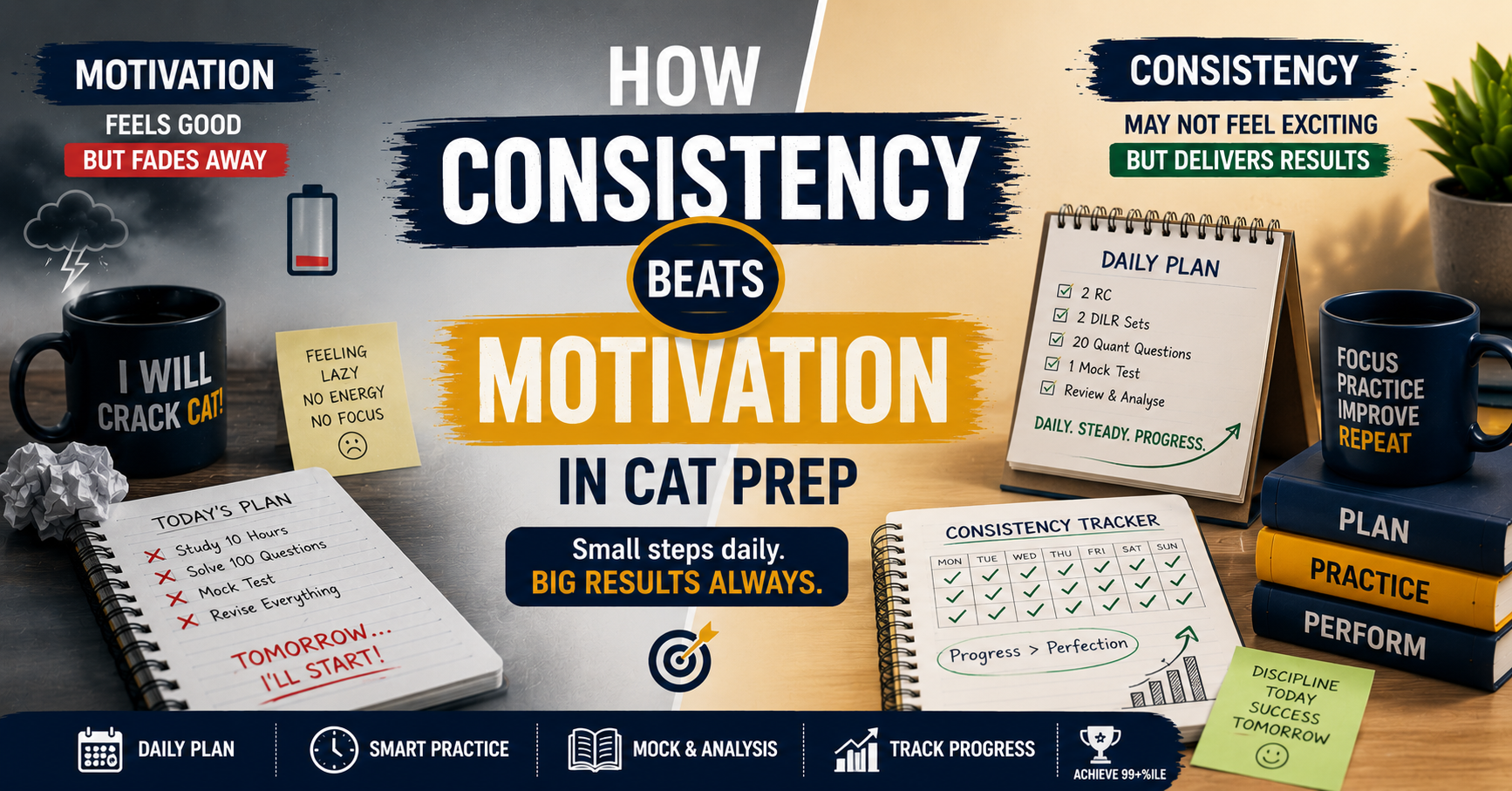
Every year, thousands of CAT aspirants start strong in July and fade out by September. They feel motivated on Day 1, overwhelmed by Day 30, and defeated by Day 60. Furthermore, this is not a talent problem or a time problem — it is a system problem. This guide breaks down exactly why consistency always outperforms motivation, and how to build the daily habits that produce IIM calls.
Additionally, you will find practical, psychology-backed strategies you can apply today — not next Monday, not after the next mock. Consequently, by the end of this article, you will think about CAT preparation very differently from how you think about it right now.
- The Motivation Problem
- What Consistency Actually Does to Your CAT Score
- Motivation vs Consistency — The Real Difference
- The Identity Shift That Changes Everything
- Building Your Consistency System
- The Five Elements of an Unbreakable Study System
- The Streak Method for CAT Prep
- What to Do on Bad Days
- The Consistent Candidate’s Weekly Plan
- How CATMock Supports Daily Consistency
- 10 Frequently Asked Questions
The Motivation Problem
Why Motivation Always Runs Out
Motivation feels like a superpower — until it disappears at 9 PM on a Tuesday when you have a mock tomorrow. It spikes when you watch a success story video and crashes when you open a difficult Number Systems problem. Furthermore, motivation is an emotion, and like all emotions, it fluctuates unpredictably throughout the day, the week, and the month.
CAT preparation runs for six months — roughly 180 days. During those 180 days, you will feel genuinely motivated for perhaps 30 to 40 of them. Additionally, the remaining 140 days require something else entirely — and that something else is consistency. Consequently, every candidate who builds their preparation around motivation alone eventually crashes and burns, usually in October, when it matters most.
The Motivation Trap Most Students Fall Into

Most CAT aspirants fall into the same trap: they study intensively for three days after a motivational peak, skip two days when energy drops, and then guilt-study for one long day before the cycle repeats. Furthermore, this boom-bust pattern produces shallow familiarity with topics rather than deep, exam-ready understanding. Consequently, students stuck in this cycle consistently underperform their perceived preparation level on every mock test.
Additionally, the trap gets worse as the exam approaches. Motivation spikes just before mocks and collapses after a bad result. Therefore, the very moment a candidate most needs steady daily effort is the moment the motivation-based system fails most dramatically.
The Honest Truth About Motivation
Motivation serves one useful purpose in CAT prep: it starts the engine. Moreover, it occasionally restarts the engine after a setback. However, motivation was never designed to keep the engine running — that is consistency’s job. Therefore, the fastest improvement any CAT aspirant can make right now is to stop waiting to feel motivated before sitting down to study.
What Consistency Actually Does to Your CAT Score
The Compounding Effect of Daily Practice
Consistency works through compounding — the same mechanism that makes compound interest powerful over decades. A candidate who solves 15 QA questions daily for 120 days completes 1,800 practice questions by exam day. Furthermore, a candidate who studies intensively on motivated days and skips the rest might complete 600 questions in the same period — and retain fewer of them.
Additionally, daily repetition builds cognitive speed that weekend sessions simply cannot replicate. Your brain learns to access formulas, reasoning chains, and reading instincts automatically through consistent repetition. Consequently, the consistently prepared candidate answers familiar question types significantly faster on exam day — and speed directly translates into more attempted questions and higher scores.
What Neuroscience Says About Habit Formation
Neuroscience shows that repeated actions strengthen neural pathways over time. Each time you solve a percentage problem or read an editorial, your brain builds a slightly stronger connection for that skill. Furthermore, these connections grow strongest when practice happens daily — the gap between sessions matters as much as the quality of each session.
Additionally, the brain’s habit loop — cue, routine, reward — explains why consistent studiers find it easier to sit down as the months progress, not harder. The habit becomes automatic over time. Therefore, the initial discomfort of forcing yourself to study every day is actually an investment in reducing future friction — not a permanent cost.
Motivation vs Consistency — The Real Difference
A Side-by-Side Comparison
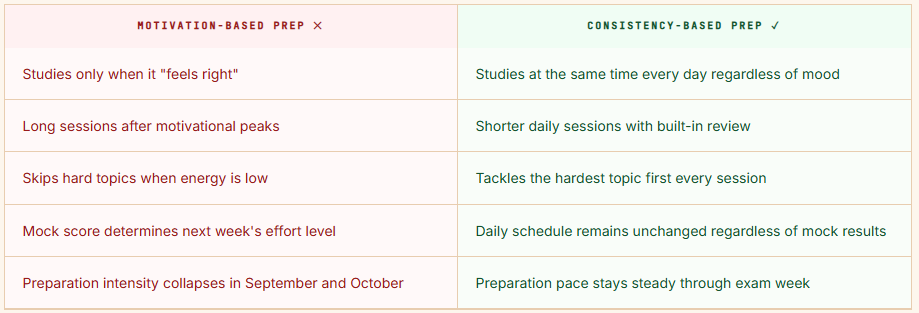
The Compound Score Gap
Consider two candidates starting CAT preparation in June. Candidate A studies daily for 2 hours using a fixed routine. Candidate B studies for 4 hours on motivated days and skips on low-energy days. Furthermore, by October, Candidate A has 360 total preparation hours and a deeply practised skill set. Candidate B has 200 hours and a fragmented, uneven knowledge base.
Additionally, Candidate A enters mock tests with a calm, automatic confidence built over months of repetition. Candidate B enters mocks with anxiety, because their preparation was never predictable enough to feel solid. Consequently, the score gap between these two candidates often reaches 20 to 30 percentile points — not because of talent, but because of system.

The Identity Shift That Changes Everything
From “I Am Preparing for CAT” to “I Am a CAT Aspirant”
The most powerful consistency shift is not about schedules or timers — it is about identity. Candidates who describe themselves as “preparing for CAT” treat study sessions as optional tasks they perform when ready. Furthermore, candidates who internalise “I am a CAT aspirant” treat daily practice as a non-negotiable expression of who they are.
Additionally, identity-based habits are self-reinforcing in a way that schedule-based habits are not. Skipping a study session feels like a violation of self when your identity includes consistent preparation. Consequently, the transition from external motivation to internal identity is the most reliable consistency upgrade any CAT aspirant can make.
How to Make the Identity Shift Practical
Start by reframing your self-talk from “I need to study today” to “I study every day — that is what I do.” Additionally, tell one person in your life that you study every day — the social commitment creates accountability without external pressure. Furthermore, place your study materials in a fixed, visible spot so the environment itself reinforces the identity through a daily visual cue.
Moreover, track your study days with a simple calendar — crossing off each completed day creates a visual streak that strengthens identity. Consequently, after 21 days of consecutive sessions, most aspirants report that skipping a session feels genuinely uncomfortable — the identity has begun to take hold.
Building Your Consistency System
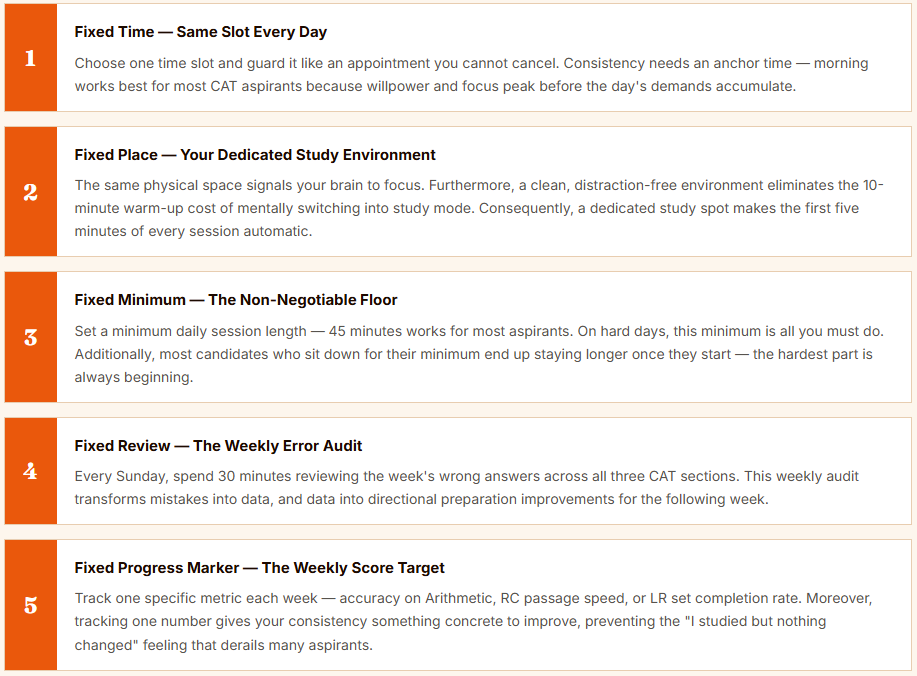
The Five Elements of an Unbreakable Study System
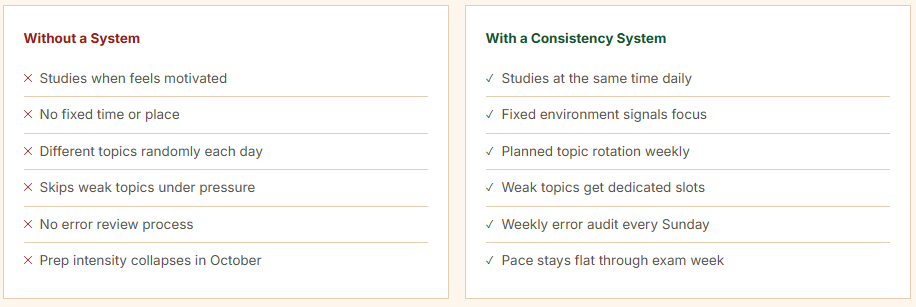
The Two-Column Contrast — System vs No System
The Streak Method for CAT Prep
Why Streaks Work Better Than Goals
Goals like “score 98 percentile in CAT” are outcome targets — they exist in the future and provide no daily direction. Streaks are process targets — they exist today, right now, and create immediate behavioural feedback. Furthermore, maintaining a study streak generates a daily psychological reward that reinforces the habit far more reliably than a distant exam outcome ever can.
Additionally, the streak method handles motivation collapse automatically. On a low-energy day, “I don’t feel like studying” loses to “I don’t want to break my 34-day streak.” Consequently, the streak becomes its own motivation — a protective system that keeps you moving on days when the original motivation has completely disappeared.
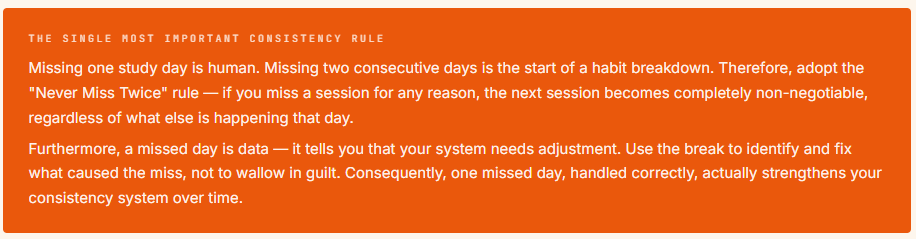
The “Never Miss Twice” Rule

What to Do on Bad Days
Bad Days Are Part of Every CAT Journey
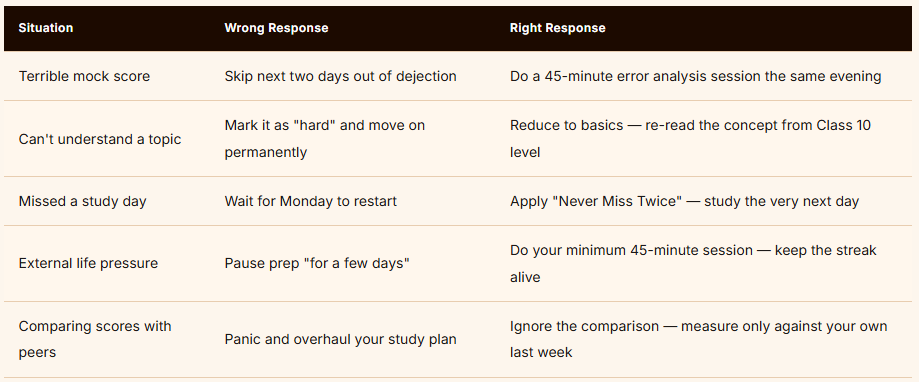
Every CAT aspirant will face days when the mock score crashes, a difficult topic refuses to click, or life outside prep demands complete attention. Furthermore, how you respond to these bad days determines your final percentile more than any single study session ever will. Consequently, having a pre-built response plan for bad days is not optional — it is a core part of your consistency system.
Additionally, bad days feel permanent in the moment but look like minor dips in retrospect. Most candidates who receive IIM calls can point to specific terrible mock results in July or August that felt devastating at the time. Therefore, building resilience into your prep system — not just skill — is what separates the IIM caller from the “I almost got there” candidate.
The Bad Day Protocol
The Minimum Viable Session
On the absolute worst days — fever, family emergency, complete mental exhaustion — the minimum viable session applies. Open CATMock, solve 5 questions from your strongest section, close the laptop. Furthermore, this 15-minute session keeps your streak alive, maintains the habit signal, and prevents the two-day gap that typically starts a full preparation collapse. Consequently, the minimum viable session is the most underrated consistency tool in any serious CAT aspirant’s system.
The Consistent Candidate’s Weekly Plan
A Proven Weekly Structure for Six Months of CAT Prep
Consistency without structure becomes aimless repetition. Furthermore, structure without flexibility becomes rigid and fragile. The ideal weekly plan balances both — a fixed rhythm of topics and session types, with enough space to adapt as preparation needs shift across the six-month cycle.

Adjusting the Plan Without Breaking Consistency
Life will occasionally disrupt this plan — and that is expected, not catastrophic. Furthermore, when disruption hits, the rule is simple: protect the daily minimum, flex the content, but never flex the habit itself. Additionally, shifting Wednesday’s DILR session to Thursday is fine — skipping Wednesday and not replacing it is what breaks the consistency system.
Moreover, the weekly plan should evolve across the six-month cycle. Months 1 to 2 focus on concept building; Months 3 to 4 add timed practice; Months 5 to 6 shift to full mocks and review. Consequently, a static six-month plan is less effective than a rolling four-week plan that gets updated every Sunday during the error audit.
How CATMock Supports Daily Consistency
Fresh Content Every Day — No Excuse to Skip
CATMock removes the most common daily consistency barrier: not knowing what to practise. Fresh VARC, DILR, and QA practice sets go live every single day, each calibrated to current CAT difficulty. Furthermore, topic-specific drills let candidates target their exact weak areas without spending 20 minutes curating practice material before every session.
Additionally, CATMock’s daily sets take between 20 and 40 minutes to complete — perfectly matching the minimum daily session target. Consequently, CATMock’s daily practice structure functions as a built-in consistency anchor: open the platform, do the day’s set, close the platform, mark the day done. Therefore, using CATMock daily eliminates the two biggest consistency killers — decision fatigue and blank-page paralysis.

10 Frequently Asked Questions
Motivation is an emotion, and emotions fluctuate unpredictably across days, weeks, and months. CAT preparation runs for six months — far longer than any motivational spike typically lasts. Furthermore, motivation peaks right after inspiring content and crashes right before difficult study sessions, which means it routinely fails precisely when you need it most. Consistency fills this gap because it operates independently of how you feel.
Two to three hours daily is the sweet spot for most CAT aspirants across a six-month preparation cycle. Additionally, the research on study retention consistently shows that two focused hours daily outperforms one six-hour weekend session in both memory consolidation and skill building. Therefore, prioritise daily frequency over session length — your brain learns better with regular exposure than with infrequent intensive bursts.
The Never Miss Twice rule states that if you miss one study session for any reason, the very next session becomes completely non-negotiable. Missing one day is human and recoverable. Furthermore, missing two consecutive days is the statistical start of a habit collapse — most preparation breakdowns begin with two missed days, not one. Therefore, protecting the day after a miss is the single most important recovery decision in any consistency system.
Decouple your daily study habit from your mock score — treat them as independent systems. A dropping mock score is data that tells you which topics need more attention, not a signal to reduce effort or abandon your routine. Furthermore, the candidates who recover fastest from a mock score drop are those who analyse the result the same evening, adjust next week’s topic focus, and continue the daily schedule unchanged the very next morning.
On genuinely difficult days, the minimum viable session is 15 minutes: open your practice platform, solve five questions from your strongest section, and stop. Furthermore, this brief session serves its most important purpose — keeping your daily habit signal active and your streak unbroken. Consequently, the minimum viable session prevents the two-day gap that typically starts a full preparation collapse.
Research on habit formation suggests that automatic habits typically form between 21 and 66 days of consistent repetition, depending on the complexity of the behaviour. Most CAT aspirants report that daily study begins to feel automatic and uncomfortable to skip after approximately 30 consecutive days. Furthermore, the initial 30 days are the hardest — they require the most deliberate effort — but the habit becomes genuinely self-sustaining after that threshold.
The time and place of your study session should stay fixed — but the content should rotate across CAT’s three sections in a planned weekly cycle. Additionally, a static content plan risks over-preparing one section at the expense of others. Therefore, fix the when and where of your routine, but update the what every four weeks based on your most recent error audit and mock test analysis.
CATMock publishes fresh VARC, DILR, and QA practice sets every single day, removing the most common consistency barrier — not knowing what to practise. Additionally, each daily set takes 20 to 40 minutes to complete, making it a natural match for the minimum daily session target. Furthermore, tracking accuracy across consecutive daily sets provides the concrete progress data that keeps aspirants motivated to return each day.
Morning study sessions consistently outperform evening sessions for most CAT aspirants because willpower, focus, and decision-making capacity peak earlier in the day. Furthermore, morning sessions face fewer cancellation risks from social plans, family demands, or end-of-day fatigue. However, the best time is ultimately the time you can protect consistently every single day — consistency in timing matters more than the specific hour chosen.
The single most important habit is solving at least one complete practice set from any CAT section every day — without exception — regardless of mood, energy, schedule pressure, or upcoming mock dates. Furthermore, this one daily practice commitment, maintained for 150 consecutive days, compounds into the preparation depth, speed, and confidence that no amount of intense weekend studying can ever replicate.
Consequently, the daily set — not the big mock, not the coaching class — is the foundational unit of every successful CAT preparation story.