
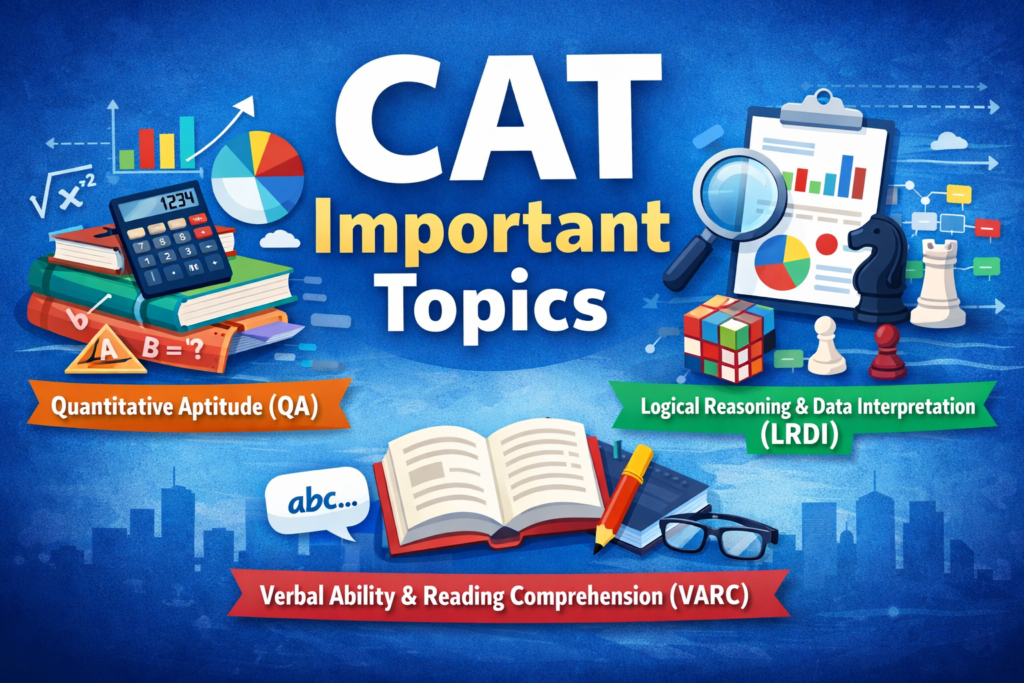
CAT 2026 preparation is not only about knowing the subjects. It also involves knowing the CAT exam pattern, syllabus pattern, and the most crucial topics that carry the highest weightage in the CAT exam. The Common Admission Test (CAT) exam has three major sections: Verbal Ability & Reading Comprehension (VARC), Data Interpretation & Logical Reasoning (DILR), and Quantitative Aptitude (QA).
The CAT exam has a fixed pattern. It starts with VARC, followed by DILR, and ends with QA, with a fixed time limit for each section. The CAT exam is conducted for 120 minutes. Therefore, time management and selecting the right questions become very important to ace the exam.
Every year, 2-3 lakh students appear for the CAT exam. They want to get into India’s top management institutes, such as the Indian Institutes of Management (IIMs) and other top business schools. In such a competitive scenario, preparing for the CAT exam with clarity and strategy is more important than just knowing the CAT syllabus. This is a one-stop solution for CAT 2026 aspirants. It discusses the most important topics in VARC, DILR, and QA. It also discusses the topic relevance and preparation strategy.
CAT 2026 PREPARATION
The first step towards preparing for CAT effectively is to know the CAT syllabus in detail. The CAT syllabus is classified into three broad sections: Verbal Ability & Reading Comprehension (VARC), Data Interpretation & Logical Reasoning (DILR), and Quantitative Ability (QA). It is essential to emphasize the most important topics under these sections. You should be aware of the weightage given to each of them. This will enable you to develop the precision and speed required to aim for a 99+ percentile rank in the CAT exam. In the following sections, we will discuss the CAT syllabus in a detailed and structured format.
The coverage will be done under VARC, DILR, and QA. Completing the CAT syllabus early provides a massive advantage to the candidates. They get ample time to focus on concepts and practice them extensively. They can attempt a huge number of questions without any time constraints. This enables them to assess their weaknesses and overcome them. Consequently, their performance and confidence in the CAT exam improve.
CAT 2026 Exam Pattern
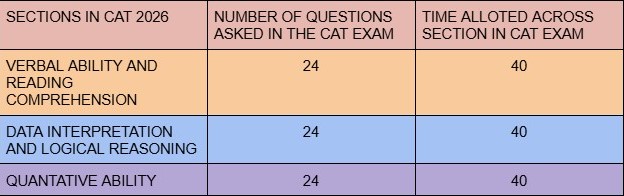
Understanding Topic Weightage
Verbal Ability & Reading Comprehension (VARC)
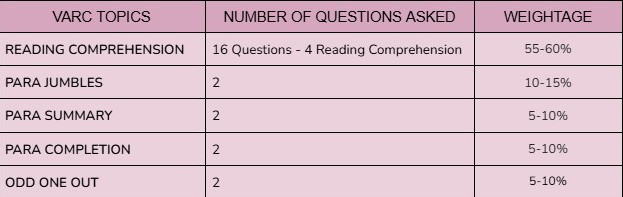
Understanding Topic Weightage Of VARC
The Verbal Ability & Reading Comprehension (VARC) section is one of the most critical sections for CAT 2026 preparation. It carries a lot of weightage in the written test. It also plays an important part in the shortlisting and interview rounds of the top IIMs and other B-schools. A poor performance in the VARC section can reduce the chances of getting calls from the top institutes, even if the overall percentile is good. Therefore, candidates aiming for the top management institutes need to work on this section.
Coming to the preparation tips for the VARC section, the most important thing is to develop a reading habit. Reading regularly can increase comprehension speed, vocabulary, and logical understanding of arguments. Candidates need to read long essays, good quality newspapers, editorials, and fiction or non-fiction books of their choice. Reading on different topics and different writing styles is very essential for overall improvement in CAT 2026.
The Reading Comprehension section of CAT VARC contains passages from disciplines such as science and technology, history, arts and literature, business and economics, philosophy, culture, politics, and abstract ideas. This requires the candidate to read and comprehend new information effectively.
Besides Reading Comprehension, another important component of the VARC section is Verbal Ability. This assesses logical flow and language comprehension through questions such as Para Jumbles, Para Summary, Odd Sentence Out, and vocabulary-based questions. High proficiency in these areas will improve the chances of getting the answer correct in the VARC section.
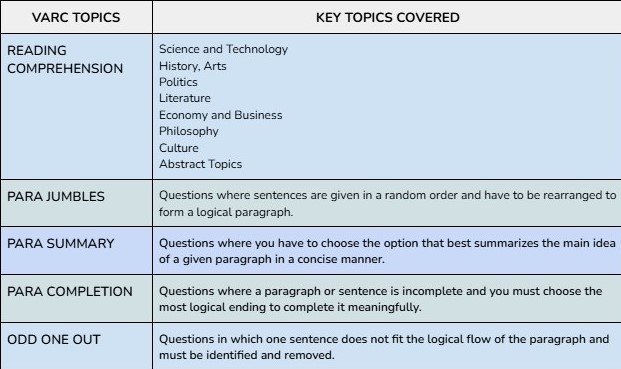
CAT VARC Syllabus: Topic-Wise Weightage
Data Interpretation & Logical Reasoning (DILR)
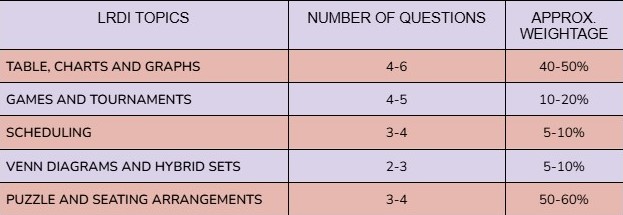
Understanding Topic Weightage Of DILR
DILR, or Data Interpretation and Logical Reasoning, is a critical component of the CAT syllabus. This section tests a candidate’s ability to work with data and use logical reasoning skills while under time pressure.The critical topics that fall under this category are tables and graphs, games and tournaments, scheduling and blood relations, Venn diagrams and mixed sets, puzzles, and seating arrangements.
Because of the diversity of sets and patterns, this section is one of the most challenging sections of the CAT exam for many candidates. To prepare for this section, a candidate needs to possess excellent problem-solving skills and the ability to work with complex caselets. A candidate needs to work on developing the skills of having clear thoughts, logical sequencing, and the ability to work patiently with sets rather than depending on memory.
For CAT 2026, this skill is imperative because LRDI is a scoring section that can help candidates perform better.
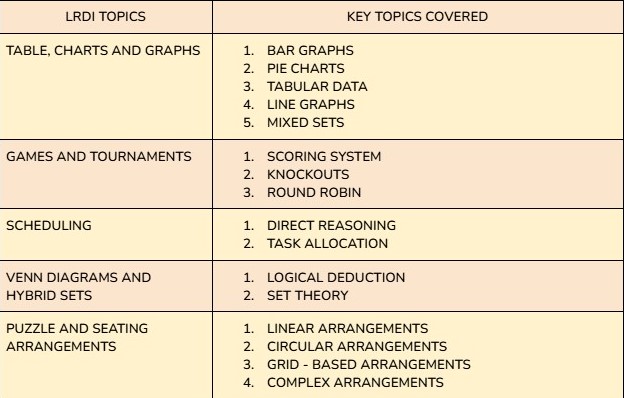
CAT LRDI Syllabus: Topic-Wise Weightage
Quantitative Ability (QA)
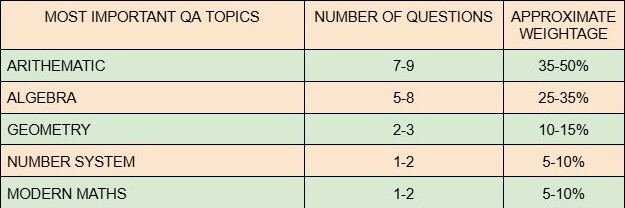
Understanding Topic Weightage Of Quants
The Quantitative Ability (QA) section of CAT is a test of the candidate’s mathematical problem-solving skills with an emphasis on accuracy. The major topics that are covered in QA include Arithmetic, Algebra, Geometry & Mensuration, Number System, and Modern Mathematics. Of these, Arithmetic and Algebra have a large number of questions in the CAT exam. Thus, these two topics are of utmost importance to the candidates.
To do well in the Quantitative Ability section of CAT, it is necessary that the candidates have strong conceptual knowledge and emphasize more on the logical application of formulas rather than shortcuts. Strong knowledge of Arithmetic and Algebra helps the candidates to be more accurate and confident, as these two topics are the basics of the QA section of CAT.
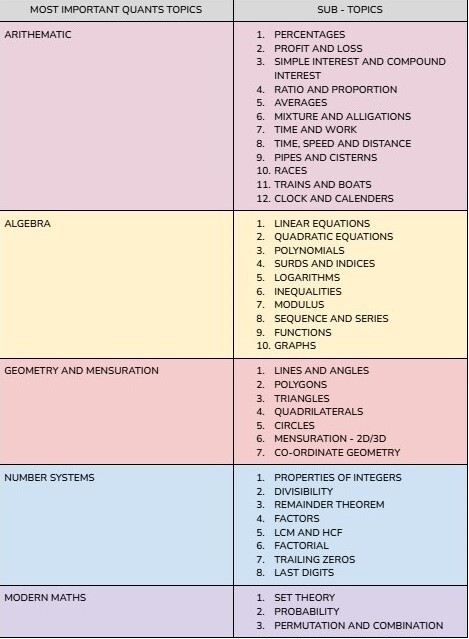
CAT Quants Syllabus: Topic-Wise Weightage
FAQs: CAT 2026 Preparation
1. Who should start preparing for CAT 2026 immediately?
-> Aspirants targeting the top IIMs and other top B-schools should start preparing early to develop strong fundamentals and confidence.
2. What are the skills that the CAT exam tests mainly?
-> CAT tests analytical skills, reading comprehension, logical reasoning, numerical ability, and time management skills.
3. Is it important to have a balanced performance in all three sections of CAT?
-> Yes, it is important to have a balanced performance in all three sections to overcome the sectional cut-offs.
4. Which section has the maximum weightage in the overall percentile calculation?
-> VARC section has maximum weightage as it is more unpredictable and has a strong impact on the rankings.
5. What kind of questions are there in the DILR section of CAT?
-> DILR section consists of caselet-based questions that require data analysis, logic-based puzzles, and structured reasoning.
6. What are the topics that beginners should focus on in the Quantitative Ability section of CAT?
-> Arithmetic and Algebra should be the first focus areas as they carry a heavy weightage in the QA section.
7. How does reading habit help in CAT preparation?
-> Regular reading improves comprehension speed, vocabulary, and critical thinking—key skills for VARC success.
8. What makes CAT different from other MBA entrance exams?
-> CAT focuses more on application of concepts and logical interpretation rather than direct formula-based questions.
9. When should candidates start taking mock tests?
-> Mocks should be introduced after basic syllabus coverage to gradually improve accuracy and exam temperament.
10. What is the biggest mistake aspirants make during CAT preparation?
-> Ignoring weak sections and delaying revision often leads to inconsistent performance in the actual exam.