

Preparing for the CAT exam as a working professional is a world apart from preparing as a college student. Office hours are long, and the mind is exhausted. Weekends are spent recovering from the week. It is hard to maintain consistency. Working professionals also feel guilty about not studying enough. This feeling is an added burden.
The truth is, the biggest problem is not a lack of talent. The biggest problem is often the lack of a doable and effective strategy.
Working professionals are highly motivated when they begin preparing for the CAT exam. However, they soon lose steam. This is not because the CAT exam is too tough. This is because most strategies are not designed for working professionals.
This book is for working professionals who want to get into the top IIMs and top B-schools but are struggling with time, consistency, and clarity. Rather than an unworkable 6-hour study plan, this book will help working professionals with smart strategies, flexible plans, and exam-centric preparation that can be accommodated in a busy work schedule.
- UNDERSTANDING THE CAT EXAM STRUCTURE IN THE SIMPLEST WAY
- COMMON MISTAKES WORK PROFESSIONALS MAKE IN CAT PREPARATION
- MINDSET SHIFT : THINKING LIKE A CAT ASPIRANT, NOT JUST AN EMPLOYEE
- TIME MANAGEMENT STRATEGIES THAT ACTUALLY WORK
- SECTION – WISE PREPARATION STRATEGY
- Importance of CAT Previous Year Questions (PYQs)
- Mock Tests: How Many, When, and How to Analyze
- Conclusion: You Don’t Need More Time, You Need Better Strategy
UNDERSTANDING THE CAT EXAM STRUCTURE IN THE SIMPLEST WAY
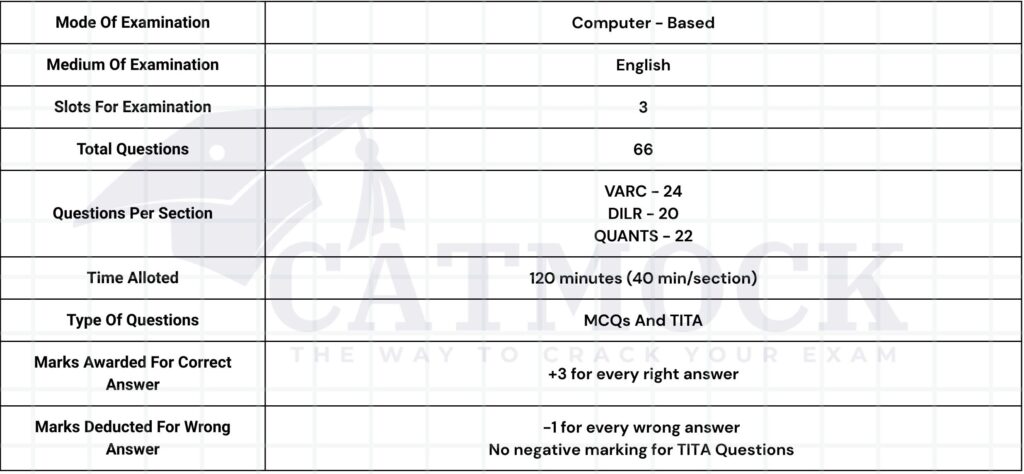
Before even beginning CAT preparation, one of the most common mistakes that working professionals make is overcomplicating the CAT exam. The CAT exam is not a test of how much you know. It is a test of how well you think under pressure, how well you use time, and how well you apply basic concepts.
Let’s break down the CAT exam pattern in the simplest way possible.
COMMON MISTAKES WORK PROFESSIONALS MAKE IN CAT PREPARATION
Working professionals usually embark on their CAT journey with a strong intent, but many of them tend to lose their way in the middle because of some avoidable strategic mistakes. These mistakes are not about skill or hard work; they are about the way.
1. Beginning CAT Preparation Late
Most working professionals tend to delay CAT preparation, thinking that they can start once the work pressure eases or when they ‘feel ready’ to start. The truth is that work responsibilities will hardly ease down on their own. This results in a compressed timeline for learning, with little time left for developing sound basics or adjusting to test strategies. CAT requires steady progress, and those who begin early, even with minimal study time, experience stability that late starters find difficult to attain.
2. Making Unrealistic Study Schedules
The mistake of making overly ambitious study schedules based on motivation rather than feasibility is common. After a long day of work, the idea of spending many hours studying can be exhausting. When such study schedules fail, as they always do, guilt replaces motivation. For a working professional, a flexible study schedule that matches one’s energy levels is much more effective than an ambitious schedule that looks good on paper but is not feasible.
3. Measuring Progress by Hours Rather Than Understanding
Many professionals associate productivity with the number of hours spent studying or solving questions. CAT, on the other hand, does not measure progress based on effort alone. It measures progress based on accuracy and logic. When a number of questions are solved without understanding the errors, it results in making the same mistakes again and again.
4. Overlooking Mock Test Analysis
Although it is necessary to perform mock tests on a regular basis, most professionals overlook the fact that mock tests should be analyzed and not just used as tools to check scores. It is a waste of time if one merely checks the percentile and then overlooks the rest of the analysis.
5. Trying to Cover the Entire CAT Syllabus
It is a common perception among working professionals that they need to know everything in order to be successful. This results in spending unnecessary time on topics that are low-yield or uncomfortable. CAT enables strategic skipping, and successful candidates know their strong points and work on their weak points selectively.
6. Underestimating VARC Preparation
VARC is considered to be a part that will “take care of itself,” particularly by professionals who read occasionally at work. This is a costly assumption. VARC needs regular practice, reading discipline, and accuracy under time pressure. Since progress in this part is gradual, underestimating it in the early stages leaves little room for improvement near the examination date.
7. Comparing Progress with Full-Time Students
Comparison with students who prepare full-time tends to raise unnecessary doubts about oneself. Working professionals tend to forget that they possess different attributes such as discipline, maturity, and decision-making skills. CAT does not measure the time taken for preparation but measures performance within a fixed two-hour time slot.
8. Overlooking Mental and Physical Fatigue
The struggle to maintain office work and CAT preparation without taking into consideration mental and physical fatigue causes burnout. Learning with mental fatigue causes lower retention and more mistakes. Most professionals work without a break, thinking that working harder will be a substitute for a break.
9. Formulas and Concepts Without an Exam Strategy
It is important to know formulas and concepts, but that is only half the battle won. Many professionals today appear for the exam without a strategy for attempting questions, selecting questions, and managing time. CAT encourages strategic thinking as much as it encourages knowledge.
10. Leaning on Motivation Rather Than Discipline
Motivation is not consistent, particularly for professionals dealing with deadlines and responsibilities. This is not a reliable approach to studying. Discipline is essential to build momentum. CAT success requires months of hard work, not spurts of motivation.
MINDSET SHIFT : THINKING LIKE A CAT ASPIRANT, NOT JUST AN EMPLOYEE
For working professionals, the most dramatic change in CAT preparation is not about time or investment—it is about attitude. Most candidates have a mindset of fitting CAT into their existing job. The best candidates think differently. They consider themselves CAT aspirants first and working professionals second.
The corporate world favors consistency, stability, and experience. CAT requires flexibility, rapid decision-making, and pressure handling. This contrast can lead to conflicts within, particularly for experienced professionals who are not accustomed to reviewing fundamentals or dealing with low mock scores.
It is essential to understand that CAT provides a level playing field. Work experience does not give any edge within the test. The most important aspect is how you think, decide, and perform during these short hours.
Another significant change is from an outcome-oriented mindset to a process-oriented mindset. Rather than being concerned about percentile, one should focus on daily improvement. Regular practice, regular revision, and mock analysis are more important than sporadic marathon study sessions.
CAT preparation also needs excellent decision-making capabilities. It is not about trying to solve all the questions. It is about selecting the correct ones, making optimal skips, and time management.
Uncertainty is also a part of CAT preparation. There will be confusion, slow movement, and doubts about oneself. Instead of considering it as a failure, it should be considered as an indicator of progress. The more comfortable one becomes with the uncomfortable zone, the better the preparation will be.
When working professionals begin to prioritize CAT in their minds, when their daily activities are synchronized with long-term goals, and when they are ready to face short-term imbalances, CAT preparation becomes more organized, optimized, and effective.
TIME MANAGEMENT STRATEGIES THAT ACTUALLY WORK
- Organize study activities according to energy levels, not just free time.
- Make use of concentrated study sessions rather than prolonged and exhausting study hours.
- Set weekly goals to remain flexible with unpredictable work schedules.
- Utilize weekends as precious preparation time, not casual catch-up days.
- Prioritize high-weightage CAT subjects to make the most of limited study time.
- Avoid resource-hopping and rely on a few trusted study resources.
- Schedule mocks and mock analysis only after fresh mental states.
- Divide large subjects into smaller, manageable daily tasks.
- Make use of commute or break times for light revision or reading practice.
- Prioritize sleep and rest to maintain long-term consistency.
- Practice guilt-free low-productivity days and resume with a calm mind.
- Maintain a fixed study schedule to minimize daily decision fatigue.
- Prioritize consistency over compensating for lost time with last-minute overwork.
SECTION – WISE PREPARATION STRATEGY
CAT preparation for working professionals becomes efficient only when it is section-specific. Every section of CAT assesses a different set of skills and hence demands a different preparation strategy. When the same preparation strategy is adopted for all three sections, it may result in imbalance and wastage of time.
Quantitative Aptitude (QA): Focus on Developing Strong Basics, Not Just Speed
Quantitative Aptitude is always the most dreaded section for working professionals, especially those who have been out of mathematics for several years. The most common mistake made in this section is to immediately start solving advanced questions without refreshing basic concepts. CAT is more about the application of basic concepts than advanced mathematics. The approach should start with developing robust conceptual understanding, especially in Arithmetic, which always has a very high weightage. Areas like percentages, ratios, averages, time and work, and profit and loss should be given priority as they are relatively easier to grasp and have a high potential for accuracy.
After developing conceptual understanding, practice should move towards application-based questions and not just formula-based questions. Working professionals should first focus on accuracy and then speed. It is not necessary to solve all questions in QA; rather, it is more important to choose the right questions to solve. Revision and tracking of errors are very important in this section, as even a small gap in conceptual understanding can result in committing the same mistake repeatedly. A practical approach to QA would be to focus on in-depth learning of chosen topics and not just the entire syllabus.
Data Interpretation & Logical Reasoning (DILR): Emphasis on Set Selection and Logic
DILR is considered the most unpredictable part of CAT, and this unpredictability often daunts working professionals. But CAT does not require candidates to solve all sets in this part. In fact, correctly solving two to three sets can give a very high percentile. The key to success in this part is not the speed of calculations but the ability to select the correct sets and logically organize information.
Preparation for DILR should be more about exposure to different types of sets and less about the number of sets. Working professionals should work on a few quality sets and take time to understand the logic behind them. While timed practice is necessary, equal importance should be given to analysis after practice to look for patterns in error and decision-making. Aspirants should, over time, learn to make the right calls to move away from sets that are difficult or take too much time. The confidence to skip is as important as the confidence to solve.
Verbal Ability & Reading Comprehension (VARC): Build Consistency and Accuracy
VARC is often underrated by working professionals, especially those who are comfortable with English at work. This thinking results in some irregular preparation, which is evident in the form of inconsistent scores. VARC demands regular reading practice and accuracy under time pressure. Reading Comprehension is the staple of this section and must be done as a daily routine activity and not as an occasional one.
Preparation for this section should involve regular reading of varied material such as editorials, essays, and opinion-based articles to enhance comprehension and critical thinking skills. Along with reading, serious practice of RC questions is necessary to understand how CAT sets up traps and close options. Verbal Ability questions such as para-jumbles and summaries demand logical ordering and not grammatical accuracy, and progress in this area is possible only through regular practice. Inconsistency in VARC scores is very easy, and accuracy and composed decision-making are essential in this section.
Importance of CAT Previous Year Questions (PYQs)
Previous Year Questions (PYQs) are the backbone of CAT preparation. But many aspirants, especially working professionals, tend to underestimate their importance. PYQs are not mere practice questions. They are a very close representation of the actual CAT exam. They give you an idea of how concepts are tested, how options are crafted, and how decision-making skills are assessed under time constraints. For working professionals with time constraints, PYQs are the best way to concentrate on what really matters.
The most important benefit of PYQs is that they help you understand the pattern of the CAT exam. Reading theories or doing coaching content is not sufficient. Only actual CAT questions can give you a proper understanding of the subject. PYQs give you a reality check between mere learning and CAT-level application.
The other major advantage is the improvement in question selection. CAT is not about solving all the questions—it is about selecting the right ones. By practicing PYQs under timed conditions, you will understand which questions to solve and which ones to avoid. This is a distinction that often separates the average candidate from the high performer.
PYQs also help in building confidence and overcoming exam anxiety. Many candidates feel apprehensive when they are first exposed to CAT-level questions in mocks. By practicing PYQs, you become accustomed to the difficulty level. This is particularly helpful for working professionals, who have limited time for preparation.
From a learning point of view, PYQs consolidate concepts. When the same concepts are repeated in different years, it helps in understanding them better. Revising PYQs is much more helpful than solving random questions.
Lastly, PYQs are helpful in designing an effective strategy for the exam. Based on patterns and time taken, candidates can design their strategy for each part of the exam. Working professionals who use PYQs tend to design much more effective strategies for the exam.
Mock Tests: How Many, When, and How to Analyze
Mock tests are one of the most important yet most misunderstood aspects of CAT preparation. Many students use mocks as a means of testing performance rather than a learning tool, which results in frustration and stagnation. For working professionals, mock tests need to be planned in a manner that maximizes use of time, with every test contributing directly to improvement.
How Many Mock Tests Are Enough?
There is no magic number of mocks that will ensure success in CAT. The number of mocks depends entirely on the effectiveness of the analysis that follows. For working professionals, it is much more important to do fewer mocks with effective analysis than to do many mocks without analysis. On average, 25-30 mocks with effective analysis over the period of preparation are sufficient. The key is to learn from the mocks rather than focusing on percentile scores.
When Should You Begin With Mocks?
Mocks should be introduced only after some basic understanding of all three sections has been achieved. It may be demotivating to begin too early, and beginning too late will leave insufficient time for strategy correction. The best way to proceed is to begin with sectional tests and topic-level practice, and then progress to full-length mocks. Towards the end of the exam, mocks should be attempted at regular intervals to develop endurance and consistency.
Mock Tests Should Be Used to Practice Strategy, Not Just Results
Mock tests are designed to test strategy as much as they are designed to test knowledge. For working professionals, the aim of a mock test should be to try out different combinations of section order, question choices, and time allocation. Percentile variations are expected, and there is no need to obsess over them. Rather, each mock test should be treated as a simulation that can help improve strategy and minimize mistakes.
Why Mock Analysis Is More Important Than the Mock Itself
The importance of a mock test is in its analysis. If a mock test is not analyzed properly, even if the scores are high, it won’t be of much use. Working professionals need to spend time on analyzing each mock test to understand where the marks were scored or lost. This requires analyzing the questions that were attempted wrongly, the questions that should have been left, and the easy questions that were overlooked due to poor choice or panic.
How to Analyze a Mock Effectively
The analysis of a mock test should begin with a section-by-section analysis of attempts, accuracy, and time taken. Each wrong question needs to be analyzed to understand whether it was a concept error, calculation error, or poor choice. The analysis of correct questions that took a long time to answer is also important, as it helps identify inefficiencies. Over time, certain patterns emerge—certain concepts keep causing errors or certain sections keep taking more time.
Use Mocks to Identify Strengths, Not Just Weaknesses
Aspirants tend to concentrate on weaknesses alone while analyzing mocks, but it is essential to identify strengths as well. By doing so, it becomes easier to identify areas of high accuracy and low attempt times, which in turn helps to identify the safe attempt regions in the actual test. For working professionals, it is more effective to work on their strengths than to focus on their weaknesses aggressively.
Use a Mock Performance Tracker
By maintaining a simple record of mock performance, scores, attempts, accuracy, and important learnings, it becomes easier to track progress in an objective manner. This helps to avoid emotional reactions to mock performance and gives a clear long-term perspective on improvement. For working professionals, this is critical to maintain motivation levels.
Avoid Burnout from Excessive Mocking
When mocks are taken too frequently without proper analysis and recovery, it results in burnout and a subsequent drop in performance. It is essential for working professionals to space out mocks appropriately and allow sufficient time for analysis. Quality always trumps quantity when it comes to mock tests.
Conclusion: You Don’t Need More Time, You Need Better Strategy
CAT preparation for working professionals can sometimes appear tough—not because of a lack of time, but because of poor time management. Many people feel that a lot of study time and drastic changes in lifestyle are required. This is not the case. CAT is more about efficiency, decision-making, and understanding than the amount of time devoted to studying. With a good plan, sectional preparation, and effective mock analysis, time management becomes easy.
A good plan can help working professionals concentrate on key areas and prevent exhaustion. It also helps working professionals improve steadily without impacting their professional commitments. Knowledge of the exam pattern, previous year papers, and using mocks as learning aids helps in a structured and feasible approach to preparation. Improvement may be slow at times, but it results in excellent outcomes in the long run.
Finally, CAT is not about who studies for the longest period—it is about who plans the best. Working professionals can definitely compete with full-time students with the right planning, patience, and persistence. You don’t need more hours in a day—you need a better plan and the willpower to stick to it.