

Table Of Content
The Common Admission Test (CAT) is the major entrance examination for top business schools in India. The same importance will continue for CAT 2026. Every year, lakhs of aspirants appear for the exam with one clear goal—to secure admission to a leading MBA college. However, CAT is not only a knowledge-based test.
Apart from academic ability, the exam evaluates decision-making skills, clarity of thought, and the ability to stay calm under pressure. Many entrance exams rely heavily on memorization, but CAT focuses more on analytical thinking and smart problem-solving. Aspirants must learn how to select the right questions, manage time effectively, and perform well in a time-bound environment.
Because of this structure, candidates from different academic backgrounds have an equal opportunity to succeed. Whether it is a first attempt or a repeat attempt, success in CAT 2026 depends largely on strategy, consistent practice, and smart preparation.
What Is CAT?
The Common Admission Test (CAT) is an All-India entrance examination conducted every year. It serves as the primary gateway for admission to management programs at the Indian Institutes of Management (IIMs) and other leading B-schools. The exam evaluates a candidate’s aptitude for management education. Key areas tested include Verbal Ability, Logical Reasoning, Data Interpretation, and Quantitative Ability.
Unlike many entrance exams that focus on memorization, CAT emphasizes analytical thinking and problem-solving skills. Candidates must analyze information carefully, identify the right problems, and solve them within a limited time. Because of this structure, time management and decision-making become essential during the test.
Due to its unique format, the exam presents challenges for fresh graduates, repeat aspirants, and working professionals alike. Success in CAT depends less on rote memorization and more on strategy, practice, and smart question selection.
Every year, one of the IIMs conducts the CAT exam on a rotational basis. Important announcements such as registration dates, exam schedules, admit cards, and results are released on the official CAT website. Management institutes across India use CAT scores as a primary criterion for MBA and PGDM admissions.
Candidates who qualify in the exam then move to further selection stages. These stages usually include Group Discussion (GD), Written Ability Test (WAT), and Personal Interview (PI).
CAT 2026 Exam Pattern and Structure
Understanding the CAT exam pattern is essential for effective preparation. The test evaluates not only knowledge but also strategy. Although the difficulty level may change every year, the overall structure of the exam has remained largely consistent.
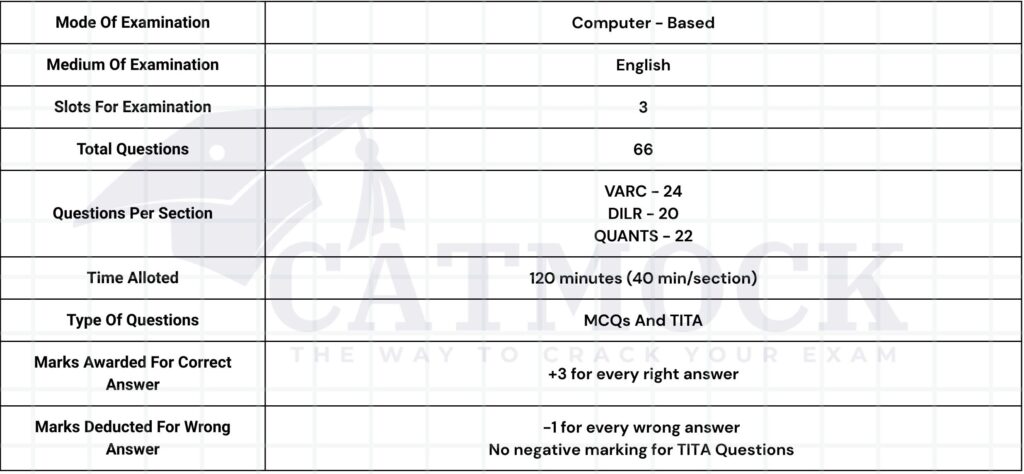
Because of this stability, CAT 2026 is expected to follow a similar format. The exam is conducted in a computer-based mode and includes three sections. Each section measures a different skill required for management education.
The CAT exam contains three sections that must be attempted in a fixed sequence. Candidates cannot switch between sections during the test. As a result, section-wise time management becomes extremely important. The sections include Verbal Ability and Reading Comprehension (VARC), Data Interpretation and Logical Reasoning (DILR), and Quantitative Aptitude (QA).
A separate time limit applies to every section. Candidates cannot transfer unused time from one section to another. Therefore, aspirants should maintain a balanced preparation strategy. Consistent performance across all three sections is necessary to achieve a high CAT percentile.
Two types of questions appear in the CAT exam. These include Multiple Choice Questions (MCQs) and Type-In-The-Answer (TITA) questions. MCQs carry negative marking for incorrect answers, while TITA questions do not have negative marking. Because of this structure, candidates must attempt questions strategically.
In simple terms, success in CAT does not depend on solving every question. Instead, it depends on selecting the right questions and solving them accurately within the time limit.
How to Start CAT 2026 Preparation
Preparation for the CAT 2026 exam is not only about books, coaching, or mock tests. It is also about understanding your current position as an aspirant. Candidates who are attempting the CAT exam are highly diversified. Some are freshers who are attempting the exam and are new to the field of management education.
Some are repeat aspirants who are attempting the exam for the second time. Some are also working professionals who are attempting the exam while still in service. Although the exam is the same for everyone, preparation needs to be customized according to one’s current position as an aspirant.
Identify Your Initial Position
Candidates who are attempting the CAT exam are highly diversified. Because of this, preparation strategies also need to be diversified. Freshers who are attempting the exam for the first time need to be focused on building strong fundamentals. Repeat aspirants who are attempting the exam for the second time need to analyze their previous performance and work on improving it.
Assess Your Current Profile
To start with, you should give yourself a diagnostic test or section-wise practice. This will give you an idea of your strengths and weaknesses. At the same time, this will also give you an idea of your current level of performance in VARC, DILR, and QA. After understanding your profile, you can follow a more specific strategy for your preparation.
Get Acquainted with the Test and Syllabus
Before starting with your preparation, you should get to know what CAT actually tests. CAT tests your analytical ability, logical ability, and problem-solving skills. Rather than referring to a syllabus, you should refer to question patterns, concepts, and skills.
Emphasis on Developing Fundamentals Before Speed
Fundamentals are the key to a good performance in the CAT. The first focus should be on the accuracy of the concepts. Speed will automatically follow as you practice more.
Create a Realistic Study Plan
A realistic study plan is a must. The plan you create should be realistic and easy to follow every day. There should be time for learning, practicing, and revisions, as well as breaks in between. An unrealistic plan that cannot be followed is of no use.
Start Practicing Early
Start attempting questions as soon as you learn any topic or concept. Early practice will allow you to recognize different types of questions related to that topic. Early practice will also enhance your problem-solving skills, which will reflect in your confidence over time.
Make Use of Mock Tests as Learning Tools
You should make use of mock tests as learning tools, not just for evaluating performance. Take every mock test as an opportunity to learn from it. Analyze every mistake you make in each mock test, which will also enhance your performance.
Progress, Not Comparison
Avoid comparing yourself with other candidates who are preparing for the same exam as you. Everyone starts from different levels of preparation, and everyone learns at their own pace.
Importance of Previous Year Questions (PYQs) in CAT Preparation
Previous Year Questions (PYQs) are considered to be one of the best tools for the preparation of the CAT. However, the focus of the students is mostly on the new practice sets and mock tests. The previous year questions provide something more valuable than that. The previous year questions provide a glimpse of how the CAT examination actually frames the questions. The syllabus of the CAT is not fixed, and the level of the questions also changes every year.
PYQs Help You Tap into the Real CAT Mentality
PYQs are a reflection of the actual approach used in the CAT exam. Unlike regular practice sets, the questions here will give you an idea of the actual logic used in the past papers. By solving the questions here, you will be able to identify the patterns of VARC, DILR, and QA. Hence, the approach to the preparation will be much closer to the actual exam.
They Help You Understand What Topics Really Matter
PYQs help you identify high-weightage topics. Rather than preparing all topics equally, you get a sense of where to prepare more. This is a huge time-saver and makes your preparation much more efficient.
PYQs Improve Conceptual Knowledge, Not Just Practice
PYQs are not just about practicing more questions but about practicing them correctly. They assess your skills in applying concepts to different scenarios. Practicing them helps in improving conceptual knowledge and laying a strong foundation.
They Train You to Make Smart Question Selection
CAT is all about making the right question selection, not about attempting all of them. PYQs train you to select the right questions to attempt and the right ones to leave.
PYQs Are the Most Effective Resource for Sectional Preparation
Every section in CAT is different. PYQs train you to understand how VARC sections test your comprehension, DILR sections test your logical skills, and QA sections test your application skills. This enables you to prepare a strategy for every section.
They Fill the Gap Between Practice and Mocks
Students often find it difficult to move from practice questions to mocks. PYQs help you bridge this gap by exposing you to actual CAT questions, making it easier for you to handle mocks.
How to Use PYQs Effectively
The actual benefit of PYQs is derived from proper analysis. It is essential to analyze errors, alternative solutions, and better ways of solving problems. Going through PYQs again and again will help you perform better.
Common Mistakes While Preparing for CAT
Preparation for CAT needs more than hard work; it needs proper strategy. Every year, bright candidates fail to perform well not because of the lack of hard work but because of common strategic errors that go against their preparation. Awareness of these errors can help candidates correct their strategy, whether it is the first time or the second time they are appearing for CAT.
CAT as a Speed Test
Aspirants often think that the more questions they attempt, the better their score will be. But CAT favors intelligent decision-making over speed.
Lack of Strategy in Starting
Random attempts are made when there is no strategy in starting preparation. There is no direction in watching videos or attempting questions, and this results in confusion rather than clarity.
Neglecting Basics and Focusing on Difficult Questions
Candidates often tend to focus on difficult questions without developing strong basics. Although CAT questions seem difficult, they are normally based on basic concepts. Candidates with weak basics tend to perform erratically and lack confidence, especially in mocks.
Getting Hooked on Mock Scores
Candidates often tend to assess their preparation only in terms of mock scores. Low scores result in demotivation, while high scores result in overconfidence. The actual benefit of mocks is in learning from errors and developing strategies after each mock.
Missing Mock Analysis
Analyzing mocks that are taken without analysis is less effective. Mock analysis is useful in understanding weaknesses, working on time management, and optimizing question selection.
Missing One Section
Ignoring any section, such as VARC or DILR, may not be a good idea as CAT has sectional cut-offs. Even if the overall score is good, performance in any section can impact the final outcome.
Comparison with Others
Comparing oneself with others can be stressful and less focused. Every individual has a different speed and learning pattern, so it is more effective to monitor one’s own progress.
Missing Burnout and Mental Fatigue
Preparation without any breaks can cause burnout and decreased productivity.
Final Tips to Stay Consistent and Avoid Burnout
Consistency is the key to success in CAT preparation. Intelligence, access to quality resources, and even time are less important than the ability to remain consistent without burning out. Many candidates begin well but find it difficult to sustain the momentum over a period of months in their preparation. Preventing burnout is not about preparing less; it is about preparing effectively and efficiently.
Focus on Systems, Not Motivation
Motivation is a temporary high, but systems help you stay consistent. Create a simple system: solve a few problems, learn concepts, or read a book every day. Small steps every day keep the momentum without any mental stress.
Set Weekly Goals, Not Just Daily Targets
Daily goals may not work because of some unforeseen events, causing stress. Weekly goals provide flexibility while keeping you on track, especially for working professionals and repeaters.
Embrace Plateaus as a Part of the Process
Each and every CAT aspirant faces periods of stagnation in scores despite hard work. Plateaus are a natural part of the process and do not represent failure. Rather than panicking or making impulsive changes to strategy, these periods can be utilized to work on basics, PYQs, and mocks in a more in-depth manner. CAT preparation is rarely linear.
Vary Study Intensity
Studying at maximum intensity every day causes burnout. Alternate between intense and light days of study: concept learning, practice, revision, or in-depth analysis of mocks.
Avoid Overexposure to CAT Content
Overconsumption of strategy videos or topper content can lead to anxiety. Prioritize implementation over excessive learning. It’s quality practice that matters, not the amount of content.
Conclusion: CAT 2026 Is a Strategy Game, Not a Speed Test
CAT 2026 is not meant to favor those who prepare for the longest or solve problems at the fastest pace—it favors those who think clearly, plan astutely, and perform calmly under pressure. Every year, the CAT exam demonstrates that success is less about trying to solve every problem and more about selecting the right ones. Whether you are a fresher, an aspirant who has attempted CAT before, or someone preparing for CAT while working, the key is the same: CAT favors decision-making over speed.
A good CAT preparation strategy is based on understanding the CAT pattern, mastering the basics, learning from previous year papers, and using mock tests as tools for improvement, not as a measure of performance. It demands that aspirants learn to accept limitations, resist the temptation to panic, and leverage their strengths. The capacity to leave questions blank, allocate time effectively, and remain calm under pressure often distinguishes top performers from the rest.
CAT 2026 also requires patience. The pace of progress may seem slow, mock scores may keep fluctuating, and doubts about oneself may creep in, but these are only stages of the process, not indicators of failure. It is the people who believe in their process, work on their approach, and remain consistent over a period of months who perform well on the day of the exam.
At the end of the day, CAT is more about how well you can adapt than about how quickly you can calculate or how many questions you can attempt. If you approach your preparation in that manner, CAT 2026 will no longer be a daunting task but a doable challenge that will reward you for your clarity, discipline, and smart work.