

Let’s be honest — most CAT 2026 aspirants start strong in January, hit a wall by June, and panic-prep in October. If you’re reading this now, you’re already ahead of that curve. This guide is not another generic listicle. It’s a real, structured playbook written from the trenches — the kind of guide you’d want from a mentor who cracked CAT, not from someone who just read about it.
Let’s get into it.
- Understand the CAT 2026 Exam Pattern First
- Build a Realistic Study Timeline for CAT 2026
- VARC: Read More, Think Smarter
- DILR: The Game-Changer Section
- QA: Build Concepts, Not Just Speed
- Why Mock Tests Make or Break Your CAT Rank
- Why CATMock is Your Unfair Advantage in CAT 2026
- Free Resources to Kickstart Your CAT 2026 Prep
- When to Invest in a Paid Bundle — and Why It’s Worth It
- Final Words: The CAT 2026 Mindset That Actually Wins
Understand the CAT 2026 Exam Pattern First
Before you touch a practice set, know exactly what you’re walking into. CAT 2026 is a 2-hour exam with three sections: Verbal Ability & Reading Comprehension (VARC), Data Interpretation & Logical Reasoning (DILR), and Quantitative Ability (QA). Each section gets 40 minutes and you cannot switch between them.
The scoring is +3 for correct MCQs, -1 for wrong MCQs, and 0 penalty for Type-In-The-Answer (TITA) questions. Non-MCQs are your best friends — learn to identify and attempt them strategically.
Mentor tip: IIM Calcutta, IIM Lucknow, and IIM Kozhikode are the 2026 convening IIMs. Study their past year question sets closely — difficulty and style often align with the convenor’s preferences.
Build a Realistic Study Timeline for CAT 2026
CAT is announced around July–August with the exam in late November. You have roughly 7–8 months from now if you’re starting in April — which is actually a great time to start. Divide your prep into three clear phases:
- Apr – Jul: Concept Building
Master fundamentals across all three sections. No pressure on speed — focus on understanding.
- Aug – Sep: Sectional Practice & Speed
Daily practice sets, sectional mocks, time management refinement.
- Oct – Nov: Full Mocks & Revision
One full mock per week minimum. Deep analysis after every test. No new topics.
Golden rule: 3 hours of daily prep on weekdays + 5–6 hours on weekends is more than enough — if those hours are focused and well-analyzed.
VARC: Read More, Think Smarter
VARC is the section that trips up even strong students. The RCs in CAT are dense — philosophy, economics, literary criticism, science journalism. You cannot crack VARC by memorising vocabulary lists alone. You need reading speed and comprehension depth, together.
Start reading one editorial and one long-form article daily — from sources like The Hindu, Aeon, or Nautilus. For Verbal Ability (VA), parajumbles and odd-sentence questions are heavily TITA-based, so practice them without fear of negative marking.
Strategy: In VARC, attempt RC passages first — pick 3 of 4 passages wisely. Leave the passage with dense technical jargon for last or skip entirely. Use the saved time on high-accuracy VA TITA questions.
DILR: The Game-Changer Section
DILR has separated 95 percentilers from 99+ percentilers in recent years. It tests your ability to think logically under time pressure — there’s no formula-based shortcut here. The sets are either straightforward or brutally layered, and picking the right sets in the exam is half the battle.
Practise a minimum of 2 DILR sets daily. Focus on set-selection strategy — spend the first 3 minutes scanning all sets and committing to the 2–3 most solvable. A partially solved easy set scores more than a fully attempted hard set that eats 25 minutes.
CATMock’s DILR practice sets are crafted to mirror actual CAT difficulty — not inflated, not watered down. Visit catmock.com and use the Daily DILR Practice feature to train your set-selection instinct daily.
QA: Build Concepts, Not Just Speed
QA intimidates non-engineers, but the truth is: CAT QA tests class 10 mathematics at a clever angle. Arithmetic, Algebra, Geometry, and Number Theory form the core. Most aspirants rush to shortcuts before their concepts are solid — that’s the trap.
Spend the first two months doing thorough concept revision — don’t skip basics like percentages, ratios, and triangles. Speed comes naturally once clarity is there. For engineers: do not take QA for granted — the questions are deceptively tricky.
- Arithmetic — 35%
- Algebra — 20%
- Geometry — 20%
- Number Theory — 15%
- Modern Maths — 10%
Free resource: CATMock’s YouTube channel publishes concept-first QA lecture videos at zero cost. Watch, pause, solve — don’t just passively consume.
Why Mock Tests Make or Break Your CAT Rank
Here’s something nobody tells you early enough: your percentile in CAT is determined less by what you know and more by how well you perform under pressure. Mock tests are the only tool that bridges this gap. They build exam temperament — the ability to stay calm when DILR sets look alien and VARC is eating your time.
Taking a mock without reviewing it thoroughly is like going to the gym without tracking your form. The analysis phase — understanding why you got a question wrong — is where the real score jumps happen. One well-analyzed mock is worth five casually attempted ones.
Target: Start with 1 mock per fortnight in Phase 1. Move to 1 per week in Phase 2. Hit 2 per week in the final 6 weeks before CAT.
Why CATMock is Your Unfair Advantage in CAT 2026
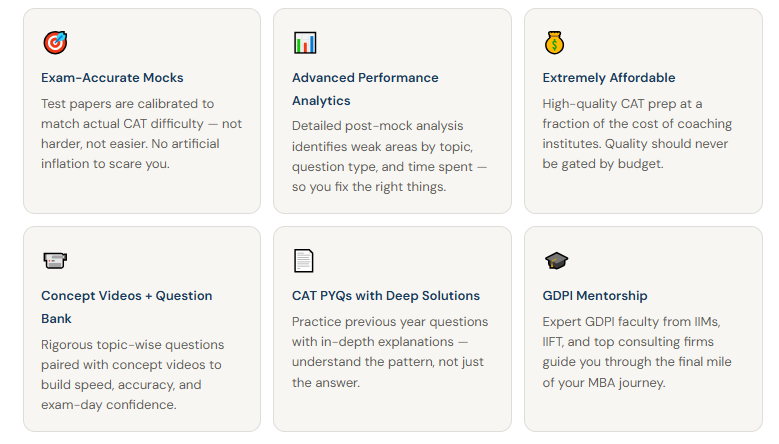
With 3,000+ students already trusting it, CATMock.com has been built by CAT experienced mentors with multiple 99.5+ percentile scores — people who genuinely know what the exam demands. Here’s what makes it different from every other platform out there:

Free Resources to Kickstart Your CAT 2026 Prep
You don’t need to spend a rupee to start. CATMock offers free mock tests to every new student — sign up at catmock.com and start with the free trial immediately. Beyond that, their YouTube channel has concept lecture videos across VARC, DILR, and QA that are genuinely useful — not watered-down previews.
Join the CATMock WhatsApp Community for daily practice questions, peer discussions, live session alerts, and mentor tips shared directly by the team. It’s the kind of accountability circle that keeps your prep consistent through the long, grinding months between April and November.
Free + Community = no excuse to not start today. Sign up free at catmock.com and join the WhatsApp community. The door is open — just walk in.
When to Invest in a Paid Bundle — and Why It’s Worth It
Free resources get you started. Paid prep gets you ahead of the competition. CATMock’s combo packages give you access to 25+ premium mock tests, full sectional test series, in-depth analytics, and concept resources — all in one affordable bundle. This is where serious aspirants separate themselves from casual ones.
Think of it this way: thousands of students are using the same free materials. The ones who invest in structured, analysed mock practice — and commit to reviewing every test seriously — are the ones who consistently break into 99+ percentile territory. CATMock’s paid bundles are priced to be accessible, not exploitative.
When to buy: Ideally by April, before your intensive mock phase begins. Early access = more tests = more data = sharper exam strategy. Check the latest combo pricing at catmock.com/combos.
Final Words: The CAT 2026 Mindset That Actually Wins
CAT is a marathon, not a sprint. The aspirants who make it to the IIMs aren’t necessarily the smartest people in the room — they’re the most consistent, the most honest about their weaknesses, and the most disciplined about their analysis. They don’t skip mock reviews. They don’t avoid their weak sections. They show up every day, even on the days it doesn’t feel like it’s working.
Use the free resources. Join the community. Take the mocks. Review them seriously. And when you’re ready to go all-in — invest in the tools that give you a structured edge. You’ve got 7+ months. That’s more than enough time to transform your percentile.