

CAT mocks are the backbone of smart CAT 2026 preparation because they train you for the real 120‑minute, three‑section, time‑bound exam environment better than any book or PDF can. When you combine free online tests with structured analysis, a clear timeline and a focused platform like Cat Mock, you turn practice into predictable percentile growth instead of random trial and error.
CAT 2026 in Brief: Why Mocks Matter
Recent updates show CAT 2026 will continue with three sections – VARC, DILR and QA – 40 minutes each, total duration 120 minutes, with no option to switch sections once the timer starts. There are around 68 questions across sections, with a mix of MCQs and TITA (type‑in‑the‑answer) questions and negative marking on MCQs.
This structure means:
- You must build the stamina to focus intensely for two hours.
- You need section‑specific strategies because you can’t compensate for a bad section later.
- Time management can’t be learned theoretically; it must be practised in a simulated environment.
Free CAT mocks for 2026 on platforms like CAT MOCK are designed to mirror this pattern as closely as possible, so every test feels like a dress rehearsal for the real exam.
Why Full‑Length Online Mocks Are Non‑Negotiable
Expert blogs and coaching platforms repeat one message: regular mock tests are essential for a high CAT percentile.
Key benefits of full‑length online mocks:
- Pattern familiarity: You learn question distribution, section order, and interface behaviour.
- Realistic time pressure: A strict 40‑minute sectional timer conditions your brain to move faster.
- Performance diagnosis: Analytics show strengths and weaknesses by section and topic.
- Question exposure: You see multiple RC types, tricky DILR sets and varied Quant styles.
- Confidence building: Giving many mocks reduces fear and makes the actual exam feel routine.
Cat Mock builds on these advantages by offering free online tests plus data‑driven insights that turn each attempt into a learning cycle, not just a score.
What Mocks Train That Books Cannot
How Many CAT Mocks Do You Need in 2026?
Different sources suggest ranges rather than a fixed number, but they converge on one truth: you need more than just a few.
Indicative range (assuming quality mocks with analysis):
- For 85–95 percentile: 15–20 full‑length mocks.
- For 95–98 percentile: 20–30 mocks.
- For 98–99+ percentile: 30–40+ mocks with rigorous review.
CATMOCK’s free and paid series can be planned to hit these ranges over 5–7 months, mixing proctored mocks, unproctored mocks and sectional tests for consistent practice.
CAT 2026 Timeline & When to Start Mocks
Mock‑test pages for CAT 2026 outline a typical exam calendar:
- CAT 2026 notification: July 2026 (tentative).
- Registration: August–September 2026.
- Exam date: November 2026.
- Result: First week of January 2027 (expected).
You shouldn’t wait for notification to begin mocks. A sensible approach:
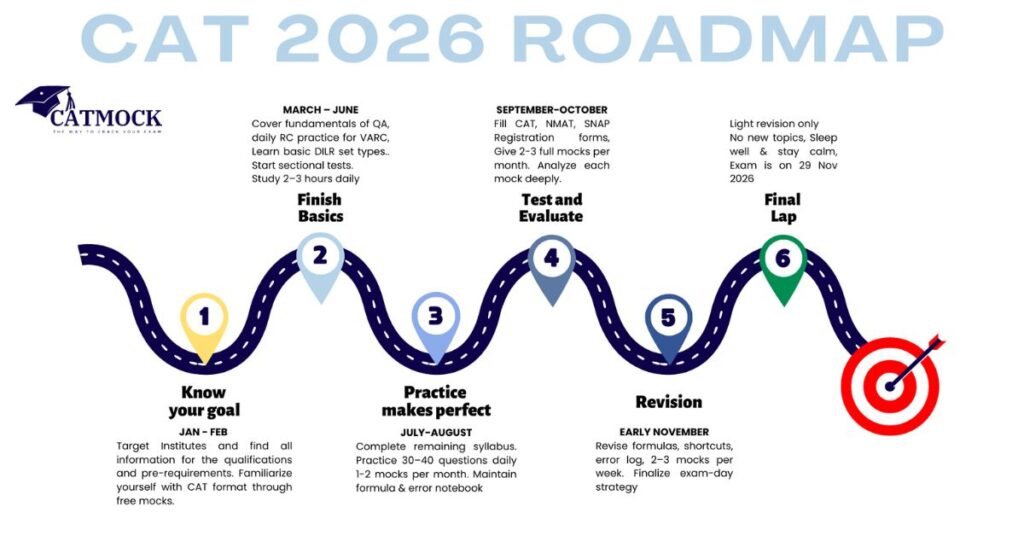
- Start light mocks 7–8 months before the exam.
- Ramp up to 2–3 mocks per week in the last 2–3 months.
Month‑Wise Mock Plan with CAT MOCK
CAT MOCK can position itself as a year‑round testing companion, not just a last‑month rescue tool.
Section‑Wise Impact of Mocks
VARC – Getting Comfortable with RC & VA Mix
Latest pattern summaries show VARC focusing heavily on Reading Comprehension, with 4–5 passages and additional Verbal Ability questions like para summary, para jumbles and odd‑one‑out.
Mocks help you:
- Practise reading unfamiliar, dense passages under time pressure.
- Compare accuracy on RC vs VA, and adjust focus accordingly.
- Experiment with strategies: RC‑first vs VA‑first, skimming vs detailed reading.
CATMOCK should provide:
- RC sets from diverse domains (science, philosophy, business, history).
- A balanced mix of para‑based questions.
- Post‑test analysis showing which passage type and question type you struggle with.
DILR – Learning Set Selection
DILR often decides your overall percentile because many aspirants either panic or waste time on the wrong sets.
Mocks train you to:
- Scan all sets in the first few minutes.
- Judge difficulty and choose 3–4 solvable sets instead of attacking everything.
- Build comfort with charts, tables, puzzles, games and logical networks.
CATMOCK can tag sets by pattern (bar graphs, tournaments, arrangements, etc.) and show you:
- Which set types you solve fastest.
- Where you over‑invest time without returns.
QA – Balancing Attempts & Accuracy
CAT 2026 QA is again expected to emphasise Arithmetic and Algebra, with supporting topics like Geometry, Modern Math, and Number System.
Mocks help you see:
- Your natural accuracy level at different attempt counts.
- Topics that consistently pull your score down.
- Whether you should aim for more attempts with moderate difficulty or fewer, high‑accuracy attempts.
CATMOCK’s topic‑wise analytics can plot your performance across:
- Arithmetic (Percentages, TSD, Averages, etc.).
- Algebra (Equations, Functions, Inequalities).
- Geometry & Mensuration.
- Modern Math (P&C, Probability, Progressions).
CATMOCK: Free Online Tests with Smart Analytics
Various platforms show what a good online mock ecosystem looks like: full‑length tests, instant scorecards, and deep analytics. CAT MOCK can adopt and highlight these best practices in one place.
Core features you can promote for CAT MOCK:
- Free full‑length CAT 2025–26 mocks following the latest pattern.
- Instant results – raw score, scaled score simulation and approximate percentile bands.
- AI‑style analytics – accuracy, time taken per question, section and topic.
- Question‑wise solutions and shortcuts, not just final answers.
- Sectional and mini‑mocks for focused practice when you can’t sit for 2 hours.
How CATMOCK Adds Value to Each Mock
With this, every free test on Cat Mock becomes a personal feedback session – you know exactly what to fix before the next attempt.
Ideal Mock Routine with CATMOCK
Before the Mock
- Pick a fixed slot (e.g., 9–11 AM on weekends) to match likely CAT timings.
- Decide a specific focus for the test – e.g., “today I’ll try a conservative attempt strategy in QA with 90% accuracy.”
- Ensure a quiet environment and stable internet.
During the Mock
- VARC: Decide how many RCs you’ll attempt and how much time to give each passage.
- DILR: Spend the first 5–7 minutes scanning all sets, then pick the most approachable ones.
- QA: Use a two‑round strategy – easy questions first, then come back for moderate ones.
CATMOCK’s interface should support easy navigation, flagging, and revisiting questions within a section, just like the real exam.
After the Mock – The Real Improvement Zone
According to mock‑strategy experts, post‑test analysis is where your percentile is built.
Use CATMOCK’s analytics to:
- List all silly mistakes where you knew the concept but slipped under time pressure.
- Identify time‑sink questions – ones that consumed too many minutes.
- Check sectional balance: Are you overspending time in VARC and rushing QA?
- Note topic‑wise weaknesses and create a micro‑plan for the coming week.
Keep a simple mock diary with: date, score, percentiles, main errors, and strategy changes for the next test.
Integrating CATMOCK with Your Study Plan
Mocks should drive what you study next, not just sit alongside your preparation. A weekly loop might look like:
- Take a full CAT MOCK test on Sunday.
- Analyse it on Sunday evening and Monday using the analytics dashboard.
- Identify 2–3 topics per section that caused trouble.
- From Tuesday to Friday, focus your study on these topics (concepts + sectional tests).
- On Saturday, do light revision or a mini‑mock.
- Repeat the full mock next Sunday.
This creates a feedback‑driven system that naturally improves scores over time.
Dealing with Common Mock‑Related Problems
“My marks are low; should I stop mocks?”
Low scores at the start are normal; mocks are diagnostic, not judgement. Use Cat Mock to see whether the problem is:
- Low attempts but high accuracy – you need speed.
- High attempts but low accuracy – you need selection discipline.
- One particularly weak section dragging you down.
Adjust your next mock’s goal accordingly rather than quitting tests.
“I never finish sections on time.”
Time issues usually come from:
- Over‑reading RCs, not scanning questions first.
- Getting stuck in one DILR set for too long.
- Trying to solve every QA question instead of picking your battles.
Use time analytics on Cat Mock to pinpoint where minutes are leaking and practice specific fixes (e.g., maximum 10 minutes per DILR set before moving on).
“Mocks make me anxious.”
The solution is more controlled exposure:
- Start with mini‑mocks or sectional tests on CAT MOCK.
- Gradually move to full‑length tests as your comfort grows.
- Remember: the aim is to make the final CAT feel like “just another mock.”
Quick Reference: CAT Mocks for Preparation in 2026
| Question | Short Answer |
|---|
| Question | Short Answer |
|---|---|
| When to start CAT 2026 mocks? | 7–8 months before exam; ramp up close to CAT. |
| How many mocks are enough? | 20–30 for serious prep; 30–40+ for 98–99+%ile. |
| Why use online mocks like Cat Mock? | Real exam pattern, instant results, smart analytics. |
| Should I analyse every mock? | Yes – analysis is more important than the test. |
| Are free mocks sufficient? | Great to start; add series later for full coverage. |
Using CAT mocks for preparation in 2026 is not just about taking “free tests”; it’s about using a platform like Cat Mock to repeatedly simulate the real exam, get clear feedback, and refine your strategy until stepping into the CAT hall feels like sitting down for one more familiar mock.
You May Also like : Free Mock Test Online, Mock Test Online