
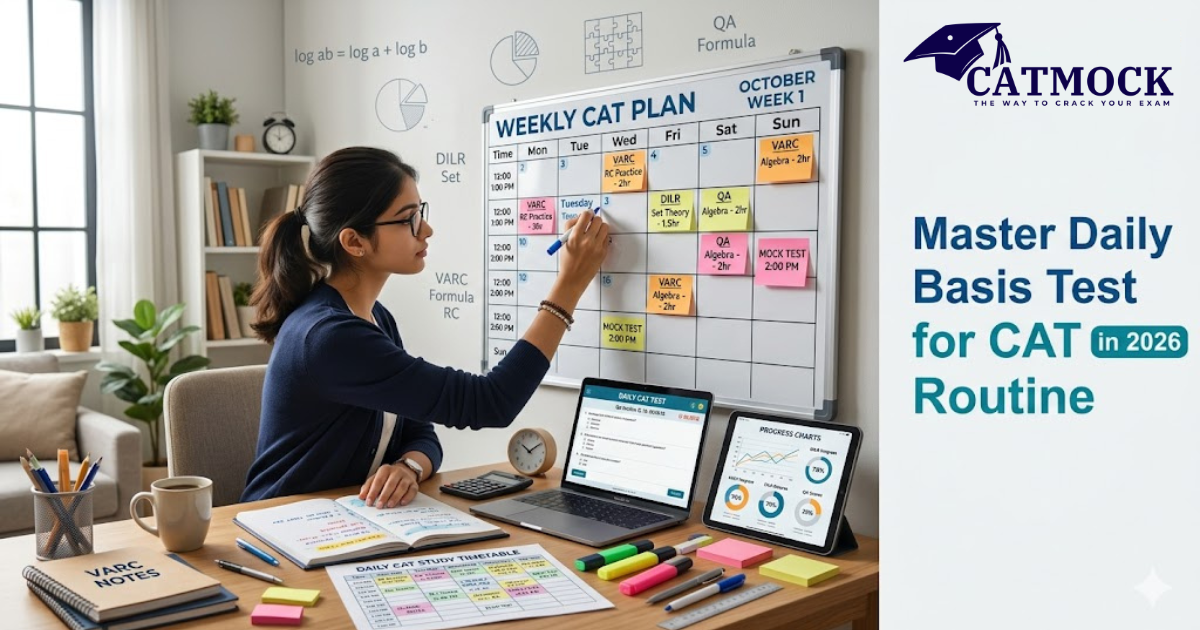
A daily basis test for CAT is a short, structured practice test that you take every day to build consistency, accuracy and speed in all three CAT sections – VARC, DILR and Quant. Instead of random questions, you follow a planned set of mini tests so that your preparation becomes measurable and focused.
Why Daily Testing Matters for CAT 2026
CAT 2026 is expected to follow the recent pattern with three timed sections and a mix of MCQ and non-MCQ questions, so regular testing is the best way to stay exam-ready. Daily tests help you avoid long gaps in practice, reduce exam fear and make you comfortable with time pressure.
How CATMock Fits into your 2026 Routine
CATMock is a dedicated platform for free and premium CAT mock tests, sectional tests and practice resources designed for CAT 2026 aspirants. It offers detailed analysis, performance tracking and mobile-friendly access so you can practice and review your daily tests anytime.
Key CATMock Features
- Full-length CAT 2026-style mocks with instant performance breakdown.
- Sectional and topic-wise tests for VARC, DILR and Quant to use as daily mini tests.
- Analytics dashboard to track accuracy, speed and topic-wise strengths/weaknesses.
Daily basis test vs Full-length mock
Daily mini tests and full-length mocks serve different but complementary purposes in your CAT 2026 preparation.
Role of Daily Tests vs Mocks
| Aspect | Daily basis test | Full-length CAT mock |
| Duration | 20–40 minutes (short sets) | About 2 hours as per CAT pattern |
| Focus | Single topic or one section at a time | Complete paper with all three sections |
| Frequency | Daily or 5–6 days a week | Weekly or bi-weekly |
| Goal | Build fundamentals, accuracy, habits | Build exam stamina and strategy |
Ideal Daily Routine for a CAT 2026 Aspirant
An effective 2026 routine should give daily touch to VARC, DILR and Quant without burning you out. You can use CATMock’s mocks, sectional tests and practice sets to fill these daily slots.
Sample Weekday Schedule
| Time | Activity | Duration | Resource idea |
| Morning | 1 mini VARC test (RC + VA mix) | 30–40 min | CATMock VARC sectional/topic test |
| Afternoon | 1 DILR set + analysis | 30–45 min | CATMock DILR practice set |
| Evening | 8–10 Quant questions from one topic | 40–50 min | CATMock Quant topic test |
| Night | Review mistakes & update notes | 20–30 min | CATMock analytics + your error log |
On weekends, replace one or two daily mini sessions with a full-length CATMock test and deep analysis.
Section-wise Daily Basis Test Strategy
Breaking your daily routine by section helps you see improvement more clearly.
VARC Daily Tests
Recent CAT papers give high weight to Reading Comprehension, supported by para-summary, odd sentence and jumbled paragraph questions. Daily targeted VARC tests improve reading speed, comprehension and verbal accuracy.
Suggested daily VARC routine:
- One short RC passage with 4–5 questions under a strict time limit.
- Two to three VA questions (para-summary, odd sentence, para-jumble).
- Quick review of every incorrect answer and note why your chosen option was wrong.
DILR Daily Tests
DILR is considered one of the most unpredictable sections, so daily exposure to different types of sets is very useful. Short but focused DILR practice helps you improve set selection and logical thinking.
DILR daily routine:
- One puzzle/arrangement or games & tournaments set every day.
- One pure DI set (tables, charts, graphs) on alternate days.
- After each set, record how you chose the set, where you got stuck and what you would do differently.
Quant Daily Tests
Quant covers arithmetic, algebra, geometry, number systems and modern math, so a daily topic-wise micro test works best. Regular small tests build both formula recall and application speed.
Quant daily plan:
- 8–10 questions from a single topic such as ratios, averages or quadratic equations.
- Alternate between easy–medium and medium–high difficulty day by day.
- For each question, think about a shorter or smarter method and note it for revision.
CAT 2026 Timeline and Planning
Planning your Daily Basis Test for Cat in 2026 routine around the expected CAT schedule keeps your preparation realistic.
Expected CAT 2026 Timeline
| Milestone | Tentative period |
| Official notification | July 2026 |
| Registration window | August–September 2026 |
| Exam date | Around November 2026 |
| Result | Early January 2027 |
From March to July, focus on fundamentals and light daily tests; from August onwards, increase the weight of mocks and advanced sectional tests.
Three-Phase Daily Test Roadmap
Dividing your year into phases makes it easier to know what kind of daily test you should be taking at each stage.
Phase 1: Foundation (till around June)
- Aim: Cover the syllabus and build basic understanding.
- Daily tests: Very short topic-wise quizzes in each section, 20–30 minutes.
- Mocks: One full-length mock every 2–3 weeks simply to get familiar with the pattern.
Phase 2: Consolidation (July–September)
- Aim: Mix topics and build section-wise strength.
- Daily tests: Sectional tests (only VARC, only DILR, only Quant) of 30–40 minutes.
- Mocks: One full-length mock every week, with detailed analysis after each attempt.
Phase 3: Final lap (October–Exam)
- Aim: Fine-tune strategy, stamina and speed.
- Daily tests: Mixed mini tests plus revision sets made from your past mistakes.
- Mocks: Two mocks per week, still with proper review rather than just taking more tests.
What to Track in your Daily Basis Test for Cat in 2026
Without tracking your numbers, daily tests become random practice. A simple tracking system plus CATMock’s analytics can show exactly where you are improving.
Important Daily Metrics
| Metric | Why it matters | How to track |
| Accuracy | Shows concept clarity and decision making | % correct in each mini test |
| Time per question | Reflects speed and efficiency | Total time ÷ questions attempted |
| Topic-wise score | Reveals strong and weak areas | Sectional breakdown in analytics |
| Error type | Tells you what to fix (concept or carelessness) | Label each mistake in an error log |
Using CATMock Combos in a Daily Routine
CATMock offers preparation combos that bundle full mocks, sectional tests and analytics to support a structured daily routine. These packs are meant to give you enough high-quality tests so you do not have to search for new material every day.
Typical combo benefits:
- Multiple full-length CAT-pattern mocks for weekly simulation.
- A large number of sectional and topic-wise tests to plug into your daily plan.
- Performance analytics that highlight your improvement and problem areas over time.
Common Daily Test Mistakes to Avoid
Many students “take tests daily” but still do not see improvement because they repeat the same mistakes.
Avoid these errors:
- Focusing only on number of questions instead of quality analysis.
- Ignoring weak areas and always practising favourite topics.
- Never increasing difficulty level and staying in a comfort zone.
- Not maintaining any error log, so the same mistake appears again in mocks.
Combining Daily Tests with PYQs
Previous Year Questions (PYQs) give you the most authentic idea of CAT-level questions, while daily tests build routine. Mixing both into your weekly plan makes your practice more exam-aligned.
How to use PYQs:
- Twice a week, create a 30–40 minute mini test only from PYQs of one section.
- Use your analysis to update which question types you must include more often in daily tests.
Building Mental Stamina and Exam Temperament
Daily time-bound tests slowly train your brain to stay focused and calm under pressure. This habit directly helps when you sit for a two-hour CAT 2026 paper.
Good habits for stamina:
- Always use a timer, even for small sets or 5–10 question drills.
- After each test, spend a few minutes reflecting on stress, panic or loss of focus and how you handled it.
Personalising your Daily Basis Test Routine
Every CAT 2026 aspirant has a different background and starting level, so your ideal daily routine must be customised. CATMock’s performance insights and your own error log give you the data to do this.
Examples:
- If Quant is relatively weak, allocate more daily questions to Quant and slightly reduce VARC/DILR for a few weeks.
- If DILR set selection is a problem, design micro-drills where you only practise choosing the right set quickly by scanning multiple sets.
- If VARC is slow, focus on timed short passages and gradually increase passage length and difficulty.
Why Master Daily Basis Test for Cat in 2026 Routine | CatMock Matters
A well-designed daily basis test routine turns your CAT 2026 preparation from random study into a data-driven system. With CATMock mocks, sectional tests, analytics and flexible access, you get everything needed to build and master that routine for a serious 95–99+ percentile attempt.
Conclusion
Mastering a daily basis test routine for CAT 2026 is not about taking endless random questions; it is about following a structured, data-driven practice plan that gradually upgrades your accuracy, speed and confidence. When you combine smart daily mini tests with regular full-length mocks, deep analysis and a clear error log, every single day starts pushing your percentile closer to your target range.
CATMock gives you the exact ecosystem to make this happen – realistic CAT 2026-style mocks, sectional and topic-wise tests, detailed performance reports and flexible practice options you can plug directly into your daily schedule. If you stay consistent with this routine for the coming months and refine it based on your analytics, you will walk into the CAT 2026 exam with a proven system rather than last-minute guesswork.
You May Also like : Free Mock Test Online, Mock Test Online