

- What is NMAT?
- Why NMAT Matters for MBA Aspirants
- NMAT Exam Pattern and Structure
- The Three Sections of NMAT Explained
- How NMAT Scoring Works
- Eligibility and Exam Details
- NMAT’s Unique Three-Attempt Policy
- Career Impact of a Strong NMAT Score
- Top Colleges Accepting NMAT Scores
- How to Prepare for NMAT
- 15 Frequently Asked Questions (FAQs)
What is NMAT?
The Exam at a Glance
NMAT by GMAC stands as one of India’s most flexible and widely accepted MBA entrance exams. GMAC — the Graduate Management Admission Council — administers this exam every year. Furthermore, over 60 top management institutions across India accept NMAT scores for their MBA and PGDM programmes.
The exam primarily serves as the gateway to NMIMS (Narsee Monjee Institute of Management Studies), one of India’s most respected business schools. Additionally, NMAT scores work for programmes in business analytics, banking, insurance, and healthcare management. Consequently, one strong NMAT score opens doors across a remarkably diverse set of specialisations.
A Brief History of NMAT
NMIMS conducted NMAT as its own private exam for several decades before GMAC took over its administration in 2015. Under GMAC, the exam adopted international standards, a computerised adaptive format, and a global testing infrastructure. Moreover, this shift brought NMAT’s quality and credibility on par with globally recognised management tests.
Today, NMAT runs across a 75-day testing window from October to December every year. Furthermore, candidates enjoy the unique flexibility of attempting the exam up to three times in the same cycle. Therefore, NMAT gives aspirants more second chances than any other major MBA entrance exam in India.

Why NMAT Matters for MBA Aspirants
The Gateway to NMIMS and Premier B-Schools
NMAT serves as the primary entry route to NMIMS, which ranks among India’s top five private business schools. NMIMS’s MBA programmes in Mumbai, Bengaluru, and Hyderabad consistently deliver strong placement outcomes. Furthermore, the school’s average CTC regularly exceeds ₹20 LPA, with top offers crossing ₹50 LPA at the Mumbai campus.
Beyond NMIMS, prestigious schools like SPJIMR, SBM NMIMS, Shiv Nadar, and VIT Business School also accept NMAT scores. Additionally, many niche management programmes in banking, insurance, and healthcare use NMAT as their primary selection filter. Therefore, a single strong NMAT score casts a wide net across both general and specialised MBA programmes.
NMAT’s Flexible Testing Model
Unlike CAT or XAT, NMAT allows candidates to choose their own exam date within a 75-day window. This flexibility lets every aspirant pick a date that suits their preparation schedule. Consequently, candidates avoid the anxiety of a single fixed date that determines everything.
Furthermore, the three-attempt policy means candidates can retake the exam twice more if their first score falls short. Each retake attempt counts separately, and institutions receive the best score across all attempts. Therefore, NMAT genuinely rewards persistent, strategic candidates who improve with each attempt.
Why NMAT Stands Apart from Other MBA Exams
NMAT carries no negative marking, which fundamentally changes the test-taking strategy every candidate should adopt. Consequently, attempting every single question becomes a smart and valid approach. Moreover, this feature reduces exam anxiety and lets candidates focus purely on speed and accuracy rather than risk management.
Additionally, NMAT’s section-order flexibility lets candidates choose which section to tackle first. This design rewards candidates who understand their own strengths and plan accordingly. Therefore, NMAT consistently favours well-prepared, self-aware aspirants who take a structured and strategic approach to the exam.
NMAT Exam Pattern and Structure
Overall Format
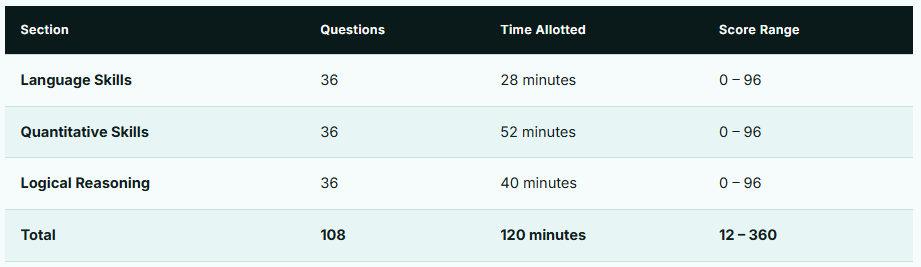
NMAT runs as a computer-based test lasting exactly two hours across three sections. It consists of 108 questions in total, with each section carrying a fixed number of questions and a fixed time limit. Furthermore, candidates cannot carry over unused time from one section to another, so managing each section’s clock independently is critical.
The exam uses a linear format — not computer-adaptive like GMAT — which means question difficulty stays consistent throughout. Additionally, there is no negative marking for wrong answers, making NMAT one of the most forgiving major MBA exams. Consequently, every candidate should attempt all 108 questions without hesitation.
NMAT Exam Pattern at a Glance
Marking Scheme
Each correct answer earns one raw mark, which the scoring algorithm then scales to the section’s score range. No negative marking applies for wrong or unanswered questions. Furthermore, NMAT uses scaled scoring, so each attempt’s result stays comparable across different exam windows.
Additionally, candidates can customise the order in which they attempt the three sections at the start of the exam. This section-ordering choice gives well-prepared candidates a meaningful tactical advantage. Therefore, deciding the section order in advance — based on personal strengths — forms a key part of effective NMAT strategy.
The Three Sections of NMAT Explained
Language Skills
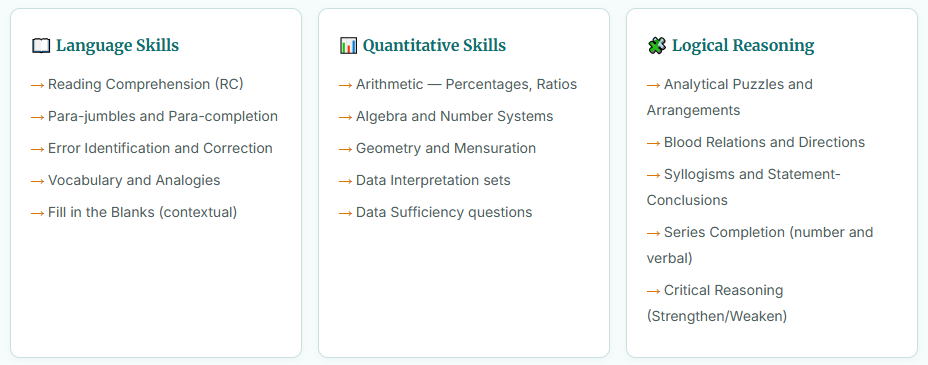
The Language Skills section tests reading speed, vocabulary depth, and grammatical accuracy across 36 questions in just 28 minutes. This tight time limit makes it the most time-pressured section in the entire exam. Furthermore, Reading Comprehension passages here tend to be moderate in length but require fast and accurate comprehension.
Vocabulary-based questions on analogies, antonyms, and synonyms appear regularly and reward consistent vocabulary building. Additionally, para-jumble and fill-in-the-blank questions test contextual language understanding rather than rote rules. Therefore, daily reading of quality English content — editorials, essays, and business articles — forms the most effective preparation for this section.
Quantitative Skills
The Quantitative Skills section covers arithmetic, algebra, geometry, data interpretation, and data sufficiency across 36 questions in 52 minutes. This section gives the most time per question among the three, making it the best opportunity for candidates to maximise their score. Furthermore, the difficulty level stays moderate, focusing on application rather than extreme complexity.
Data Interpretation sets require candidates to read graphs, tables, and charts quickly and accurately. Additionally, Data Sufficiency questions test whether a given problem is solvable with stated conditions — without requiring the actual answer. Consequently, building both calculation speed and logical discipline across all topic areas ensures strong performance here.
Logical Reasoning
The Logical Reasoning section challenges candidates with 36 questions across puzzles, arrangements, syllogisms, and critical reasoning in 40 minutes. This section heavily rewards systematic thinking and a clear mental framework for tackling each question type. Moreover, arrangement and analytical puzzle sets often carry three to four questions each, making each set a high-value target.
Critical reasoning questions here ask candidates to identify assumptions, strengthen arguments, or draw conclusions from short passages. Furthermore, number and letter series questions test pattern recognition and analytical speed. Therefore, practising a wide variety of question types consistently — not just the familiar ones — is the most reliable path to a high Logical Reasoning score.
How NMAT Scoring Works
Scaled Scoring System
NMAT reports scores on a scale of 12 to 360, with each of the three sections scoring between 0 and 96. The exam applies a scaling algorithm to ensure that scores across different test windows remain comparable and fair. Furthermore, this scaled scoring means a candidate’s raw score translates into a standardised total that institutions can trust regardless of the exam date.
Each section score matters individually because most institutions set section-wise cutoffs alongside an overall cutoff. Consequently, performing strongly in two sections but poorly in one can still result in disqualification at the shortlisting stage. Therefore, balanced preparation across all three sections consistently delivers better admission outcomes than specialising in just one or two.
Score Benchmarks by Institution

Score Validity and Best-Score Policy
Best Score Forwarded: NMAT sends the best score across all valid attempts directly to every institution a candidate selects. The score remains valid for one year from the date of the exam. Furthermore, candidates must select the institutions they want to receive their scores during or after each attempt, with a limited number of free score sends included in the registration fee.
Eligibility and Exam Details
Who Can Register for NMAT?
Any candidate holding a graduation degree of at least three years from a recognised university can register for NMAT. Final-year students may also apply provisionally, subject to fulfilling the degree requirement before admission. Furthermore, no minimum aggregate percentage applies for NMAT registration itself.
There is no upper age limit for appearing in NMAT, making it accessible to both fresh graduates and experienced working professionals. Additionally, candidates can register for NMAT every year, as the three-attempt limit resets with each new exam cycle. Consequently, aspirants who miss their target score in one year can plan, prepare better, and retake the exam in the next cycle.
Key Registration and Exam Details
📋 NMAT Exam Details at a Glance
Registration: Opens in August each year at nmat.org.in (GMAC’s official NMAT portal). Exam Fee: Approximately ₹2,600 for the first attempt; ₹2,600 per rescheduling and ₹2,600 per retake. Exam Mode: Online computer-based test at authorised Pearson VUE test centres or at home. Testing Window: Approximately 75 days from October to December. Score Validity: One year from the exam date. Results: Scores release within 48 hours of each attempt.
NMAT’s Unique Three-Attempt Policy
How the Three-Attempt Policy Works
NMAT allows every candidate to take the exam up to three times within the same 75-day testing window. A mandatory gap of at least 15 days must separate each consecutive attempt. Furthermore, all three attempts draw from the same question pool but use different question sets, ensuring a fair and independent evaluation each time.
After each attempt, the best score across all valid sittings goes to institutions. Additionally, candidates decide which institutions receive their scores, giving them full control over their applications. Consequently, this policy lets aspirants use their first attempt as a real exam rehearsal and improve strategically with each subsequent try.
Smart Strategy for Multiple Attempts

Why This Policy Benefits Every Candidate
The three-attempt model dramatically reduces the high-stakes pressure that a single-date exam like CAT creates. Candidates who feel under-prepared on day one still have two more chances to deliver their best performance. Moreover, the psychological benefit of knowing a second attempt exists often helps candidates perform better even in their first sitting.
Furthermore, candidates who score well in their first attempt can choose not to retake, saving time and preparation energy for GD-PI readiness. Therefore, NMAT’s attempt policy actively rewards both first-time performers and persistent improvers in equal measure.
Career Impact of a Strong NMAT Score
Placements at NMIMS Mumbai
NMIMS Mumbai consistently delivers some of the strongest placement outcomes among India’s private business schools. The average CTC for the MBA Core batch at NMIMS Mumbai regularly crosses ₹22 LPA, with top offers touching ₹60+ LPA. Furthermore, leading recruiters at NMIMS include Deloitte, EY, KPMG, Amazon, Hindustan Unilever, and Goldman Sachs.
Additionally, NMIMS’s MBA in Finance and MBA in Business Analytics attract specialist recruiters from investment banking and data-driven companies. Consequently, a strong NMAT score leading to NMIMS admission directly fast-tracks a candidate’s career in high-demand sectors. Therefore, the time and effort an aspirant invests in NMAT preparation translates into measurable, long-term professional gains.
Specialised Programmes and Niche Careers
One of NMAT’s strongest differentiators is the range of specialised programmes it unlocks beyond general management. NMIMS offers dedicated MBA programmes in Banking Management, Insurance Management, and Capital Markets — all fuelled by NMAT scores. Furthermore, these programmes connect graduates directly to top employers in BFSI, one of India’s fastest-growing sectors.
Beyond NMIMS, institutions like SPJIMR, Shiv Nadar, and VIT Business School also use NMAT scores to build diverse, high-quality MBA batches. Additionally, candidates who score well in NMAT gain access to post-graduate management programmes in over 60 institutions simultaneously. Consequently, one strong score can generate multiple interview calls and admission opportunities in a single cycle.
Long-Term Professional Transformation
An MBA earned through a top NMAT-accepting institution reshapes a professional’s career trajectory in lasting ways. Alumni of NMIMS and other leading NMAT colleges consistently lead teams at major Indian and multinational corporations. Moreover, the alumni network at NMIMS spans industries from consulting and finance to healthcare and technology.
The analytical and reasoning skills built during NMAT preparation also carry direct value in every management role. Furthermore, the discipline of preparing for a timed, multi-section exam builds the focus and mental clarity that top employers actively seek. Therefore, every aspirant should view NMAT preparation as a long-term professional investment, not merely a short-term academic exercise.
Top Colleges Accepting NMAT Scores
NMIMS Campuses and Programmes
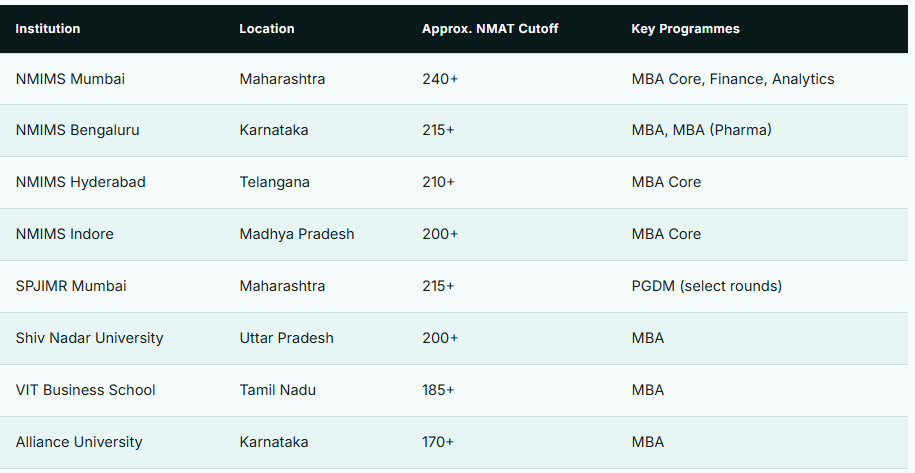
NMIMS remains the most sought-after destination for NMAT toppers across India. The Mumbai campus draws the highest scorers, while Bengaluru, Hyderabad, Indore, and Navi Mumbai campuses accept lower but still competitive score cutoffs. Furthermore, NMIMS offers more than eight distinct MBA programmes across its campuses, covering general management, finance, analytics, and specialised tracks.
NMIMS’s Separate Application Process
NMIMS requires candidates to apply directly on its official website in addition to registering for NMAT. Each NMIMS campus and programme demands a separate application and fee. Therefore, aspirants targeting multiple NMIMS campuses must submit multiple applications well before each campus-specific deadline.
NMIMS also runs its own CDPI (Case Discussion and Personal Interview) round, which carries significant weight in the final selection process. Additionally, work experience, academic performance, and extracurricular profile all factor into the final admission decision. Consequently, preparing holistically — beyond just the NMAT written exam — is essential for securing an NMIMS seat.
How to Prepare for NMAT
Building Your Study Plan
Most successful NMAT candidates invest three to five months of consistent preparation before their first attempt. The ideal starting point is always a full-length diagnostic mock test to map current strengths and weaknesses across all three sections. Subsequently, a weekly plan should give proportional time to each section based on that diagnostic output.
Language Skills demands daily reading and vocabulary practice over a sustained period. Meanwhile, Quantitative Skills benefits most from concept-first learning followed by timed drill sets. Additionally, Logical Reasoning improves fastest through varied puzzle practice combined with careful post-session error analysis.
Leveraging the Three-Attempt Window Strategically
Candidates should treat their first NMAT attempt as a live mock test with real consequences but no finality. Using the actual exam experience to identify gaps makes the second attempt significantly more targeted. Furthermore, planning the three attempts at roughly 20-day intervals gives just enough time to improve each weak area before the next sitting.
Additionally, candidates should keep a detailed error log after every mock test and every actual attempt. Reviewing this log before each subsequent sitting prevents repeating the same avoidable mistakes. Consequently, a disciplined error-review habit consistently separates top NMAT scorers from those who plateau after the first attempt.
Time Management Inside the Exam
Managing time effectively across NMAT’s three sections is a skill that demands specific and deliberate practice. The Language Skills section allows less than 47 seconds per question, making it the most time-critical of all. Furthermore, spending more than 90 seconds on any single Language Skills question almost always costs a candidate their overall target score.
For Quantitative Skills, candidates get roughly 86 seconds per question, which allows more time for multi-step calculations. Moreover, attempting the easier questions first within each section and circling back to harder ones saves precious time. Therefore, practising this skip-and-return strategy consistently in full-length mocks builds the exam-day instincts every NMAT aspirant needs.
Section-Wise Preparation Tips
For Language Skills, reading high-quality content daily — newspaper editorials, academic essays, and business articles — builds both speed and comprehension. For Quantitative Skills, mastering arithmetic and algebra fundamentals first, then layering DI and DS practice, delivers the fastest improvement. Additionally, for Logical Reasoning, solving at least two full puzzle sets daily while timing every session builds the fluency required to score well within the section’s 40-minute window.
15 Frequently Asked Questions (FAQs)
NMAT stands for NMIMS Management Aptitude Test. GMAC — the Graduate Management Admission Council, the same body that administers the GMAT — has administered NMAT since 2015. Furthermore, GMAC’s involvement ensures international testing standards, a robust computer-based infrastructure, and credible scaled scoring across all exam windows.
NMAT runs across a 75-day testing window from October to December every year. Candidates choose their own preferred exam date within this window during registration. Additionally, the registration process typically opens in August, so aspirants should plan and register early to secure their preferred dates before slots fill up.
NMAT has three sections: Language Skills, Quantitative Skills, and Logical Reasoning. Each section contains exactly 36 questions, giving a total of 108 questions across the exam. Furthermore, candidates can choose the order in which they attempt the three sections at the start of every sitting.
No, NMAT does not carry any negative marking for wrong answers. This means every candidate should attempt all 108 questions without skipping any. Furthermore, this no-penalty policy makes NMAT one of the most accessible MBA entrance exams for candidates who are still building their confidence and accuracy.
NMAT allows candidates up to three attempts within the same 75-day testing cycle. A mandatory gap of at least 15 days must separate each consecutive attempt. Furthermore, institutions receive only the best score across all valid attempts, so there is no penalty for scoring lower on a retake.
The total NMAT score ranges from 12 to 360, with each of the three sections scoring between 0 and 96. The exam applies a scaled scoring algorithm so scores remain comparable across different exam dates. Furthermore, section-wise scores carry independent importance because most institutions set individual section cutoffs alongside the overall cutoff.
NMIMS Mumbai’s MBA Core programme typically requires an overall NMAT score above 240. However, exact cutoffs vary each year depending on the applicant pool and the number of seats. Furthermore, strong performance in all three sections individually is essential because NMIMS applies section-wise cutoffs alongside the overall score benchmark.
Over 60 management institutions across India accept NMAT scores. These include all NMIMS campuses, SPJIMR (select rounds), Shiv Nadar University, VIT Business School, Alliance University, and many others. Consequently, a single strong NMAT score gives candidates access to a wide range of MBA programme options simultaneously.
An NMAT score remains valid for one year from the date of the exam. Candidates must use this score to apply to institutions within the same admission cycle. Therefore, candidates who miss their target in one year must retake NMAT in the following year’s testing window to apply afresh.
Any candidate holding a graduation degree of at least three years from a recognised Indian or foreign university can register for NMAT. Final-year students may also apply provisionally. Furthermore, no minimum aggregate percentage applies at the NMAT registration stage, though individual institutions may set their own academic minimum requirements for admission.
Yes, NMAT offers both a test centre mode and an at-home online proctored mode through Pearson VUE. The at-home option requires a stable internet connection, a compatible device, and a distraction-free test environment. Furthermore, both modes produce equally valid scores that all NMAT-accepting institutions recognise without distinction.
NMAT differs from CAT and XAT in three major ways. First, NMAT allows three attempts while CAT and XAT allow only one per year. Second, NMAT carries no negative marking, whereas both CAT and XAT penalise wrong answers. Third, NMAT uses a flexible 75-day testing window rather than a single fixed exam date, giving candidates far more scheduling control.
Yes, NMIMS requires a separate online application on its official website in addition to NMAT registration. Each campus and each programme requires a separate application along with its own fee. Therefore, candidates targeting multiple NMIMS programmes must track and submit all individual applications well before each campus-specific deadline.
Most candidates targeting scores above 230 prepare for three to five months before their first attempt. Those aiming specifically for NMIMS Mumbai’s 240+ cutoff often invest five to six months of focused preparation. Furthermore, using the three-attempt window strategically — with active improvement between each attempt — consistently delivers better final scores than one long preparation push without real exam exposure.
The official NMAT practice platform by GMAC provides the most accurate simulation of the actual exam format and difficulty. Additionally, full-length timed mock tests from reputed third-party platforms help candidates build speed, stamina, and section-specific accuracy. Furthermore, topic-wise drills for each of the three sections — combined with thorough error analysis after every practice session — consistently produce the fastest improvement for aspirants at every starting level.