
- What is VARC in CAT?
- VARC Structure and Weightage
- Reading Comprehension — Full Breakdown
- Verbal Ability — Full Breakdown
- VARC Scoring — Marks, Penalties, and Strategy
- What VARC Score Gets You Into an IIM?
- Common Mistakes Students Make in VARC
- Best Resources for VARC Preparation
- A Daily VARC Practice Plan
- Practice VARC Daily on catmock.com
- 15 Frequently Asked Questions (FAQs)
What is VARC in CAT?
The Section That Separates Top Scorers
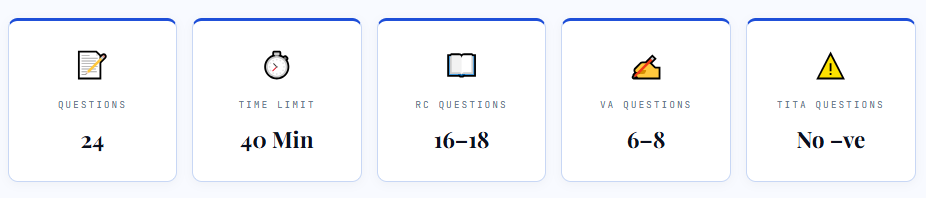
VARC stands for Verbal Ability and Reading Comprehension. It is the first section candidates face when they sit for the CAT exam. Furthermore, it carries 24 questions and runs for exactly 40 minutes within the CAT’s 120-minute structure.
Most engineers fear VARC, and most arts graduates underestimate it. Additionally, the section has evolved over the past five years to become more analytical and less grammar-based. Consequently, VARC today tests how well you think through language — not just how well you know it.
Why VARC Matters More Than Most Candidates Realise
Every IIM sets a sectional cutoff for VARC alongside the overall CAT cutoff. Scoring 99 percentile overall but dropping below the VARC cutoff results in automatic rejection. Therefore, VARC is not a section you can afford to neglect in favour of Quants or DILR.
Furthermore, VARC improvements tend to be slower and harder to sustain than improvements in quantitative sections. This means students who start working on VARC early gain a compounding advantage over those who begin late. Moreover, a strong VARC score signals communication ability — something business schools actively seek in every candidate.
VARC’s Position in the CAT Exam
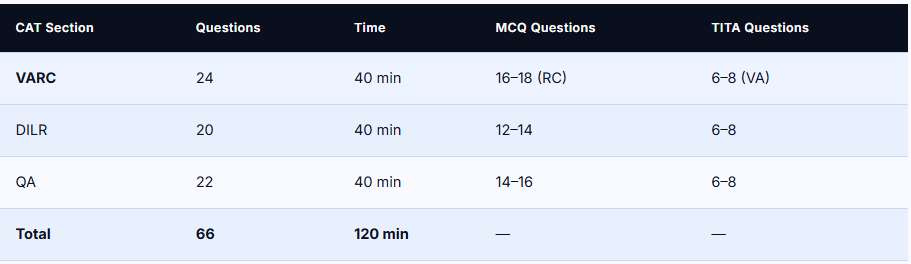
CAT divides into three sections: VARC, DILR (Data Interpretation and Logical Reasoning), and QA (Quantitative Ability). Each section runs for 40 minutes, and candidates cannot switch between sections during their allotted time. Furthermore, VARC always runs first, which means candidates enter it cold — before nerves settle and focus sharpens.
Additionally, the exam format means a poor VARC start can psychologically derail performance in the remaining two sections. Therefore, building exam-day VARC stamina through regular timed practice is as important as mastering the content itself. Consequently, top scorers always treat VARC preparation as both a knowledge challenge and a mental conditioning exercise.

VARC Structure and Weightage
The Two Sub-Sections Inside VARC
VARC splits into two distinct parts: Reading Comprehension (RC) and Verbal Ability (VA). RC dominates the section, typically accounting for 16 to 18 out of the 24 total questions. Furthermore, VA questions make up the remaining 6 to 8 questions, covering para-jumbles, para-summary, and odd sentence out.
This structure makes RC the single most important skill to develop for anyone targeting a strong VARC score. Additionally, VA questions in CAT are almost entirely TITA (Type In The Answer) format — meaning they carry no negative marking. Consequently, the smart approach treats RC as your scoring engine and VA as a risk-free bonus opportunity.
VARC Weightage in the Full CAT Structure
MCQ vs TITA — Why It Changes Everything
MCQ questions in VARC carry +3 marks for a correct answer and −1 mark for a wrong one. TITA questions, however, award +3 for a correct answer with zero penalty for a wrong one. Furthermore, all VA questions — para-jumbles, para-summary, and odd sentence out — appear only in TITA format in recent CAT exams.
This design means candidates should always attempt every VA question, regardless of confidence level. Additionally, for MCQ RC questions, candidates must apply strict accuracy discipline to avoid burning marks through careless wrong attempts. Therefore, understanding which question type you face before answering is not optional — it is the first step of every correct VARC strategy.
Reading Comprehension — Full Breakdown
What RC in CAT Actually Tests
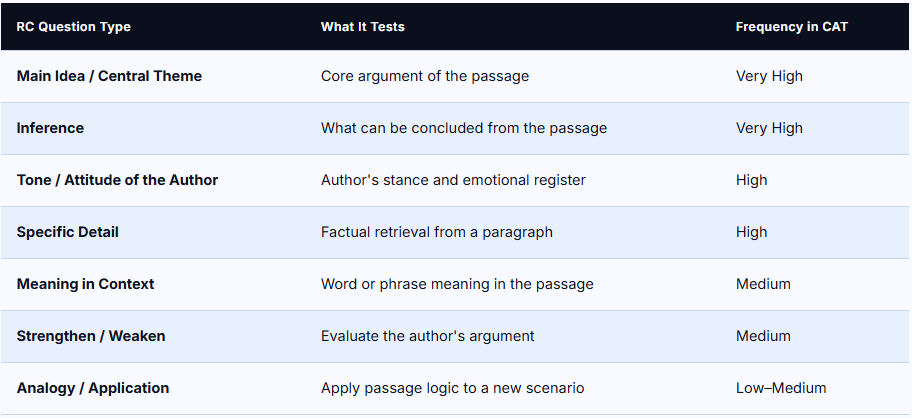
CAT RC does not simply test whether you understood a passage. It tests whether you can analyse an author’s argument, identify tone, draw inferences, and evaluate logic — all at speed. Furthermore, passages draw from a diverse range of subjects: philosophy, science, economics, literature, social policy, and business history.
Each RC set in CAT contains one passage followed by 4 to 6 questions. Additionally, CAT typically includes 4 RC passages per VARC section, bringing the total RC question count to 16 to 20. Consequently, a candidate who can handle all four RC passages effectively has already secured the majority of their VARC score.
Types of RC Passages in CAT

RC Question Types — What CAT Actually Asks
The Right Way to Approach an RC Passage
Top VARC scorers read each passage actively, not passively. This means tracking the author’s argument as you read, noting shifts in tone, and identifying the main claim of each paragraph. Furthermore, marking the passage mentally — or physically on scratch paper — helps reconstruct the logic before answering questions.
Additionally, the biggest RC mistake most candidates make is re-reading the passage after every question. Instead, build a strong mental map during the first read and then answer questions using that framework. Consequently, this approach cuts the per-passage time significantly and reduces the chance of getting confused between answer choices.
Passage Length and Reading Speed
CAT RC passages typically run between 450 and 700 words. With 40 minutes for the entire VARC section, candidates have roughly 8 to 10 minutes per RC passage including question time. Therefore, a reading speed of at least 250 words per minute is the baseline requirement for any candidate targeting the 90th percentile or above in VARC.
Furthermore, reading speed alone does not guarantee a good score — comprehension accuracy matters equally. Most candidates improve their reading speed fast but plateau because they do not understand complex sentence structures. Additionally, regularly reading academic and editorial content builds both speed and comprehension depth at the same time.

Verbal Ability — Full Breakdown
The Three VA Question Types in CAT
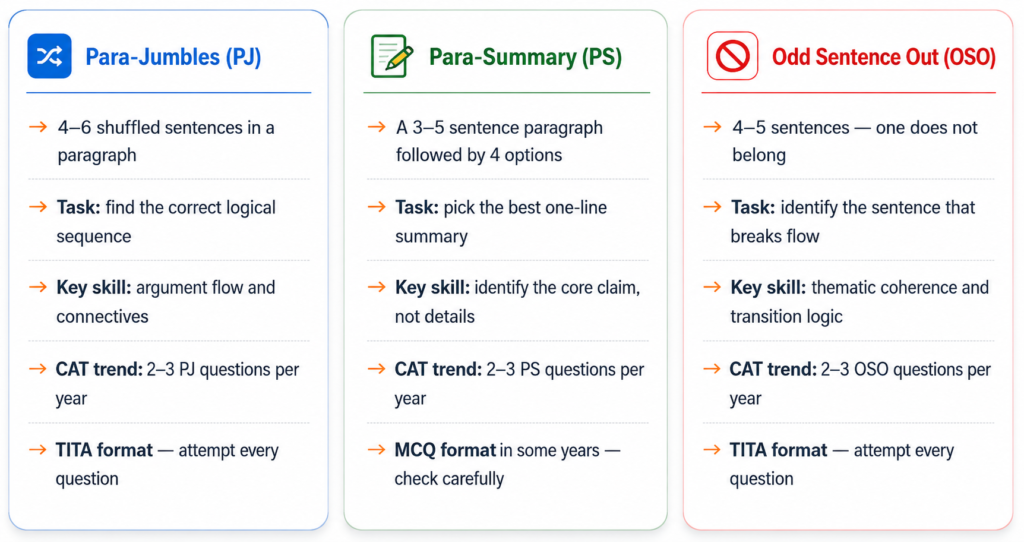
The VA component of VARC covers exactly three question types in recent CAT exams. These are Para-Jumbles (PJ), Para-Summary (PS), and Odd Sentence Out (OSO). Furthermore, all three types appear exclusively in TITA format — so every attempt carries zero negative marking risk.
Additionally, CAT no longer tests fill-in-the-blanks, grammar rules, antonyms, or vocabulary in isolation. The shift moved entirely toward reasoning-based verbal tasks from 2017 onwards. Therefore, candidates who still prepare grammar rules as a primary VARC strategy are investing time in the wrong place.
Para-Jumbles — How to Solve Them Correctly
Para-Jumbles test whether you can reconstruct the logical flow of an argument from scrambled sentences. The expert approach begins with identifying the opening sentence — one that introduces a concept without referring to anything prior. Furthermore, look for pronoun-antecedent pairs, cause-effect chains, and transition connectives (however, therefore, additionally) to anchor the sequence.
Additionally, the closing sentence typically offers a conclusion, resolution, or summary — never an introduction. Many candidates waste time trying all possible arrangements; instead, eliminate sequences that break obvious logical rules first. Consequently, a structured, elimination-based approach solves most PJ questions in under 90 seconds.
Para-Summary — The Most Approachable VA Question
Para-Summary asks you to distil a paragraph into its single most important idea. The correct answer always captures the main argument — never a supporting detail, an extreme claim, or something outside the passage. Furthermore, wrong options in PS typically fall into two traps: being too narrow (just one detail) or too broad (beyond the passage scope).
Additionally, the correct PS option always uses neutral, balanced language that mirrors the passage’s tone. Options that introduce new ideas not mentioned in the paragraph are never correct. Therefore, train yourself to identify the core claim in every paragraph you read — this skill transfers directly to better RC performance as well.
Odd Sentence Out – The Trickiest VA Question
Odd Sentence Out asks you to spot the one sentence that disrupts the thematic flow of a paragraph. The odd sentence often sounds related on the surface but introduces a different subject, perspective, or time frame. Furthermore, it frequently lacks a grammatical or logical connector to the sentences around it.
Additionally, the most common mistake candidates make is choosing the sentence that seems most surprising — rather than the one that breaks the argument’s coherence. Focus on whether each sentence contributes to the same central thread. Consequently, practising OSO with a strict “does this sentence serve the argument?” checklist dramatically improves accuracy.
VARC Scoring — Marks, Penalties, and Strategy
The Exact Marking Scheme

What a Target VARC Score Looks Like
A score of 48 to 54 out of 72 typically places a candidate in the 90th to 95th percentile range in VARC. Scoring above 54 pushes a candidate into the elite 97th to 99th percentile bracket. Furthermore, getting there requires attempting roughly 18 to 20 questions with an accuracy rate above 75%.
Additionally, attempting all 24 questions with 60% accuracy yields a raw score close to zero after negative marking eats into the gains. Therefore, a selective, high-accuracy approach always outperforms a high-volume, low-accuracy strategy in VARC. Moreover, attempting fewer questions correctly beats attempting more questions carelessly — every single time.
The Golden Rule of VARC Scoring

How Many Questions Should You Attempt?

What VARC Score Gets You Into an IIM?
IIM VARC Sectional Cutoffs
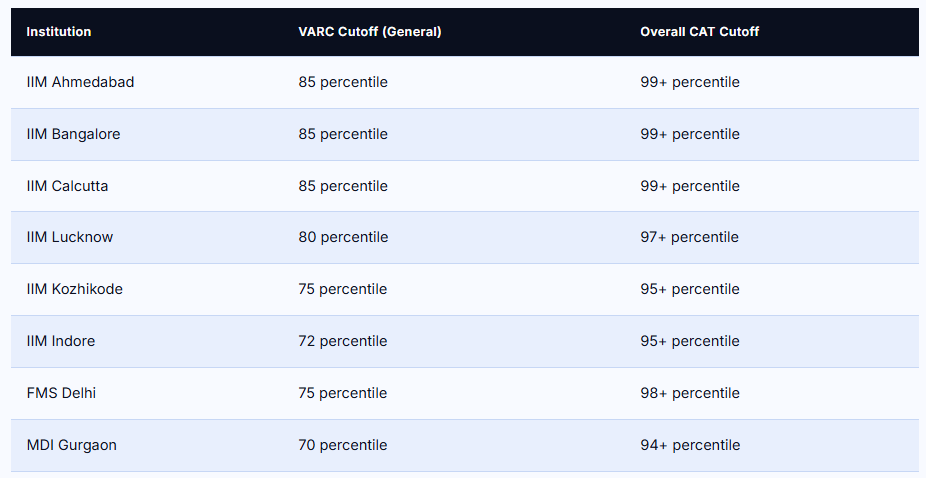
Every IIM sets its own VARC sectional cutoff, and these cutoffs shift slightly each year based on exam difficulty. Generally, the older IIMs (IIM A, B, C) require a VARC percentile of 85 or above for general category candidates. Furthermore, newer IIMs and IIM Indore set their VARC cutoffs between 70 and 80 percentile.
Why a High VARC Score Does More Than Open IIM Doors
A 90th percentile VARC score, combined with strong overall performance, keeps options open across virtually all top MBA programmes in India. Furthermore, many non-IIM schools like SPJIMR, MDI, and XLRI also give significant weight to CAT VARC performance. Therefore, investing deeply in VARC always generates returns across a much wider range of institutions than most candidates anticipate.
Additionally, strong verbal skills built during VARC preparation directly help in GD-PI rounds. Candidates who read widely, think analytically, and communicate precisely consistently perform better in personal interviews. Consequently, VARC preparation is an investment in both the exam score and the admission interview — making it doubly valuable.
Common Mistakes Students Make in VARC
The Biggest RC Errors
The single most common RC mistake is answering from memory rather than from the passage. Many candidates read a passage and then answer based on what they already know about the topic. Furthermore, this habit leads to choosing answers that are factually accurate but not supported by the specific passage text — and CAT penalises this consistently.
Additionally, many students rush through RC passages to “save time” and end up spending more time on confusing questions. A fast but shallow read costs more time overall than a slightly slower but thorough first read. Therefore, investing 3 to 4 minutes in a proper first read of each passage almost always saves time at the question stage.
The Biggest VA Errors
The most damaging VA mistake is skipping TITA questions because they feel uncertain. Since VA carries no negative marking, skipping any TITA question is always the wrong decision. Furthermore, even a semi-educated guess on a TITA question gives a positive expected value, while skipping always yields zero.
Additionally, many candidates solve para-jumbles by trying all possible arrangements one by one — a time-destroying approach. Instead, anchor two or three sentences first, then build the sequence outward from those anchors. Consequently, this structured approach reduces average PJ solving time from 3 to 4 minutes down to 90 seconds.
The Attitude Mistakes That Kill VARC Scores
Many engineering students write off VARC as purely subjective and stop practising it seriously. This attitude produces flat, stagnant scores that fall below IIM cutoffs every year. Moreover, treating VARC as a skill to develop — rather than a talent you either have or do not — is the mindset shift that separates consistent improvers from perpetual plateauers.

Best Resources for VARC Preparation
Reading Material That Directly Builds VARC Skills
The best VARC preparation starts with reading high-quality, complex English content every single day. Publications like The Economist, The Atlantic, Aeon, and Harvard Business Review match the style and complexity of CAT RC passages closely. Furthermore, reading one article from each of these sources daily — with active comprehension, not just passive scrolling — builds the right mental habits within weeks.
Additionally, philosophical and literary essays train candidates to handle abstract reasoning passages — the type that most students find hardest in CAT. Sources like The New Yorker, Project Syndicate, and Arts and Letters Daily provide this kind of content freely online. Consequently, a structured daily reading habit, sustained over five to six months, is the most powerful VARC preparation tool available to any candidate.
Practice Resources and Mock Tests
Official CAT papers from 2017 onwards provide the most accurate representation of current VARC format and difficulty. Working through every RC passage from past papers — with careful question analysis — builds pattern recognition that generic coaching material cannot replicate. Furthermore, CATMock.com uploads fresh VARC practice sets daily, covering all three VA question types and multiple RC passage types every week.
Additionally, section-wise timed mock tests help candidates build the specific 40-minute VARC pacing instinct. Attempting an untimed practice session is useful for learning, but it never replicates exam pressure. Therefore, combining daily reading with weekly timed VARC mocks creates the two-track preparation system that top scorers consistently use.
The One Book Every VARC Aspirant Should Read
“How to Read a Book” by Mortimer Adler remains the single most useful non-CAT book for VARC preparation. It teaches analytical reading skills — how to identify arguments, assumptions, and conclusions — that apply directly to every CAT RC question type. Moreover, developing these reading habits early transforms an average VARC performer into a genuinely strong one within two to three months.
A Daily VARC Practice Plan
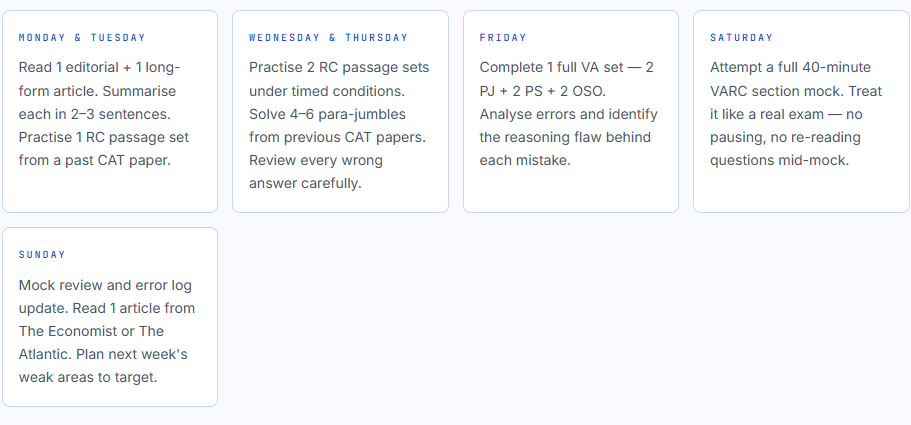
The Expert-Recommended Weekly Schedule
Consistent daily practice beats weekend cramming every time in VARC preparation. The ideal daily VARC time investment is 45 to 60 minutes, structured across three specific tasks. Furthermore, this structured approach produces measurable score improvement within four to six weeks of consistent execution.
The 90-Day VARC Transformation Plan
Month 1 focuses entirely on building reading habits and understanding all RC question types through past papers. Month 2 introduces timed section practice and systematic VA question drilling. Furthermore, Month 3 switches to full-length section mocks twice a week with deep post-mock analysis sessions.
Additionally, candidates should track their accuracy rate per question type across every practice session. Watching accuracy rise from 60% to 80% on specific question types provides concrete evidence of improvement. Consequently, this data-driven approach keeps preparation focused, efficient, and motivating throughout the 90-day cycle.
The One Daily Habit That Changes Everything
Every top VARC scorer shares one habit: they write a three-sentence summary of everything they read each day. This practice forces active comprehension, trains argument identification, and builds the kind of structural thinking that makes RC questions easier to answer. Moreover, it directly improves Para-Summary performance, since the skill of extracting core arguments transfers perfectly from this daily exercise to the exam question.
Practice VARC Daily on catmock.com
What CATMock.com Offers for VARC
CATMock.com uploads fresh VARC practice content every single day — covering all RC passage types and all three VA question formats. Each daily set mirrors the actual CAT difficulty level, passage length, and question style. Furthermore, detailed explanations accompany every answer, so candidates understand exactly why each option is correct or incorrect.
Additionally, CATMock.com provides full 40-minute VARC section mocks that simulate the real exam’s time pressure and interface. Attempting these mocks weekly builds the specific pacing and decision-making habits that only real timed practice can develop. Consequently, candidates who use CATMock.com consistently show measurably faster VARC improvement than those who rely on self-curated practice alone.
15 Frequently Asked Questions (FAQs)
VARC stands for Verbal Ability and Reading Comprehension. It carries 24 questions in total and runs for exactly 40 minutes within the CAT exam. Furthermore, VARC always appears as the first section in the exam, making it critical to start strong and set the right psychological tone for the sections that follow.
2. What is the split between RC and VA questions in CAT VARC?
Reading Comprehension typically accounts for 16 to 18 questions, while Verbal Ability covers the remaining 6 to 8 questions. RC questions appear in MCQ format with negative marking, whereas VA questions appear in TITA format with no negative marking. Additionally, this split means RC performance drives the majority of a candidate’s final VARC score.
The three VA question types are Para-Jumbles, Para-Summary, and Odd Sentence Out. CAT typically includes 2 to 3 questions of each type per exam. Furthermore, all three appear in TITA format, meaning candidates face zero negative marking risk on every VA attempt — making it essential to attempt all of them.
No — CAT removed direct grammar, vocabulary, and fill-in-the-blank questions from the VARC section from 2017 onwards. The current format focuses entirely on reasoning-based verbal tasks and reading comprehension. Therefore, candidates who spend significant preparation time on grammar rules or vocabulary lists are misallocating their effort in the current exam context.
Every correct answer earns +3 marks. MCQ RC questions carry a penalty of −1 for each wrong answer. TITA VA questions carry zero penalty for a wrong answer, so candidates should always attempt every TITA question regardless of confidence level.
Most candidates targeting the 90th percentile or above should aim to attempt 18 to 20 questions with an accuracy rate above 75%. Attempting all 24 questions with low accuracy consistently produces poor scores due to negative marking on MCQ RC questions. Furthermore, selective, high-accuracy attempts always outperform high-volume, low-accuracy approaches in VARC.
IIM Ahmedabad, Bangalore, and Calcutta typically require a VARC percentile of 85 or above for general category candidates. Newer IIMs generally set their VARC cutoffs between 70 and 80 percentile. Furthermore, failing to meet the VARC sectional cutoff results in automatic rejection — regardless of overall CAT score — making VARC performance non-negotiable for IIM aspirants.
Reading at least two long-form articles daily from sources like The Economist, The Atlantic, or Aeon builds reading speed systematically over two to three months. Additionally, practising with past CAT RC passages under timed conditions helps calibrate speed to the actual exam format. Consequently, most candidates who follow this habit for 90 days increase their reading speed from 150 to 250 words per minute.
Start by identifying the opening sentence — one that introduces a concept without referring to anything prior. Then look for pronoun-antecedent pairs, cause-effect chains, and transition words to anchor the sequence from both ends. Furthermore, eliminate obviously wrong sequences first rather than testing every possible arrangement, which dramatically reduces the time each PJ question takes to solve.
Read the paragraph carefully and identify its single most important claim — not any supporting detail or example. The correct option always captures this central argument using neutral, balanced language. Additionally, eliminate options that are too narrow (just one detail), too broad (beyond the passage), or introduce ideas the paragraph does not mention.
Ideally, VARC preparation should begin five to six months before the exam — much earlier than most candidates start. VARC improvements build slowly through consistent habits like daily reading and regular practice. Furthermore, candidates who start VARC preparation two months before CAT almost always hit a ceiling before reaching their target percentile, simply because the skill-building phase takes time.
Philosophy, economics, social policy, science, history, and business topics appear most frequently in CAT RC passages. Philosophy and abstract reasoning passages are notoriously the hardest for most candidates. Furthermore, the best defence against difficult passages is building prior familiarity with these genres through regular reading — not just practising RC questions in isolation.
Yes — always attempt OSO questions, since they carry no negative marking in TITA format. A semi-educated guess based on coherence analysis gives a positive expected value. Furthermore, even eliminating two obviously wrong sentences before guessing from the remaining options significantly raises the probability of getting it right.
CATMock uploads fresh daily VARC practice sets covering all RC passage types and all three VA question formats. Each set matches actual CAT difficulty and comes with detailed answer explanations for every question. Furthermore, full 40-minute timed VARC section mocks help candidates build the specific pacing instincts and decision-making habits that only real exam pressure can develop.
Absolutely — many top VARC scorers come from non-English medium schooling backgrounds. VARC tests analytical reasoning through language, not native English fluency. Furthermore, with consistent daily reading, regular practice with past CAT papers, and a structured preparation plan of five to six months, any motivated candidate can reach the 90th percentile in VARC regardless of their linguistic background.