
- What is DILR in CAT?
- DILR Structure and Exam Format
- Data Interpretation — Full Breakdown
- Logical Reasoning — Full Breakdown
- Hybrid Sets — The Modern CAT Challenge
- DILR Scoring — Marks, Penalties, and Reality
- The Art of Set Selection
- DILR Cutoffs and IIM Requirements
- Mistakes That Destroy DILR Scores
- How to Prepare for DILR Systematically
- 15 Frequently Asked Questions
What is DILR in CAT?
The Section That Makes or Breaks IIM Calls
DILR stands for Data Interpretation and Logical Reasoning. It sits as the second section in the CAT exam, running for 40 minutes after VARC. Furthermore, it presents 20 questions grouped into four or five sets — and those sets decide whether a candidate walks away with an IIM call or not.
No other CAT section swings scores as dramatically as DILR. A candidate can ace QA and VARC, yet crash to the 40th percentile in DILR by picking the wrong sets. Consequently, DILR is the section where strategy matters as much as skill — sometimes more.
What DILR Actually Tests
CAT uses DILR to test structured analytical thinking under time pressure. It checks whether candidates can extract patterns from complex information and reason logically through multi-step problems. Moreover, these are exactly the skills that consulting, banking, and operations careers demand from every MBA graduate every day.
Additionally, DILR does not test bookish knowledge — no formula guarantees a correct answer here. Instead, it rewards candidates who think clearly, spot patterns fast, and stay calm when the data looks complicated. Therefore, DILR preparation is fundamentally a training exercise in structured thinking, not subject-matter revision.
DILR Structure and Exam Format
How the Section Is Organised
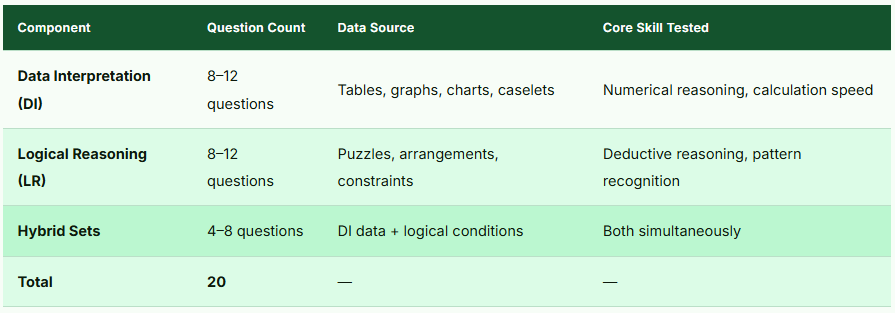
DILR carries 20 questions grouped into four or five sets of four to six questions each. Every set shares one common data source — a table, a graph, a logical puzzle, or a hybrid scenario. Furthermore, a candidate must engage deeply with each set’s data before answering any question from it.
This set-based format creates a critical strategic reality: time spent understanding a set’s data is shared across all questions in that set. Additionally, a correct understanding of one set’s structure often unlocks three to five questions simultaneously. Consequently, investing 3 to 4 minutes in genuinely understanding a set almost always delivers better returns than rushing through questions one by one.
DI vs LR — The Two Pillars
Marking Format Breakdown
DILR questions appear in both MCQ and TITA formats. MCQ questions carry +3 for a correct answer and −1 for a wrong one. Furthermore, TITA questions reward correct answers with +3 and carry zero negative marking — making them safe to attempt even under uncertainty.
Typically, 12 to 14 questions within DILR appear as MCQs and 6 to 8 appear as TITA. Additionally, TITA questions in DILR often appear at the end of a set, typically as the most calculation-intensive one. Therefore, completing the easier MCQ questions within a set first and then tackling TITA questions helps maximise both score and time efficiency.
Data Interpretation — Full Breakdown
Every Format You Will Face
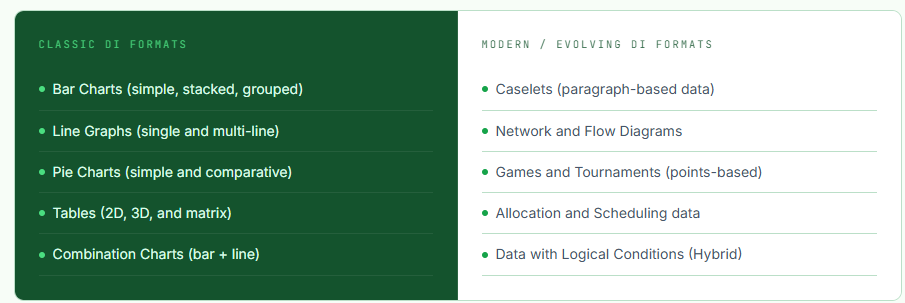
Data Interpretation sets in CAT present numerical data in multiple formats and ask candidates to compute, compare, and conclude from that data. The variety of formats keeps growing each year, making exposure to all types a non-negotiable part of preparation. Furthermore, recent CAT exams frequently blend two or more data formats within a single set.
What Most Candidates Miss About DI
Most students approach DI as a pure calculation exercise and practise approximation tricks obsessively. However, recent CAT DI sets are less about calculation speed and more about understanding multi-layered data relationships. Furthermore, sets involving network flows or games require systematic case-building — not arithmetic shortcuts.
Additionally, the critical skill in DI is recognising what the data does not tell you. Some questions require candidates to identify which information is insufficient to answer a question. Consequently, practising “what can I conclude and what can I not conclude?” as a reading discipline dramatically improves DI accuracy.
Approximation and Mental Math
DI still requires fast and accurate mental arithmetic for percentage calculations, ratio comparisons, and large number operations. Building a habit of approximating to two significant figures saves 15 to 20 seconds per calculation. Furthermore, most DI answer choices are sufficiently spread apart that a close approximation identifies the correct answer without full precision.
Additionally, candidates should practise mental multiplication of two-digit numbers and quick percentage calculation daily. Moreover, learning to spot “round number” patterns in data tables speeds up comparison questions significantly. Therefore, 10 minutes of daily mental arithmetic practice — separate from full DI set practice — pays consistent dividends on exam day.
Logical Reasoning — Full Breakdown
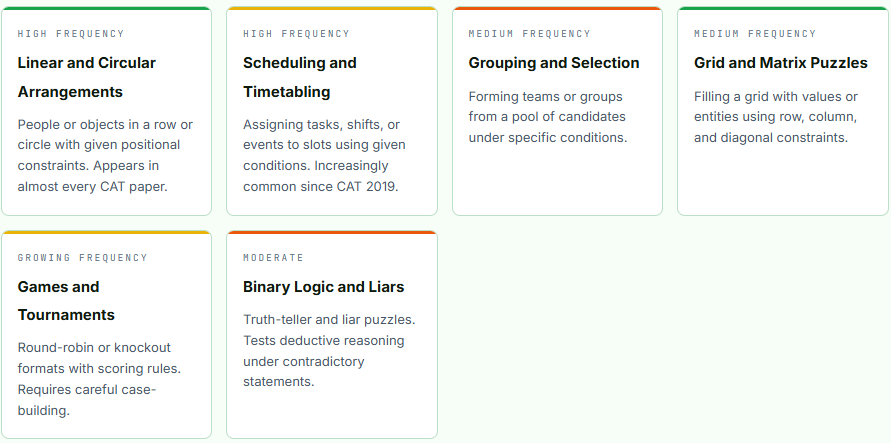
The Core Set Categories in CAT
Logical Reasoning in CAT presents constraint-based puzzles where candidates must derive correct arrangements, assignments, or sequences from a set of given conditions. Each set introduces characters, objects, or events and then imposes a series of rules that govern their relationships. Furthermore, the questions test whether candidates can build the one valid solution — or narrow down to a few possibilities — from those constraints.
How to Crack an LR Set — Step by Step
- Read all conditions before drawing anything. Jumping to diagrams before reading all constraints wastes time and forces redrawing.
- Identify “fixed” vs “flexible” conditions. Fixed conditions place entities definitively. Start building your solution from those fixed points outward.
- Use a visual diagram immediately. Draw a table, grid, or arrangement diagram as soon as you begin. Visual structures prevent errors and speed up deduction significantly.
- Apply “if-then” branching for ambiguous constraints. When a condition allows two possibilities, explore each branch separately and eliminate the one that produces a contradiction.
- Answer questions using your diagram — not the original text. Re-reading the original conditions while answering wastes 30 to 60 seconds per question.
The LR Mindset Shift That Changes Everything
Most students treat LR sets like puzzles to be solved — and then panic when the solution does not come quickly. Expert solvers treat LR sets like information maps to be decoded systematically. Furthermore, they never expect an instant answer; instead, they trust their step-by-step method to produce the solution eventually.
Additionally, the willingness to abandon a set after 4 minutes of non-progress is itself a critical LR skill. Staying stuck on a difficult set drains time from sets you could have solved easily. Consequently, developing a firm “cut-and-move” rule for tough LR sets consistently improves DILR scores more than solving one more practice set ever does.
Hybrid Sets — The Modern CAT Challenge
When DI Meets LR
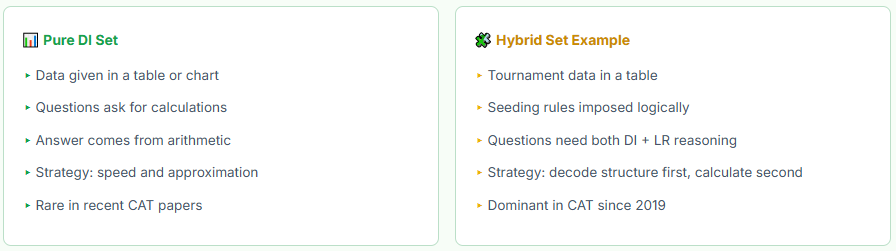
Hybrid sets combine numerical data with logical constraints in the same question set. A typical hybrid set might present a tournament’s match results as a table and then add seeding rules and scoring conditions that candidates must apply simultaneously. Furthermore, these sets have appeared in every CAT paper since 2017 and now account for roughly 30 to 40% of all DILR questions.
Additionally, hybrid sets require candidates to switch fluidly between quantitative and logical thinking within a single problem. This dual-mode thinking is exactly what separates the 95th percentile DILR scorer from the 80th percentile one. Consequently, candidates who only practise pure DI or pure LR in isolation consistently underperform on the actual exam.
How to Prepare for Hybrid Sets
Hybrid sets demand a specific type of daily practice — one that forces candidates to handle numerical and logical information simultaneously. The best approach starts with recent CAT papers from 2019 to 2024, which contain the highest density of genuine hybrid sets. Furthermore, CATMock.com publishes fresh hybrid DILR sets daily to give aspirants consistent exposure to this format throughout their preparation cycle.
Additionally, when practising hybrid sets, always spend the first 3 minutes doing nothing but understanding the data structure. Resist the urge to jump straight to question one. Consequently, candidates who build this “structure-first” habit in practice carry it into the exam naturally and decode hybrid sets far faster than peers who never trained that discipline explicitly.
DILR Scoring — Marks, Penalties, and Reality
The Exact Scoring Scheme

What a Good DILR Score Actually Looks Like
Cracking DILR does not mean solving all 20 questions. Most candidates who receive IIM calls solve between 12 and 16 questions correctly. Furthermore, a raw score of 36 to 48 out of 60 places a candidate in the 90th to 97th percentile range in DILR.
Additionally, solving just two full sets perfectly (10 questions, 30 marks) with zero wrong answers already positions a candidate near the 80th percentile. Therefore, depth and accuracy within two or three well-chosen sets consistently beats shallow attempts across five sets with numerous wrong answers.

How Many Questions to Target
Targeting 14 to 16 attempts with 80% or higher accuracy reliably produces a score in the 90th percentile or above. Targeting fewer than 12 attempts — even with perfect accuracy — risks falling below IIM sectional cutoffs. Furthermore, targeting 18 or more attempts with 65% accuracy typically produces a lower score than 14 attempts with 85% accuracy due to the −1 penalty drag.
The Art of Set Selection
Why Set Selection Is a Standalone CAT Skill
Set selection — choosing which DILR sets to attempt — is arguably the highest-leverage skill in the entire CAT exam. Spending 8 minutes on an impossible set and abandoning it costs exactly as much as spending 8 minutes on a solvable set and completing it. Furthermore, the exam gives no credit for time spent on sets you eventually leave blank.
Additionally, every DILR section contains at least one set that nearly every student finds easy, one that nearly every student finds hard, and two or three that sit in between. Consequently, the candidate who correctly identifies the solvable sets in the first three minutes of the section holds a decisive structural advantage over everyone who dives into the first set they see.
The Expert Set Selection Protocol
- Spend the first 3 minutes scanning all sets. Read only the introduction and the first question of each set — do not begin solving. This scan gives you a mental map of the entire section.
- Label each set: Easy / Medium / Hard. Base your label on data complexity, number of conditions, and whether you recognise the set type from your practice. Familiarity is the fastest signal of solvability.
- Attempt your “Easy” sets first. Complete these fully — ideally in 7 to 9 minutes each. Securing certain marks from these sets before touching uncertain territory is the foundation of a stable DILR score.
- Move to “Medium” sets only after Easy sets are done. If a Medium set reveals itself as Hard after 4 minutes of work, cut your losses and move on without hesitation.
- Never start a “Hard” set with less than 10 minutes remaining. Hard sets take 12 to 15 minutes minimum to crack. Starting one with insufficient time guarantees a poor return on every minute you invest.

DILR Cutoffs and IIM Requirements
What Each IIM Requires From DILR
DILR cutoffs vary significantly across IIMs, and the section consistently produces the most extreme spread in percentile scores among all CAT sections. A difficult DILR section can drop the median score to the 40th percentile — yet the same difficulty pushes the 90th percentile cutoff for IIM calls down too. Furthermore, this variability makes DILR the most volatile and most impactful section in terms of IIM admission outcomes.

Why Sectional Cutoffs Matter More Than You Think
Failing the DILR sectional cutoff results in automatic rejection from an IIM — regardless of the overall percentile. A candidate with 99 overall but 60th percentile DILR receives no IIM call. Furthermore, because DILR produces the widest score variation in CAT, it is also the section that most frequently eliminates otherwise strong candidates from IIM contention.
Additionally, DILR’s set-based format means the entire section can collapse for a candidate who picks three unsolvable sets in a row. Consequently, meeting the DILR sectional cutoff requires both preparation and intelligent set selection — one without the other rarely produces consistent results.
Mistakes That Destroy DILR Scores
Practising Only Standard Set Types
Many students build a practice library of “classic” DILR sets — circular arrangements, simple bar charts, seating problems — and feel well-prepared. However, CAT routinely introduces completely new set formats that candidates have never seen before. Furthermore, a candidate who only recognises familiar formats panics when faced with a novel set on exam day.
Additionally, the solution is not to practise every possible set type in existence. Instead, build a flexible problem-solving process that works regardless of the set’s surface format. Consequently, practising “how do I decode unfamiliar information?” as an explicit skill — not just solving known set types — is the real preparation goal.
Refusing to Abandon a Stuck Set
Ego and sunk-cost thinking destroy DILR scores every year. A candidate spends 8 minutes on a set, gets partially through, and refuses to abandon it because “I’ve already invested so much time.” Furthermore, those 8 minutes of stuck time have already been lost — continuing to invest more time does not recover them.
Additionally, a solvable set left untouched because you ran out of time costs exactly 3 marks per question you did not attempt. Therefore, developing the psychological discipline to cut and move — even after significant time investment — is one of the highest-ROI habits a DILR aspirant can build.
Not Practising Under Timed Conditions

How to Prepare for DILR Systematically
Months 1–2: Build the Foundation
Month 1 focuses on solving one DI and one LR set daily without a timer. The goal is not speed — it is building the habit of thorough data decoding and step-by-step deduction. Furthermore, reviewing every set’s solution carefully after solving it — especially the sets you got right — teaches you which thinking moves produced the correct answer.
Additionally, Month 2 introduces hybrid sets for the first time. Work through every DILR set from CAT papers 2019 to 2022, as these contain the highest density of hybrid formats. Consequently, by the end of Month 2, most candidates recognise the five or six structural patterns that underlie the majority of CAT DILR sets.
Months 3–4: Add Timing and Selection
Month 3 introduces strict timing — one complete DILR section (20 questions, 40 minutes) every three days. After each timed section, review your set-selection decisions first before reviewing your answers. Furthermore, asking “which sets should I have picked?” teaches more than asking “which answers did I get wrong?”
Additionally, Month 4 focuses on mock test integration — taking full CAT mocks and treating DILR as the pressure point. Moreover, tracking your DILR percentile across mocks over four weeks gives objective evidence of improvement and exposes specific set types that still need work. Therefore, mock data — not feelings — should guide every preparation decision in this phase.
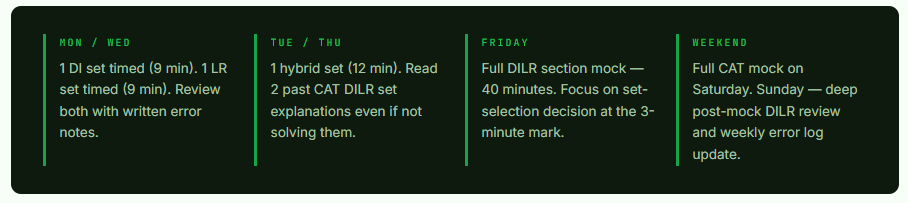
The Non-Negotiable Weekly Practice Structure
What to Practise With
Official CAT papers from 2017 to 2024 provide the most accurate DILR sets available anywhere. Every serious DILR aspirant must work through all of them at least once, ideally twice. Furthermore, CATMock uploads daily DILR practice sets — both DI and LR — specifically calibrated to current CAT difficulty and format.
Additionally, avoid DILR preparation books that focus on traditional puzzle types like blood relations or coding-decoding — CAT dropped those formats years ago. Instead, prioritise resources that include set-based practice with complex data and multiple conditions. Consequently, the right practice material matters as much as the amount of time you invest in preparation.
15 Frequently Asked Questions
DILR stands for Data Interpretation and Logical Reasoning. CAT includes 20 DILR questions grouped into four or five sets, each running for 40 minutes. Furthermore, DILR sits as the second section in the exam — after VARC and before QA — making it the psychological midpoint where many candidates either gain or lose their IIM admission chances.
CAT DILR typically presents four or five sets, with each set carrying four to six questions. All questions within a set share the same data source — a table, chart, puzzle, or hybrid scenario. Furthermore, the set-based structure means a candidate’s ability to understand one set’s data unlocks multiple questions simultaneously, making early comprehension investment the highest-leverage move in the section.
Every correct MCQ answer earns +3 marks, and every wrong MCQ answer deducts −1 mark. TITA questions award +3 for a correct answer and carry zero penalty for a wrong or unattempted response. Therefore, candidates should always attempt every TITA question in DILR — the risk-free nature of TITA makes skipping them a costly and avoidable mistake.
DI sets present numerical data — graphs, tables, charts, or caselets — and ask candidates to compute, compare, or conclude from that data. LR sets present logical puzzles with entities and conditions, asking candidates to derive arrangements, assignments, or sequences. Additionally, modern CAT papers frequently combine both into hybrid sets that require simultaneous numerical and logical reasoning within a single question set.
Hybrid sets combine quantitative data with logical conditions in a single question set — for example, a tournament table with seeding rules applied. They have appeared in every CAT paper since 2017 and now account for roughly 30 to 40% of all DILR questions. Furthermore, candidates who only practise pure DI or pure LR consistently underperform on the actual exam because they never train the dual-mode thinking that hybrid sets demand.
IIM Ahmedabad, Bangalore, and Calcutta typically require a DILR percentile of 85 or above for general category candidates. Newer IIMs generally set their DILR cutoffs between 70 and 80 percentile. Furthermore, failing the DILR sectional cutoff results in automatic rejection — regardless of overall CAT score — making DILR performance a make-or-break factor for IIM admission.
Targeting 14 to 16 attempts with 80% or higher accuracy reliably places a candidate in the 90th percentile or above. Solving just two sets perfectly — 10 questions, 30 raw marks — already places most candidates near the 80th percentile. Therefore, depth and accuracy within chosen sets consistently outperforms high-volume, low-accuracy attempts across all sets.
Set selection is the skill of choosing which DILR sets to attempt and in which order, based on a quick scan at the start of the section. Spending 8 minutes on an unsolvable set costs exactly as much as spending 8 minutes on a solvable one — but only the latter produces marks. Furthermore, research across mock test data consistently shows that set selection improvement delivers larger DILR score gains than solving speed improvement alone.
Linear and circular arrangements, scheduling and timetabling, games and tournaments, and grid-based matrix puzzles appear most frequently in CAT papers from 2019 to 2024. Traditional set types like blood relations, coding-decoding, and syllogisms no longer feature in the CAT DILR section. Therefore, candidates who focus preparation on these outdated formats risk missing the actual question types that appear on exam day.
Budget 7 to 10 minutes per set for your “easy” sets and no more than 12 minutes for medium-difficulty sets. If a set does not yield at least one answer within 4 minutes of genuine effort, cut your losses and move to the next set. Furthermore, never start a hard set with less than 10 minutes remaining — insufficient time guarantees a poor return on every minute invested.
Speed in DILR comes primarily from three sources: recognising the set structure quickly, building your diagram efficiently, and answering questions directly from your diagram rather than re-reading the original problem. Additionally, consistent timed practice — one complete set under a 9-minute timer every day — builds these instincts far faster than open-ended practice. Consequently, candidates who practise with strict timers from Month 2 onwards consistently outperform those who add timing only in the final weeks.
Absolutely — LR is a trained reasoning skill, not an innate talent. Most engineering students already have strong quantitative intuition that helps with DI, and LR’s constraint-based thinking is structurally similar to programming logic. Furthermore, with four to five months of consistent LR set practice — starting with simpler arrangement sets and progressing to complex multi-condition puzzles — most students build genuine LR fluency well before the exam.
Mock tests play a uniquely important role in DILR because they replicate the set-selection pressure and time constraints that no isolated practice session can reproduce. Reviewing your set-selection decisions after each mock — not just your wrong answers — teaches the most valuable lesson. Furthermore, tracking DILR percentile trends across multiple mocks provides objective data on whether preparation is producing real improvement or just familiarity with known set types.
Official CAT papers from 2017 to 2024 provide the most authentic and relevant DILR practice available. CATMock.com publishes daily DILR sets — both pure and hybrid — calibrated to current CAT difficulty. Furthermore, candidates should avoid older DILR books that focus heavily on blood relations, coding-decoding, and traditional puzzle types, as these formats no longer appear in the modern CAT paper.
CAT DILR uses a set-based format where all questions share one data source — a structure unique to CAT among major Indian MBA exams. XAT’s Decision Making section covers some similar logical reasoning skills but in a different format with ethical and business decision layers. Furthermore, CAT DILR’s hybrid sets — combining data and logic simultaneously — are more complex and more ambiguous than the equivalent sections in most other MBA entrance exams, making CAT-specific practice the most reliable preparation for exam day.